Back to Blog
OEM & Compliance

Betterment Deductions: What Insurance Is Actually Claiming and the OEM Documentation That Ends It

6 min read
Share
Dark table figure listing GM ADAS sensor, SRS airbag module, structural rail and ADAS calibration line items against the carrier position, the OEM position, and betterment marked as not applying

Betterment deductions hit your shop and most owners just absorb them. The carrier says the part was worn, the repair is an improvement, and they're taking a cut. What they're not telling you is that betterment deduction insurance logic falls apart the moment you can show an OEM required the part. No upgrade happened. Restoration to manufacturer spec happened. Those are not the same thing.

What the Carrier Is Actually Claiming When It Takes a Betterment Deduction

The legal premise behind betterment is simple: insurance exists to restore pre-loss condition, not improve on it. If a tire was 60% worn and you replace it with a new one, you've improved the vehicle. The carrier has an argument.

But carriers have stretched that logic far beyond tires and batteries. Shops see betterment applied to structural components, safety sensors, restraint systems, and ADAS hardware. The premise breaks down on every one of those.

Here's why. When a manufacturer says a specific part must be replaced with a new OEM component to restore the vehicle to its pre-accident safety specification, there is no "improvement" occurring. The repair returns the vehicle to the condition the manufacturer designed it to be in. A shop that installs anything other than what the OEM requires is not restoring the vehicle. It's creating a liability.

That distinction matters. And it's provable with documentation.
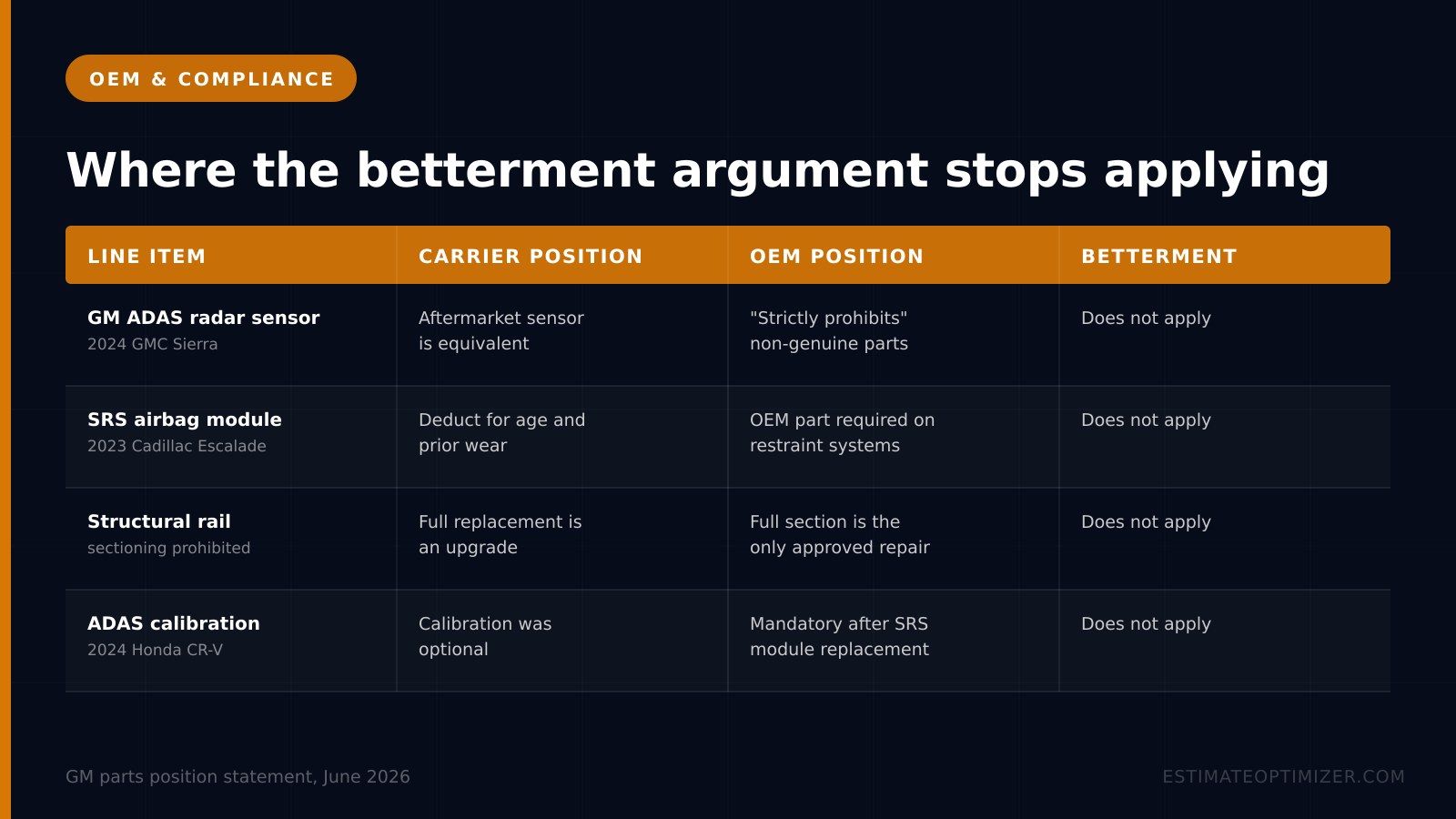
Dark table figure comparing four collision repair line items, each showing the carrier position beside the OEM position, with betterment marked as not applying on all four
On each of these line items the OEM leaves the shop no alternative. Where no alternative exists, the repair is spec compliance, not an upgrade.

Where Betterment Deductions Cost Shops Real Money on Parts They Were Required to Install

Think about how often betterment shows up on a Chevrolet Silverado with blind spot monitoring. The bumper cover takes damage. The radar sensor behind it is in the strike zone. GM's position statement, updated June 2026, does not allow aftermarket or salvaged sensors on any Chevy, Buick, GMC, or Cadillac vehicle. The statement uses the words "strictly prohibits." That means the shop cannot use a non-genuine part, and if they do, GM voids warranty coverage on any resulting failure.

So the carrier imposes a betterment deduction on the new GM sensor. The shop installs it anyway because there's no other option. The carrier kept money it wasn't entitled to keep, and the shop had no leverage because the file didn't have the GM position statement in it.

The same pattern plays out on airbag components, Toyota sensing restraint systems, Ford's inflatable safety belt assemblies, and structural parts on vehicles where the OEM explicitly prohibits sectioning or non-OEM substitution. The part was required. The installation was not optional. Betterment doesn't legally apply. But without documentation, the shop has no way to make that argument stick.

Here's the self-diagnostic: what percentage of your betterment challenges come with an OEM position statement or procedure page attached? Under 25% is red territory. Over 75% is where the argument stops before it starts. Most shops are operating at under 10%. Not because they don't know the OEM standard. Nothing in their workflow forces the documentation into the file before submission.
The OEM Documentation That Ends the Betterment Argument Before Submission

The shift is not about fighting betterment after a carrier imposes it. That's the reactive version. The proactive version is building the documentation case before the estimate leaves your shop, so the betterment deduction never appears.

Three categories of OEM documentation are the strongest in this context.

Parts substitution prohibitions. GM's June 2026 position statement is the clearest current example. It states that non-genuine aftermarket, salvage, or recycled parts are strictly prohibited on Chevrolet, Buick, GMC, and Cadillac vehicles, covering ADAS sensors and supplemental restraint systems. Toyota, Honda, Ford, and Stellantis all have comparable statements on safety systems. When the OEM says no alternative exists, the carrier cannot claim the OEM part was a "luxury" choice that improved the vehicle.

Structural sectioning prohibitions. On vehicles where the OEM prohibits partial replacement of a structural rail or rocker panel, a full section replacement is not an upgrade. It's the only procedure the manufacturer approves. The sectioning restriction is documented in the OEM repair procedures, and that documentation, attached to the line item, eliminates the betterment argument before it can be made.

ADAS calibration requirements triggered by replacement. When a part replacement triggers a mandatory OEM calibration, the calibration was not optional. Installing an airbag module on a 2024 Honda CR-V without performing the required SRS system reset and calibration violates Honda's documented repair requirements. The repair was required to reach pre-loss spec. No betterment occurred.

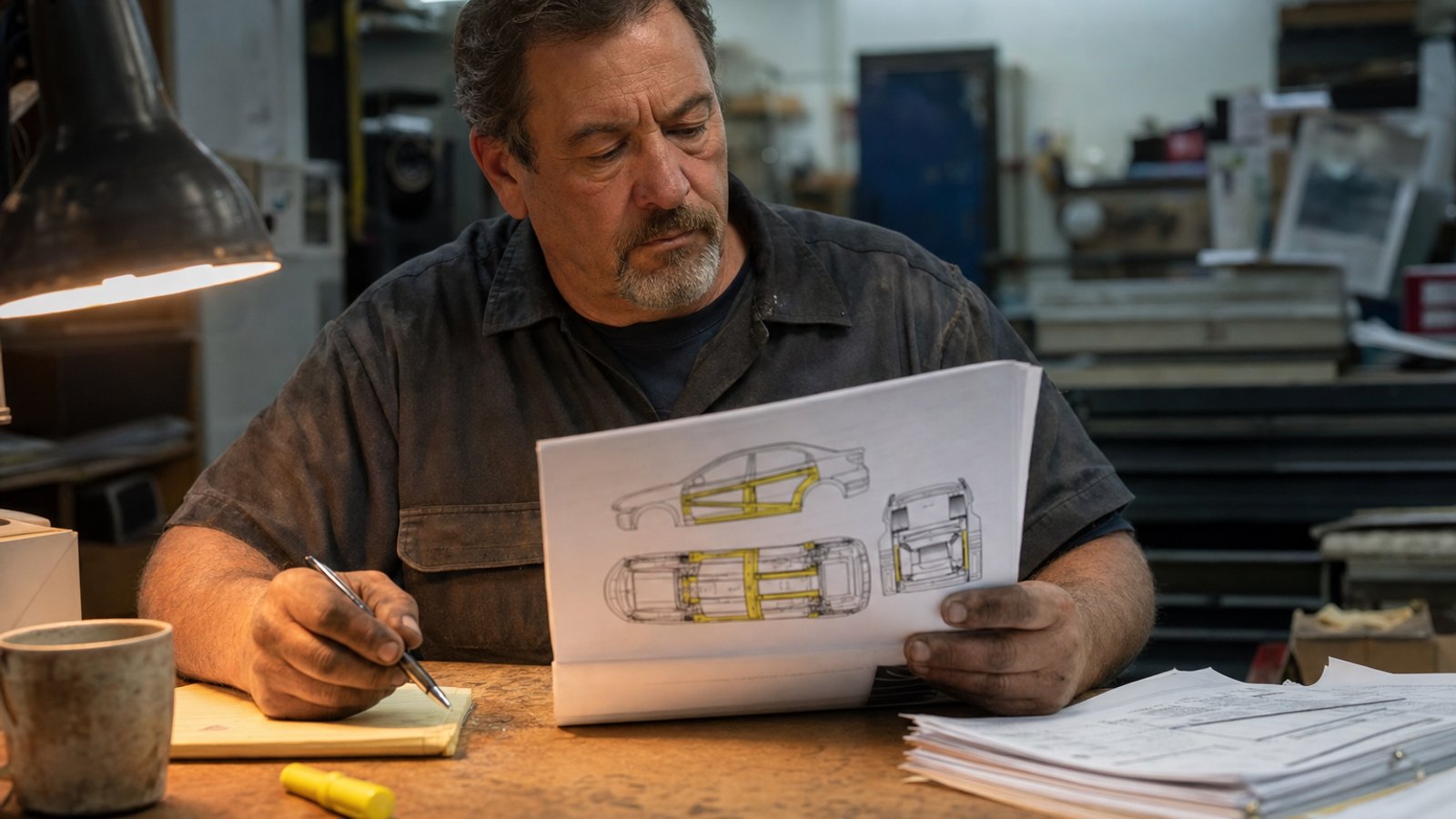
Shop owner at cluttered desk reviewing printed OEM position statement document with yellow highlighter and grease-stained hands
The OEM position statement is the argument. A shop owner who can put it in the file before submission has already won the betterment dispute.

The Bottom Line

The collision industry knows what happened at the John Eagle shop in Texas: a $31.5 million verdict in 2017, because a repair deviated from OEM procedures. The documented standard exists, and it cuts both ways. Carriers cannot claim betterment on parts that OEM procedures require, and shops cannot accept betterment on those same parts without documenting why the installation was mandatory. Tools like Estimate Optimizer scan estimates against OEM documentation and flag betterment-contested line items with the relevant position statements attached, so the documentation is in the file before the estimate is submitted. Every estimate is a legal document. The betterment deduction is only an argument if you let it be one.

Related Articles

Frequently Asked Questions

Can an insurance company take a betterment deduction on a required OEM part?
Not when the OEM procedure prohibits any alternative. If a manufacturer's position statement states that aftermarket or salvage parts are not permitted for a safety-critical system, the shop had no choice but to install the OEM part. That is restoration to specification, not an improvement. The OEM documentation is the counter-argument.
What parts are most commonly hit with betterment deductions in collision repair?
Betterment deductions show up most on wear items like tires and batteries, but shops increasingly see them applied to ADAS sensors, airbag components, structural rails, and restraint system hardware. The key distinction is whether the OEM allows any alternative. If no alternative is permitted, betterment does not legally apply.
How do I fight a betterment deduction from my insurance company?
The most effective approach is preventing the deduction before it appears. Attach the OEM position statement or procedure page to the line item before submitting the estimate. When the carrier can see that the manufacturer prohibits any other part, they lose the 'improvement' argument. Fighting it after denial is harder and slower.
Do OEM position statements actually change whether insurance pays betterment?
Yes. OEM position statements document what is required versus what is optional. When GM's 2026 position statement says a part is strictly required and aftermarket alternatives are prohibited, the carrier cannot credibly argue the OEM part was an improvement. The documentation shifts the burden of proof back to the carrier.
Are there states where betterment deductions are regulated or capped?
Some states restrict how carriers apply betterment, particularly on late-model vehicles. But regulatory protection is inconsistent, and enforcement is complaint-driven. The most reliable protection is OEM documentation that makes the betterment argument factually wrong, regardless of what state you're in.
Share this article
OEM proceduresinsurance claimssupplementsshop ownerscollision repairrevenue recoveryestimate scrubbing
Back to Blog
Follow us