If you want to know how to write a supplement auto body shops can actually collect on, start with this: the supplement isn't a request. It's a proof package. Insurance companies don't pay because you asked nicely. They pay because you made it impossible to say no. Most shops haven't figured that out yet, and it costs them thousands per month.
According to CCC Intelligent Solutions' 2024 data, 63% of collision repairs require at least one supplement. The average gap between an insurer's initial estimate and the final approved repair cost runs $1,200 to $1,800. That's not rounding error. That's real money sitting on the table, waiting for whoever builds the better case.
Why Most Supplements Get Pushed Back
Supplements get denied or delayed for one reason: insufficient documentation. Not because the damage isn't there. Not because the operation isn't legitimate. Because the shop didn't give the adjuster what they needed to approve it.
SCRS executive director Aaron Schulenburg has been direct about this. Shops that aren't providing adequate photos, OEM procedures, and supporting documentation are making it easy for insurers to push back. But here's the frustrating part he also acknowledged: plenty of shops that do everything right still face friction. You can't control how the insurer behaves. You can control whether they have any legitimate basis to delay you.
The shops that get paid fastest are the ones who remove every possible excuse before the adjuster opens the file.
There's also a structural problem that works against shops. Adjusters don't get paid to write supplements. When one comes back to a shop to reinspect, that's a cost to them: time, travel, workflow disruption. From the insurer's perspective, the path of least resistance is to question or reduce the supplement rather than approve it outright. Your documentation is the counterweight to that incentive. The more complete and airtight your file, the less friction the adjuster has cover for.
Independent shops running 2–3 supplements per job face this math every single week. A shop doing 30 ROs a month with an average of 1.5 supplements per job is writing 45 supplements a month. If even 20% of those get reduced or delayed due to documentation gaps, that's money walking out the door on a schedule.
The supplement file is built at teardown. By the time you're entering line items, the evidence should already be locked in.
Build the File Before You Write the Line
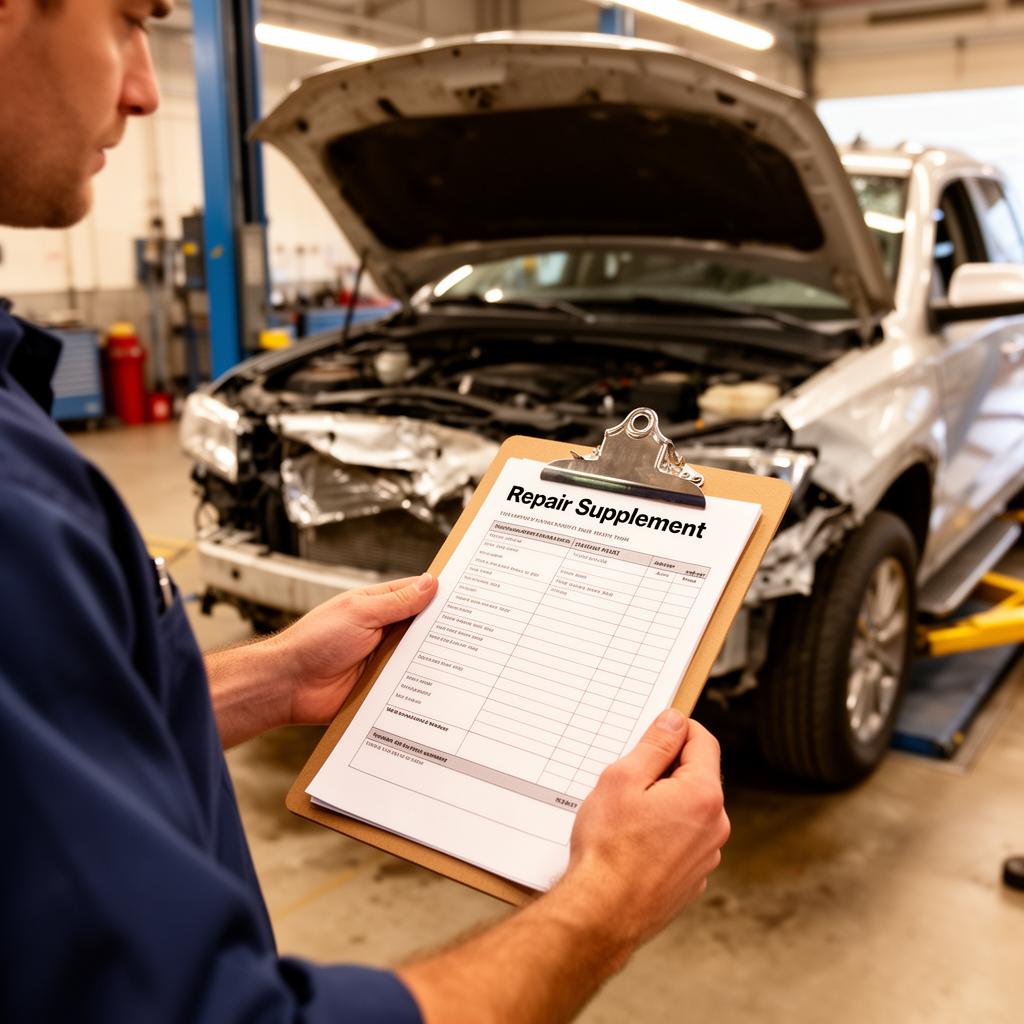
The supplement starts at teardown, not at the keyboard. What you document during disassembly determines whether the supplement holds up. By the time you're entering line items in CCC ONE or Mitchell, the evidence should already be locked in.
Photos That Actually Work
One overview photo of the damage won't cut it. You need photos that tell a story: before disassembly, during disassembly, and close-up shots of every individual item you're supplementing. If you found a bent frame rail behind a bumper cover, you need a photo of the bumper cover on, a photo of it off, and a close-up of the rail showing the deformation. Timestamp everything. The timestamp is your proof of when the damage was discovered, not invented.
For a 2022 Honda CR-V rear-end repair, for example, that might mean 15–20 photos just for the supplement on top of your initial estimate documentation. Feels like a lot until you're staring at a denial on a $900 frame rail repair because you submitted one blurry jpeg.
OEM Procedures Are Your Backup
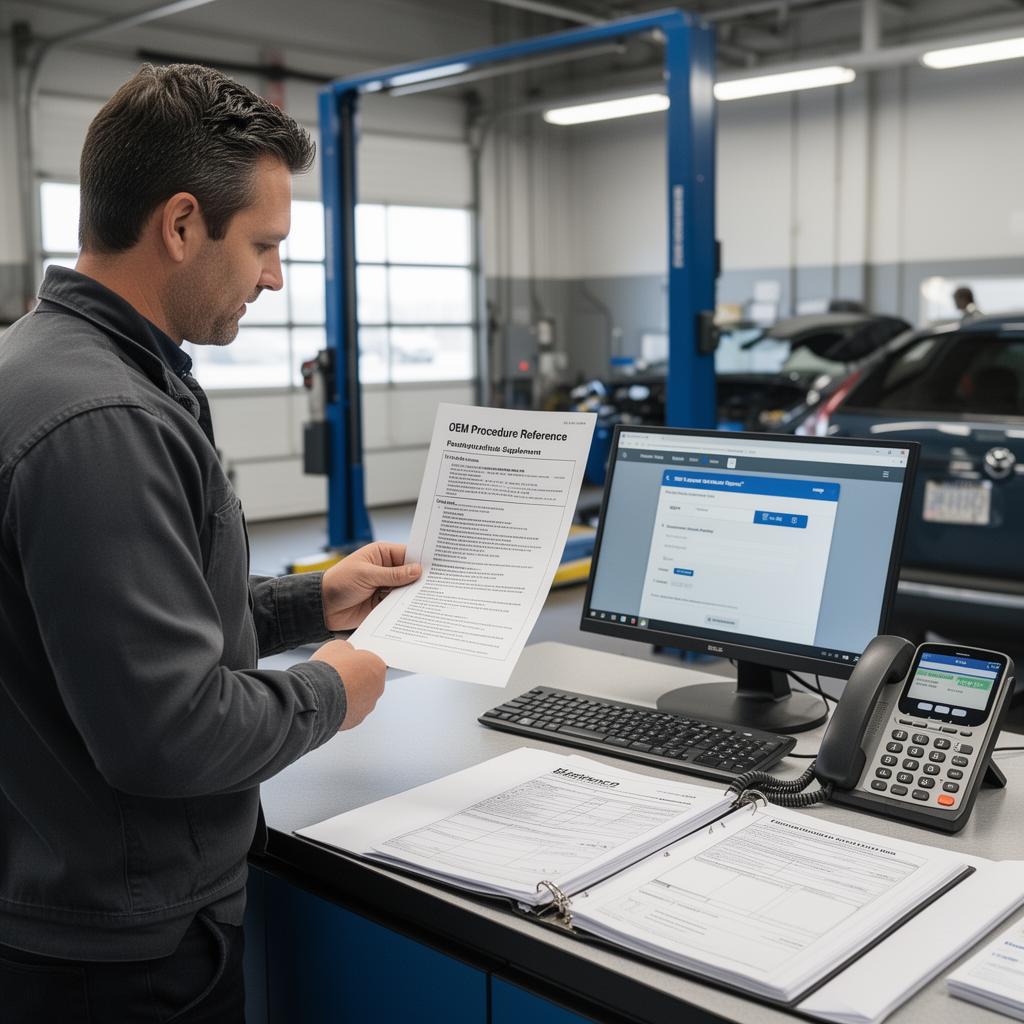
If you're billing for an operation the estimating guide marks as "not included," you need the OEM procedure document showing that operation is required. Don't assume the adjuster knows it's necessary. Print it. Attach it. Make them read it.
This matters especially for operations like battery disconnect/reconnect, pre/post-scan, and structural sectioning on newer vehicles. These are the line items insurers cut because they can, unless you've tied them to an OEM document that says the operation is required for a safe repair. At that point, denying the line item means denying OEM procedure compliance, and most adjusters won't go on record for that.
OEM procedures are available through each manufacturer's repair information portal: Toyota's TIS, Honda's Service Express, GM's SI, Ford's OASIS, and so on. ALLDATA and Mitchell ProDemand aggregate them into one interface. Whatever access your shop has, the procedure lookup has to happen before the supplement is written, not after the adjuster pushes back. Have the procedure number, the page reference, and the specific step that mandates the operation you're billing for. That's not overkill. That's how you get paid on a reinspection-free supplement.
DEG (Database Enhancement Gateway) inquiries are another tool that gets underused. If you're consistently seeing a specific operation undervalued or excluded by the estimating platform, a DEG inquiry puts your position on record and can result in a database update that benefits every shop, not just yours. Document your DEG inquiries and reference them in supplement notes when relevant. It signals to the adjuster that your position isn't a one-off billing attempt. It's a recognized industry issue.
Parts Documentation
List every part with its OEM part number. If you're billing for a part the initial estimate left off, document where it came from in the repair process: which photo shows it damaged, which step of the teardown revealed it. If the insurer wants to know why you need a new door beam on a 2021 Toyota RAV4, show them exactly what the camera revealed after the outer skin came off.
For structural parts especially, include the OEM part description alongside the part number. Adjusters reviewing remotely may not have the vehicle's parts catalog open. Make it easy for them to confirm what you're ordering and why. A supplement that reads "Part #04631-0E060, Toyota RAV4 rear floor crossmember, discovered deformed upon removal of quarter panel, see photo supplement_04" is going to move faster than "crossmember, $340."
How to Write a Supplement Auto Body Adjusters Can't Fight
The supplement document itself should read like a damage narrative, not a parts list with a dollar total stapled to it. Walk the adjuster through what you found, when you found it, and why each line item is required.
Lead With the Story
Start with a brief summary of what the teardown revealed. Something like: "Upon removal of the rear bumper cover and impact bar, the following damage was identified that was not visible during the initial inspection." Then list the specific findings. This frames every line item that follows as a discovery, not an addition.
Line Item Structure
Each supplemental line item needs three things: what it is, why it's needed, and where the documentation is. In your supplement notes or attached cover sheet, you should be able to answer: what part or operation are we adding, what in the teardown made this necessary, and which photo or OEM document supports it. If you can't answer all three for a line item, you don't have enough documentation yet.
Don't Bury Safety Items
Structural repairs, scan requirements, and calibration procedures go at the top. An insurer can push back on a supplemental panel charge. It's a lot harder to deny a structural weld or a post-repair scan when the vehicle has airbag sensors and the OEM says calibration is required after any rear impact exceeding a specific threshold. Put the safety-critical items first and let the rest follow.
CCC data from Q3 2024 found that over 60% of ADAS calibrations were appearing on supplements rather than initial estimates. That means calibration is routinely missed on the front end and fought for on the back end. Document the scan results, attach the OEM calibration requirement, and make it a line item that stands on its own.
Timing: When to Submit and How to Follow Up
Don't wait until the repair is done to write the supplement. Submit as soon as you have documentation for the damage. Most insurers have built-in approval timelines. The faster you're in the queue, the faster you get an answer and the faster repairs can proceed.
Set a follow-up cadence. If you haven't heard back within 48 hours, call. Have the claim number, the supplement reference, and your contact name ready. Document every call: date, time, who you spoke with, what they said. If an insurer delays approval without explanation, that communication log becomes important if the dispute escalates.
Shops that handle supplements reactively, writing them at cycle end and waiting passively for approval, are giving up both time and money. The supplement process is a workflow, not a form you fill out when you remember.
On DRP programs, pay close attention to your agreement's supplement submission requirements. Some programs have specific timelines, required formats, and mandatory documentation fields. Missing a deadline or submitting outside the approved format can give an insurer grounds to question the supplement before they even look at the content. Know your program rules cold.
For non-DRP work, you have more flexibility and more negotiating room. Without a DRP agreement limiting your options, a fully documented supplement that gets denied without justification is a dispute you can escalate through appraisal, your state insurance commissioner, or, in states like Texas and Washington that enacted right-to-appraisal legislation in 2025, through formal legal channels. The documentation you built during teardown is the foundation of that case.
A supplement reviewed and submitted the same day damage is found, not at cycle end, is the shop discipline that separates collected revenue from written-off labor.
Common Supplement Mistakes That Cost You Money
Even shops with solid processes leave money behind. These are the patterns that show up repeatedly in under-collected supplements.
Submitting Without Pre/Post Scan Results
If your repair involved any electrical work, airbag deployment, or ADAS-equipped systems, the scan results belong in the supplement file. CCC reported that as of Q3 2024, over 60% of ADAS calibrations were landing on supplements rather than initial estimates. That means calibration is being discovered and billed after the fact on the majority of jobs that need it. An adjuster reviewing a calibration line item without a scan report to back it up has an easy reason to question it. With the report attached, they don't.
Using Vague Damage Descriptions
Line items like "additional structural damage" or "found more damage during R&I" tell the adjuster nothing. Be specific. "Upon removal of the left rear quarter panel inner skin, deformation was found to the C-pillar reinforcement spanning approximately 8 inches, requiring section per Honda Body Repair Manual procedure BRB-14." That's a line item with legs. "Additional structural damage, 4.0 hours" is an invitation to reduce or deny.
Ignoring Not-Included Operations
Every estimating platform has operations that are not included in standard times, meaning the MOTOR guide doesn't automatically account for them, and the insurer won't pay for them unless you explicitly bill them. Things like blend time on adjacent panels, corrosion protection on enclosed sections, and seam sealer application on replaced panels. These aren't hidden fees. They're legitimate operations that require documentation and manual billing. If your estimators aren't tracking not-included operations on every job, you're giving away labor on every supplement.
Waiting for the Adjuster to Come to You
The vehicle is in your shop. You're the one with eyes on the damage. Don't submit a supplement and wait for the adjuster to drive out and look at it before approval. Send the photos. Send the OEM procedures. Send the parts documentation. Give them everything they need to approve it from a desk. Many insurers now process the majority of supplements remotely. If you're structured for remote approval: complete file, labeled photos, written narrative. Your supplement moves faster than the shop relying on a physical reinspection.
What Insurers Are Looking For (And How to Beat Them to It)
Insurers review supplements with one objective: find a reason to reduce or deny the amount. They're looking for line items without photo support, operations the estimating platform shows as included in another line, and parts they can substitute with LKQ or aftermarket alternatives.
Counter each one before they get there. If a line item is "not included" per the MOTOR guide, note that in the supplement and attach the DEG inquiry or OEM procedure that confirms it's a legitimate charge. If a part needs to be OEM rather than aftermarket, cite the OEM position statement or the vehicle's warranty terms. If you're billing for additional labor hours beyond the guide time, document why: the specific damage condition, the non-standard repair method required, the OEM procedure steps involved.
The adjuster reviewing your supplement is often working a large volume of files. Make yours the one that's easiest to approve. Complete documentation, clear narrative, everything labeled. That's how you get to yes faster than the shop down the street.
Parts substitution is a specific battleground worth calling out. Insurers will push LKQ or aftermarket on supplemental parts just as aggressively as on initial estimates, sometimes more so because the supplement is already a point of tension. If you need OEM parts for a structural component, a safety system, or a certified repair, have the manufacturer's position statement ready before they ask. Toyota, Honda, BMW, and most major OEMs publish position statements on parts requirements for collision repairs. Using aftermarket structural parts on a vehicle under OEM certification isn't just a quality issue and a liability issue. Make that case in writing, and most adjusters won't push back on OEM part billing for structural components.
On labor time disputes: estimating platforms are guides, not gospel. The MOTOR database represents average times under average conditions. If the damage you're repairing required additional time due to rust, prior repair, unusual access issues, or a non-standard repair method required by OEM procedure, document the specific reason in your supplement notes. "Additional 1.5 hours. Extensive corrosion at rocker panel seam required additional surface preparation per Honda body repair manual, section 5-3" is a defensible charge. "Additional labor, 1.5 hours" is not.
The Bottom Line
Every supplement your shop writes is a revenue decision. An underdocumented supplement is a discount you didn't agree to give. A well-built one: photos, OEM procedures, clear line-item narrative, submitted fast with follow-up on a schedule: a billing document that holds up. Industry data shows the average approved supplement adds $1,200 to $1,800 to a repair. Multiply that by the number of ROs you run per month with at least one supplement, and you'll understand why this process deserves the same discipline as your initial estimate. Tools like Estimate Optimizer™ can help identify what's missing before you write the supplement, flagging removed or reduced line items against OEM databases so you're not building your documentation case from scratch on every job.
How do I write a supplement that insurance will approve?
Build the evidence file during teardown, not after. Every supplemental line item needs a photo showing the damage, an OEM procedure or MOTOR guide reference confirming the operation is required, and a clear written explanation of why it wasn't visible in the initial inspection. Insurers approve supplements fastest when there's no ambiguity. Give them a complete damage narrative, not just a parts list.
How long does it take for insurance to approve a supplement?
Most insurers have internal SLAs of 24–72 hours, but approval speed depends heavily on how complete your documentation is. A supplement with photos, OEM procedures, and a clear narrative typically moves faster than one with missing support. Follow up by phone within 48 hours if you haven't received a response, and document every contact with the adjuster in case the dispute escalates.
What documentation does a body shop supplement need?
At minimum: timestamped photos taken during teardown showing each item being supplemented, OEM part numbers for any added parts, OEM procedure documents for any not-included operations, and a written explanation of what was found and when. For ADAS-related line items like calibrations, also include the scan results and the OEM calibration requirement tied to the specific repair condition.
Can an insurance company refuse to pay a supplement?
Yes, and they frequently push back on supplements that lack documentation. However, a supplement backed by clear teardown photos, OEM procedures, and a DEG inquiry or position statement for any not-included operations is significantly harder to deny. If an insurer refuses a fully documented, legitimate supplement, you have the option to escalate through appraisal, your state insurance commissioner, or, in states with new legislation, legal remedies.
How often do collision repairs require a supplement?
Very often. According to CCC Intelligent Solutions' 2024 data, 63% of collision repairs require at least one supplement. Experienced shop owners often expect two to three supplements per job on more complex repairs. Supplements are standard, not exceptional. The variable is whether your shop has the documentation process to collect on them reliably.