Short pays are one of the most consistent ways insurers take money from your shop, and most shop owners absorb them because fighting back feels like picking a fight with the customer. The assignment of proceeds strategy fixes that problem. It's a legal mechanism that separates the shop-customer relationship from the shop-insurer relationship, and it gives you standing to go collect what you're owed without putting your customer in the middle.
Why Shops Absorb Short Pays Instead of Fighting Them
The math on short pays is brutal when you add it up. Insurers routinely pay 80 percent of a shop's total bill, according to Phil Mosley, who has tracked this over years at Valley Paint and Body in Amelia, Ohio. The discrepancies show up in materials and labor rates most often. His insurer pays $44 per hour for labor. He charges $50. That gap on a 40-hour repair on a 2023 Toyota Camry is $240 per job, gone before you close the RO. On a structural repair on a 2022 Ford F-150 with 60 labor hours, it's $360. Those numbers stack fast.
Multiply that gap across 300 repairs a year and you're looking at $72,000 in annual underpayment on labor alone, before you count materials, not-included operations, or anything else the adjuster quietly trimmed. Most shops never see that number because they're not tracking short pays as a category. They're closing ROs at whatever the insurer sends.
Most shops don't fight it because they assume fighting the insurer means making the customer uncomfortable. The customer already got their car back. Now you're asking them to get involved in a billing dispute they don't understand. That conversation is awkward, and most shop owners decide it's not worth the relationship damage.
The assignment of proceeds form eliminates that problem. The customer signed over their collection rights at intake. Your shop has standing. The customer doesn't have to do a thing.
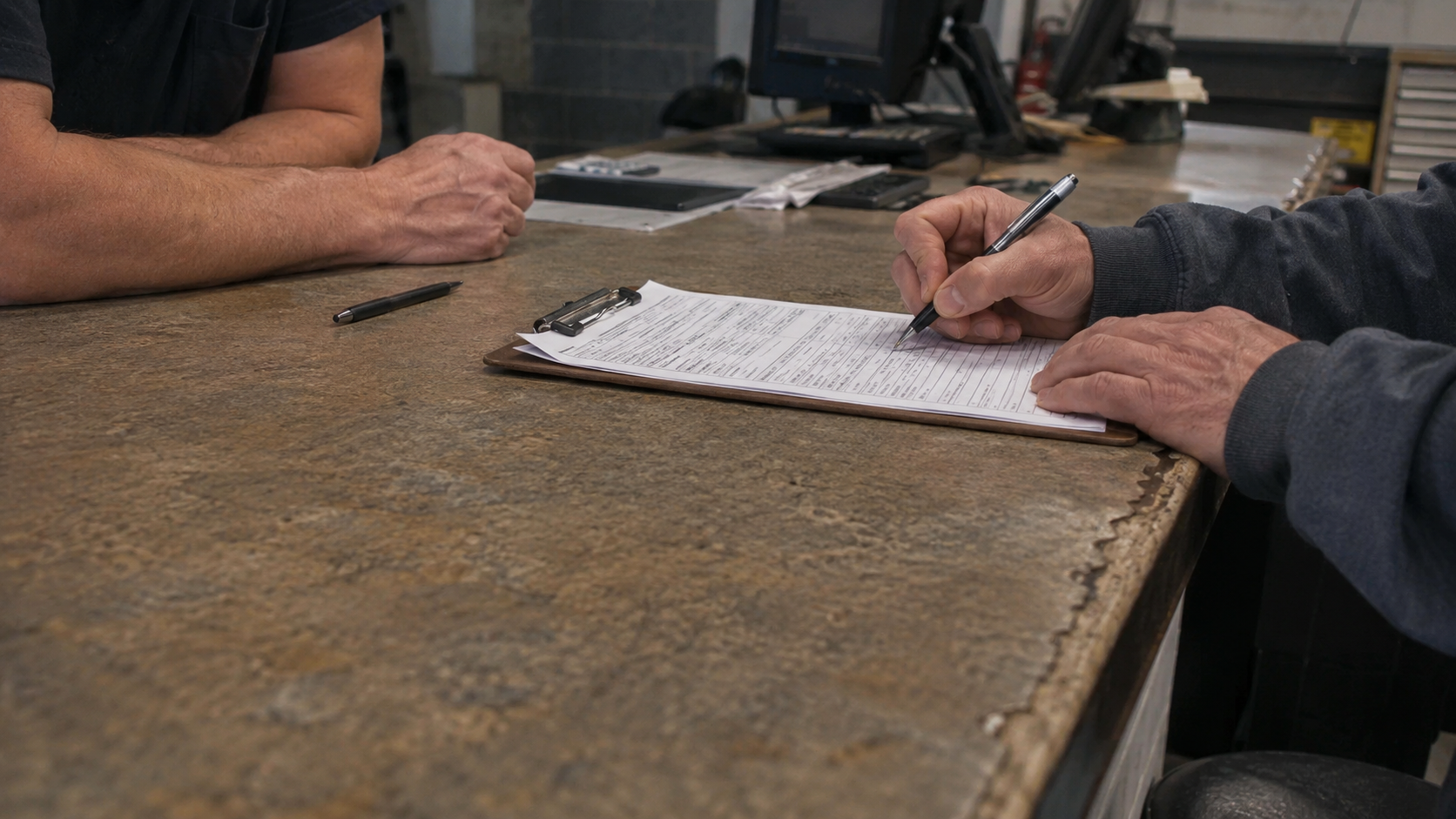
The intake form is where the assignment happens, before the repair begins, not after an insurer underpays.
What the Assignment of Proceeds Form Actually Does
When a customer signs an assignment of proceeds form at drop-off, they're transferring their right to collect insurance proceeds to your shop. You're not taking ownership of their claim. You're not inserting yourself into their policy relationship. You're getting a legal assignment: the insurer now owes you, not just them.
Erica Eversman, chief counsel at Vehicle Information Services, puts it plainly. The form is recognized in courts throughout the United States. The consideration is clean: you released the vehicle without full payment, the customer assigned you their rights in exchange. That's a valid legal transaction.
Attorney Parese, speaking at an industry event and reported in FenderBender, explains the mechanics this way: the shop is telling the customer it won't sue for what it's owed and will release the car, on the condition that the customer assigns the shop the right to stand in their shoes against the insurer. The assignment must be clear, unequivocal, and noticed by the insurer. When those boxes are checked, you have a legal claim.
Two Documents That Win in Court
If you ever take a short pay to small claims, bring two things: the signed authorization form and the final invoice. Those are the two documents Parese says matter most in front of a judge. The authorization proves the customer consented to the work and the amount. The invoice proves what you billed and what was paid. The gap between those two numbers is your case.
Anti-Assignment Clauses: What to Know
Some insurance policies include anti-assignment clauses. They're there to limit exactly this kind of action. What courts have consistently held, though, is that these clauses don't automatically void a post-loss assignment. Once a loss has occurred, the insurer's obligation to pay has already been triggered. Eversman's guidance is that assignment of proceeds forms work precisely because they operate after the loss event, not before it.
What Shops Are Actually Recovering
Phil Mosley has taken insurance companies to court 12 times since 2006. He's won every single one. He won't disclose the dollar total, but says the recoveries amount to 75 percent of his accounts receivable. More importantly, the wins have changed insurer behavior at his shop: he now reaches agreement with insurance companies 97 percent of the time before it ever gets to trial. They know he files. They know he wins. They pay.
A second shop owner, reported in NHADA sourcing, used a different approach. He experienced more than a dozen short pay situations over a two-year period and instead of filing each separately, he aggregated them into one case. He recovered $30,000 total. The legal process took about six months. That's not fast, but it's money that would have been written off without the assignment form giving him standing to pursue it.
Two documents, the signed authorization and the final invoice, are what wins underpayment cases in small claims court.
How to Implement This at Your Shop
The form has to be signed at intake. Not after the insurer pays short. Not when you realize there's a dispute. At drop-off, before the repair starts. That's when the consideration is clean: the customer needs the work done, you're agreeing to release the vehicle, they're assigning you their rights in exchange. If you try to get the signature after the fact, the enforceability drops significantly.
This is the part most shops get wrong. They hear about the AOP strategy after they've already absorbed a bad short pay, and they try to retrofit the paperwork. Courts look at the timing. The form needs to be part of your standard intake packet on every single job, not pulled out selectively when you expect trouble.
What Needs to Be in the Form
Work with an attorney familiar with insurance law in your state when drafting the language. The form needs to clearly identify what's being assigned, show intent from both parties, and include notice provisions for the insurer. Generic intake forms from estimating software aren't written with this in mind. You need language drafted specifically for this purpose.
The standard elements: an unambiguous description of what rights are being transferred, the vehicle and claim information, a statement that the shop is releasing the vehicle without full payment in exchange for the assignment, and a place for customer signature with a date. Eversman's guidance is to make it conspicuous, not buried in the small print of a broader authorization form.
When You Have Multiple Short Pays
Don't file each one separately. That costs time and money out of proportion to what you'll recover on a single $400 shortfall. Track them. Document each one with the RO, the insurer's payment, and the itemized difference. When you have a batch worth pursuing, aggregate them into one case the way the Ohio shop owner did. Your attorney can advise on thresholds, but the strategy of batching is more cost-effective and creates a stronger record of systematic underpayment.
Consistent documentation is what makes this work. If you're using an estimating audit tool to flag every short-paid line item before closing the RO, the record is already there. The shortfall amounts are itemized, timestamped, and attached to the RO. That's your case file before you even involve an attorney.
The Oklahoma Situation and Why It Matters to Every Shop
Oklahoma passed House Bill 1084 in 2025, effective November 1. The law prohibits shops from soliciting or accepting assignments of post-loss insurance benefits for property damage under auto policies. In plain terms, it bans the assignment of proceeds form for collision repair in Oklahoma.
The Oklahoma Auto Body Association filed a lawsuit the same month challenging the law as unconstitutional. Bell Auto Body owner Peyton Bell, a member of OKABA, argued the law strips both shops and consumers of a legitimate legal tool and interferes with the professional judgment of collision repairers. The case is active as of this writing.
The framing from the bill's author, Rep. Mark Tedford, was that AOB forms lead to inflated costs and legal disputes without the policyholder's awareness. That's an argument insurers have made in other states where they've pushed similar legislation. It's worth noting that the shop using an AOP form to collect a legitimate shortfall isn't inflating anything. The repair was done. The insurer just didn't pay the full bill.
Why does this matter to shops outside Oklahoma? Because insurers spent political capital to kill this tool in one state. That tells you exactly how seriously they take it. If they didn't care, they wouldn't bother. They've been watching shops win in small claims for years. The assignment of proceeds form works, and the Oklahoma fight is the clearest proof that insurers know it.
If you're not in Oklahoma, your state likely still allows this. Check with a local attorney. But don't wait. The legislative trend is not moving in shops' favor on this one, and the window to build the habit into your intake process is open now.
The Bottom Line
Short pays aren't accidents. They're the expected output of a system configured to pay less than billed. The assignment of proceeds strategy doesn't change the insurer's system. It changes your shop's position within it.
You can absorb the losses, or you can document them, assign the rights at intake, and build a paper trail that holds up in small claims. Shops using tools like Estimate Optimizer™ to flag short-paid line items before they close out the RO have the documentation ready. The assignment form and the itemized shortfall become the case file.
Phil Mosley went 12-0. The shops writing off those short pays every month aren't losing because the law is against them. They're losing because they never built the process to collect.
What is an assignment of proceeds form for an auto body shop?
An assignment of proceeds form is a document signed by the customer at drop-off that transfers their right to collect insurance benefits to the shop. This gives the shop legal standing to pursue the insurer directly for any unpaid or underpaid portion of the repair bill, rather than relying on the customer to fight the dispute.
Is an assignment of proceeds legal for body shops?
Yes, in most states. Assignment of proceeds forms are recognized in courts throughout the United States, according to Erica Eversman, chief counsel at Vehicle Information Services. Oklahoma passed a law in 2025 restricting their use, and that law is currently being challenged in court by a state auto body association. Outside of Oklahoma, shops can use them with proper documentation.
How do I win in small claims court against an insurance company for underpayment?
The two documents that matter most are the signed authorization form and the final invoice. Bring both. If you have an assignment of proceeds signed at intake, you have legal standing to sue as the assigned party. Attorney experience helps, and aggregating multiple short pays into a single case is more cost-effective than filing one claim at a time.
Do assignment of proceeds forms affect my relationship with insurance companies?
There can be short-term friction, but shops that use these forms consistently report that insurers start paying more accurately over time. Phil Mosley of Valley Paint and Body in Amelia, Ohio, went 12-0 in court against insurers and now settles 97 percent of disputes before they reach trial because the insurers know he's serious.