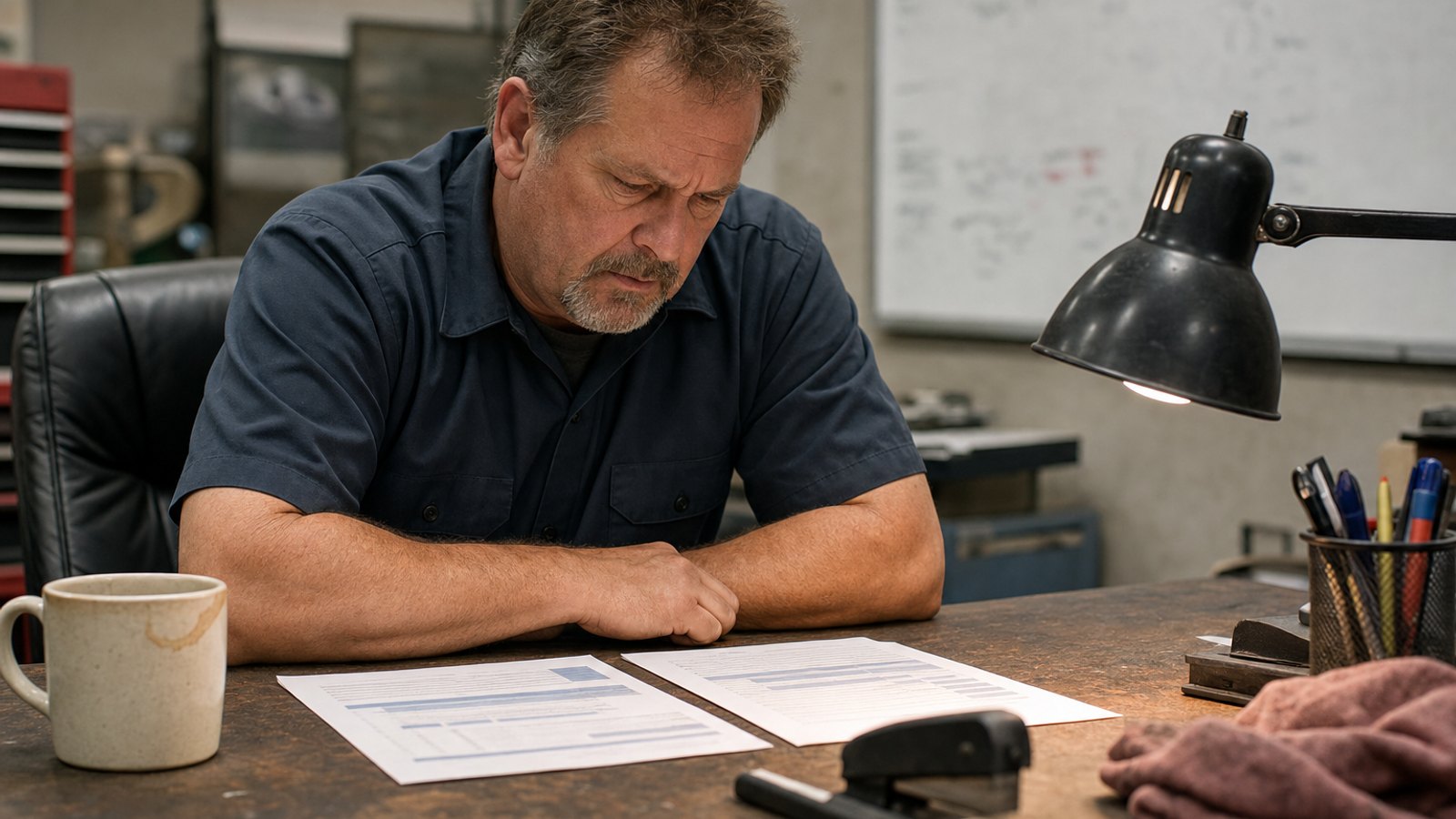
Your gross sales are up. Your shop is busy. And somehow your paycheck isn't keeping pace. If you run a collision shop, you know this feeling, and it's not your imagination. Auto body shop owner profit doesn't automatically follow revenue. There's a gap between the two, and most shops are feeding it every single week without knowing it.
The Busiest Person in the Room Isn't Always the Best-Paid One
Collision shop owners work harder than almost anyone in the building. You're writing estimates, managing supplements, talking to adjusters, sourcing parts, and signing off on repairs, all before noon. The shop is humming. Cars are moving.
But the industry average net profit margin for a collision shop runs around 6-7%. On a $2 million revenue shop, that's $120,000 to $140,000 in owner income, before you account for your own labor market rate. A senior estimator in your shop might be clearing $80,000 with no balance-sheet risk.
That math should bother you. And the reason it is what it is comes down to a single problem most shops never fully name.
Most collision shop owners review their revenue numbers without seeing where the money actually exits the system.
Is Your Take-Home Up By the Same Percentage as Your Sales?
Here's the diagnostic question. Your gross sales are up this year. Is your take-home up by the same percentage?
If not, the difference is living somewhere between the estimate and the final repair cost.
CCC data puts the average gap between the original estimate and what a job actually costs to repair at $1,200 to $1,800 per RO. That's not a billing error. That's work your shop performed and didn't fully collect on. Multiply that across 300 repair orders a year and you're looking at $360,000 to $540,000 in executed work that never made it to your bank account.
That's where your collision shop cash flow is going. Not to overhead creep. Not to parts inflation. To estimates that don't reflect what the shop is actually owed.
This Isn't a Volume Problem. Stop Solving It Like One.
The reflex when cash is tight is to run more cars. Take more assignments. Work the DRP harder. Push the estimators to write faster.
But if your capture rate is broken, more volume makes the problem bigger, not smaller. You're scaling a leak.
A 2019 Toyota RAV4 comes in with rear-end damage. The insurance estimate covers the visible panel work. It doesn't include the required OEM position-statement procedures for the rear bumper absorber, the single-use fasteners on the subframe, or the post-repair scan. Your tech does the work anyway, because not doing it creates liability. But if those operations aren't on the estimate with documentation, you're doing the labor for free.
That's not a pricing problem. It's a documentation gap. And it's repeating on every similar car that comes through the door.
The difference between what's on the original estimate and what the repair actually requires is where owner income disappears.
What Fixing It Actually Looks Like
A 25-person independent shop in Garden City, Kansas found $97,000 in 3 months. Twelve OEM certifications, zero DRP. They didn't add staff. They didn't run more cars. Volume actually went down during that stretch.
What changed was documentation accuracy on each RO. Every required operation backed by an OEM procedure source. Every removed or reduced line item flagged with a carrier-specific response. First-submission approval rate hit 99% internally.
The money was always there. It was already owed. The shop just hadn't built the paper trail to make it undeniable.
Across all clients as of June 2026, Estimate Optimizer™ finds an average of $1,100 per estimate in operations the shop performed but didn't fully document. Not on special cases. On ordinary jobs, run by experienced estimators who know the trade.
Knowing you're owed the money isn't enough. Proving it, before anyone can argue, is the shift that closes the gap between body shop revenue and what the owner actually takes home.
The Bottom Line
If your gross sales are climbing but your paycheck isn't following, the fix isn't more cars. It's more accurate documentation on the cars you already have. Every estimate is a legal document. Most shops are still writing them like receipts. The shops that changed that first are the ones whose owners stopped doing the most work for the least pay.
Why is my auto body shop revenue going up but my profit isn't?
Growing revenue without growing profit usually means your cost of capturing each repair is rising faster than your billing. In collision repair, the most common cause is incomplete estimates. The shop does the work but doesn't document every operation it's owed, so the carrier doesn't pay for it, and that shortfall never shows up in your gross sales number. It just disappears.
How much money is the average collision shop leaving on the table per job?
CCC data puts the gap between the original estimate and the final repair cost at $1,200 to $1,800 per job on average. Across all Estimate Optimizer clients as of June 2026, the per-estimate recovery average is $1,100. That's money the shop performed the work for but didn't document well enough to collect.
What does 'per-RO capture rate' mean for a body shop?
Per-RO capture rate is how much of what you're actually owed you successfully bill and collect on each repair order. A shop running $3,000 average estimates that should be $4,200 has a capture problem, not a volume problem. Fixing capture on existing jobs increases owner income without adding cars to the schedule.
Can a collision shop make more money without taking on more cars?
Yes. The shops that close the revenue-to-paycheck gap typically don't do it by running more cars. They do it by documenting more accurately on the cars they already have. When the estimate reflects every procedure the shop is actually required to perform, the approved amount goes up, and so does owner income.
What's the difference between a collision shop's gross sales and the owner's take-home?
Gross sales is the total invoiced amount before any costs. Owner take-home is what's left after labor, parts, materials, rent, equipment, and overhead come out. In collision repair, the industry average net profit margin runs around 6-7%. That means on a $2M revenue shop, the owner is clearing roughly $120,000-$140,000, often less than a senior estimator. The gap widens when estimates are incomplete and money that should have been billed simply wasn't.