Every auto body shop losing money on estimates assumes the same thing: the adjuster is the problem. He's cutting lines, questioning labor hours, pushing back on materials. That's where the money disappears, right?
It's not. The money disappears before the estimate ever leaves your building.
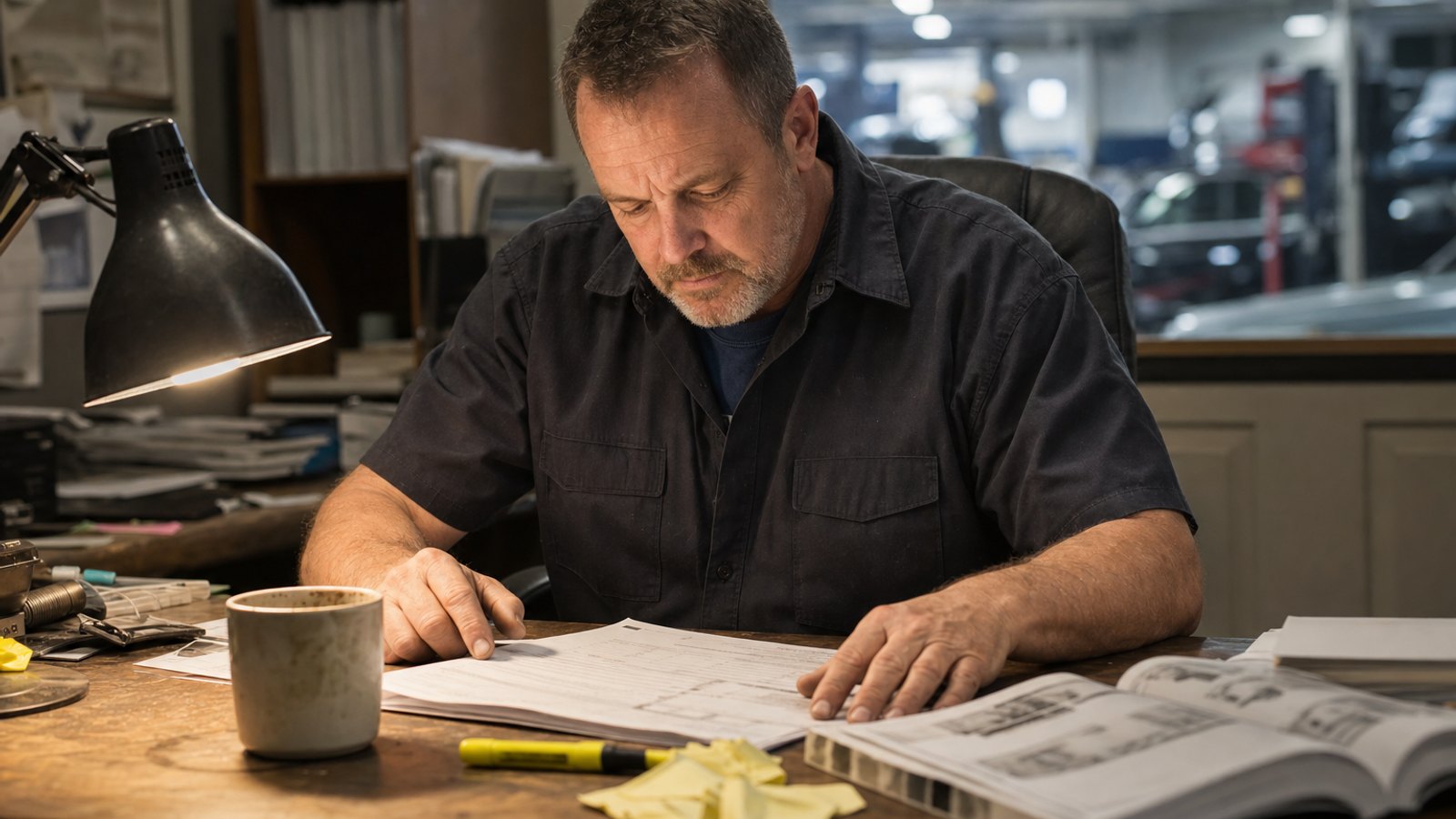
Your estimator already decided what the carrier will approve. He's been making that call for years, quietly, on every repair order, before a single line hits the submission queue. He's not being lazy. He's been trained, by thousands of denials, to pre-negotiate on the carrier's behalf before you even know a negotiation is happening.
Why Your Estimator Is Working Against Your Shop Without Knowing It
This isn't about a bad estimator. It's about what years of pushback does to the way a skilled person writes an estimate.
He's seen the same lines get questioned on the same vehicles for fifteen years. He knows State Farm's preferred adjuster is going to flag blend time on the quarter. He knows Allstate is going to push back on the clearcoat call on adjacent panels. So he stops writing them. Not because they're not legitimate, because he's tired of the fight, and he's learned, incorrectly, that the fight isn't worth having.
The technical term for this is learned helplessness. The practical result is that your estimates are being pre-cut by someone who works for you, not by the insurer.
According to the industry's own data, 96% of shop owners say insurer estimates require changes, and 72% say those changes are major. That's the industry confirming what's already being left on the table before submission. The gap isn't just what the adjuster removes. It's what never made it into the estimate in the first place.
The estimate that leaves your building isn't neutral. It reflects fifteen years of conditioning about what carriers will pay.
The Proof That the "They Won't Pay" Assumption Is Wrong
The "Who Pays for What?" survey from Collision Advice and CRASH Network runs every year. It tracks which not-included operations shops are billing for and whether carriers are paying.
The seatbelt inspection result is the one you need to sit with. In 2025, 1 in 4 collision shops still believed insurers wouldn't pay for seatbelt inspections. So they didn't bill for it. Meanwhile, 49% of shops that do bill for it get paid all or most of the time by the eight largest national insurers. Another 26% get paid at least sometimes.
That's not a story about insurer resistance. That's a story about shops pre-deciding the answer and not asking the question. The carrier isn't refusing. The shop isn't asking.
This pattern runs across every not-included operation category: blend time, clearcoat adjacent panels, hazardous waste disposal, corrosion protection, pre- and post-scan fees. The shops that bill with documentation get paid at rates that would surprise most estimators. The shops that don't bill because they "know" it won't get approved are donating that money on every repair order.
Sixty-three percent of collision repairs require a supplement after a detailed teardown inspection, per CCC data. That number is high because the initial estimate is being written short, partly by the adjuster writing from photos, and partly by your estimator writing from memory of past denials.
What This Costs Your Shop Over a Year
The industry gap between the original estimate and the final repair cost runs $1,200 to $1,800 per job, according to CCC data. Part of that is hidden damage discovered at teardown. A significant portion is documented operations that should have been on the estimate from the start.
Put that against a shop running 150 repair orders a month. Even at the conservative end, that's $180,000 a year in verified, carrier-owed money that's not being captured, not because the insurer denied it, but because it was never submitted.
The Destiny example is worth naming here. A Toyota Camry came in with what looked like a hairline crack in the bumper absorber. Standard estimator call: write the bumper, close it out, move on. Photo analysis showed structural rebar damage behind the absorber. That's a safety-critical component. The supplement came back at $2,500. It was approved on first pass with full documentation.
Destiny didn't have an adversarial adjuster. She had documentation that made the denial more expensive than the payment. That's the mechanism.
The difference between a denied supplement and an approved one is almost never the line item itself. It's whether the file makes denial more expensive than payment.
How Shops Stop Losing Money Before the Estimate Leaves the Building
The fix isn't a new training program. Your estimator doesn't need to be taught OEM procedures. He knows them. He needs a systematic check that removes the conditioning from the process.
Three things change the outcome.
First, OEM procedure research happens before the estimate is submitted, not after the adjuster pushes back. If the procedure requires a replacement fastener and that fastener is single-use, it's on the estimate. If the OEM position statement requires a pre- and post-scan on that platform, it's on the estimate. Not because the estimator might remember it, because the documentation says so and it's captured before the file moves.
Second, the assumption flips. Instead of "the carrier probably won't pay for this," the standard becomes: if the OEM requires it and we can document it, it goes on the estimate. The documentation does the arguing, not the estimator's intuition about which adjuster is going to review it.
Third, the submission is a proof package, not a request. Line items go out with the OEM page, the position statement, the photo, and the procedure reference attached. That's not aggressive. That's accurate. A carrier that wants to deny a documented, OEM-required operation has to generate paperwork explaining why. Most of them don't bother.
Skeeter's Body Shop in Garden City, Kansas runs zero DRP programs and holds 12 OEM certifications. In the first three months of running this process, the shop recovered $97,000 in additional revenue across a 99% internal approval rate. The shop didn't change what it repaired. It changed what it documented before the estimate left the building.
Tools like Estimate Optimizer™ run OEM procedure databases against the estimate before submission, flag every removed or reduced line item, and attach the documentation that makes approval the path of least resistance. The approval rate on properly documented submissions is over 80% on first pass.
The Bottom Line
The money your shop is missing isn't being stolen by difficult adjusters. It's being given away by a process that pre-decides the carrier's answer before the question is even asked.
Every estimate is a legal document. When you submit it without the documentation required to defend every line, you're not protecting the relationship with the adjuster. You're writing a receipt instead of a record.
The shops that figured this out stopped negotiating against themselves. They decided to start giving it back hard. The approval rates followed the documentation, not the other way around.
Why is my auto body shop losing money on estimates?
Most shops lose money on estimates before they ever reach the adjuster. Estimators conditioned by years of denials pre-remove legitimate line items they assume carriers won't approve. According to the 'Who Pays for What?' survey, 1 in 4 shops won't bill for seatbelt inspections even though 49% of shops that do bill get paid all or most of the time. The fix is systematic documentation, not a better adjuster relationship.
How much money is my shop leaving on the table per estimate?
The industry average gap between the original estimate and final repair cost runs $1,200 to $1,800 per job, according to CCC data. Not all of that is recoverable on every repair, but shops running a documented, OEM-backed submission process consistently find $1,100 or more in additional recoverable revenue per estimate that was legitimately owed but not captured.
What operations do body shops most commonly skip on estimates?
The most commonly skipped not-included operations are blend time, clearcoat on adjacent panels, corrosion protection, hazardous waste disposal, pre- and post-repair scanning fees, single-use fasteners, and seatbelt inspections. These are OEM-required or procedurally justified operations that shops omit because they assume the carrier will push back, even when data shows carriers regularly pay for all of them when documentation is submitted.
Will insurance pay for operations my estimator doesn't normally put on the estimate?
Yes, more often than most estimators believe. The 'Who Pays for What?' survey data shows that shops billing for previously avoided operations get paid at rates that surprise most of the industry. The variable isn't insurer willingness. It's whether the shop submits the line item with documentation that makes denial more expensive than approval.
How do I stop my estimators from pre-cutting estimates before submission?
The issue isn't estimator skill. It's a conditioned assumption about what carriers will approve. The fix is process-level: require OEM procedure documentation on every applicable line item before the estimate leaves the building, and establish a standard that anything the OEM requires and you can document goes on the estimate. When the documentation does the arguing instead of the estimator's intuition, approval rates follow.