Back to Blog
Revenue Recovery

He Was Already Talking About It Before We Ran the Numbers.

5 min read
Share
Green accented quote card with a Tennessee shop owner's line notes quote and the audit stats for 18 estimates, $16,000 found and $874 per repair order

Most shops want to see the numbers before they say anything publicly. Steve, a shop owner in Tennessee, did it the other way around.

On August 20, he was on an industry call with more than 50 shop owners. He named Estimate Optimizer and said it was working. Two days later, he sat down with us to look at what the first pass on his estimates actually said. Eighteen estimates processed. Approximately $16,000 in found opportunities. Eight hundred and seventy-four dollars per repair order.

The auto body shop estimate audit first month results confirmed what he'd already told the industry.

What He Said on the Industry Call First

Steve is a shop owner who runs in industry association circles. He knows the room. When he said it on the call, he also said the thing that made everyone nod: "Even my best estimator... she's not the best at the line notes."

That's a shop owner saying the quiet part out loud in front of 50 peers. That his own estimator, someone he trusts and who is genuinely skilled, isn't producing the documentation layer that gets estimates approved. The room recognized it because it describes every shop at some level.

He wasn't recommending EO because the numbers had changed his mind. He was recommending it because the premise of it, documentation as the variable, not estimator skill, was something he already understood to be true from his own shop floor.
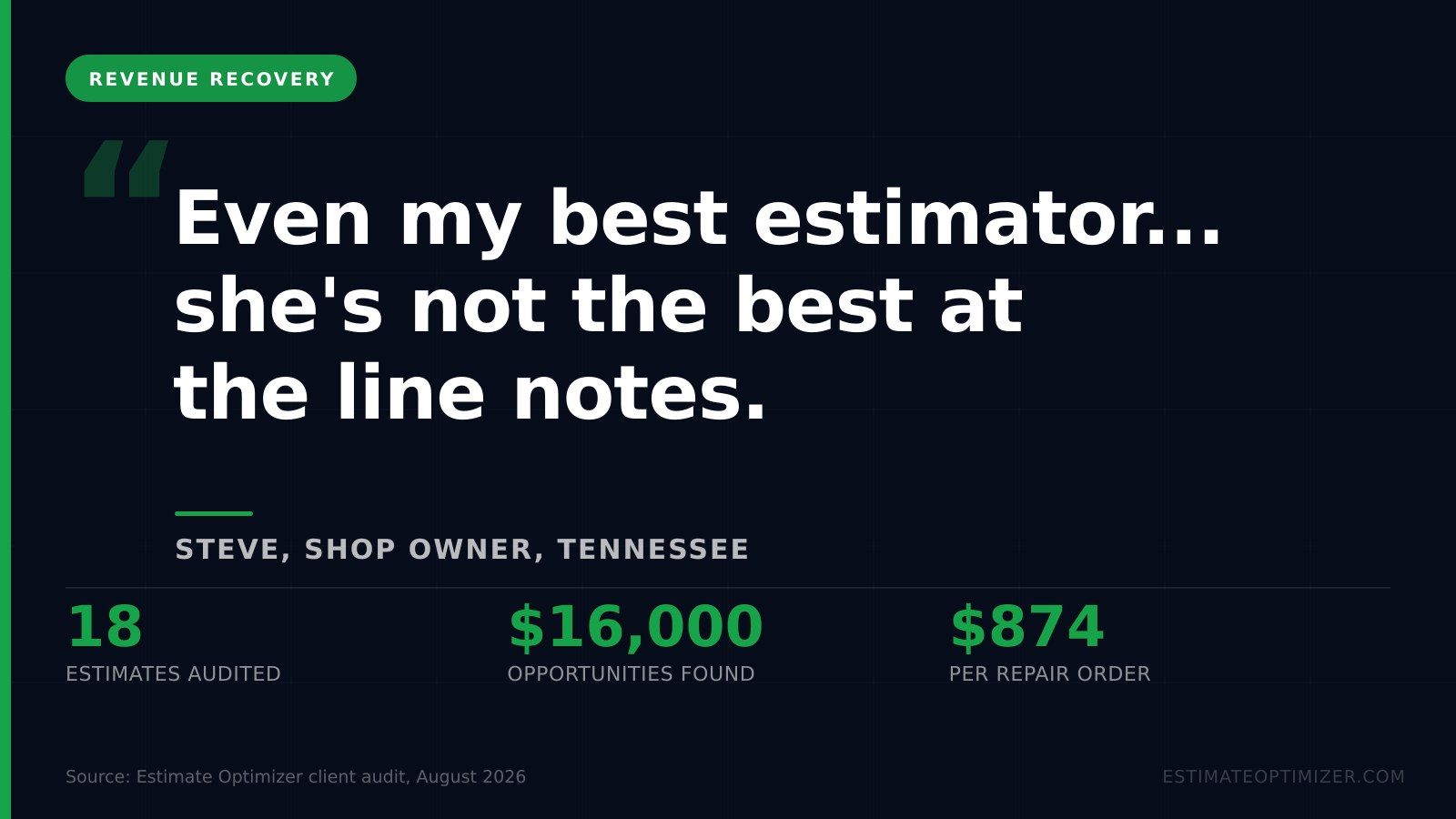
Green accented quote card reading Even my best estimator, she's not the best at the line notes, attributed to Steve, shop owner in Tennessee, with audit stats beneath
Steve named EO publicly before his audit numbers were formalized. The endorsement came from the premise, not the payout.

What Your First-Submission Approval Rate Actually Tells You

What was your first-submission approval rate last month?

If you don't know the number, that's the real starting point. Shops that know it can manage it. Shops that don't know it are operating on gut feel about their approval rate, and the number is usually worse than the gut suggests.

EO's current first-submission approval rate on properly documented submissions is over 80%. That's not industry average. Industry average doesn't get measured the same way. That 80% figure is the outcome of building the file before the question gets asked, not after the denial comes back.

Steve knew his estimator was doing the right operations. He also knew, before we looked at a single estimate, that the documentation layer wasn't what it needed to be. That's the gap the auto body shop estimate audit revealed in the numbers. Not hidden damage. Not wrong operations. Documentation that wasn't carrying the proof the adjuster's system needed to approve on first submission.
What the Numbers Said and What They Confirmed

Eighteen estimates. One shop. One month of early use.

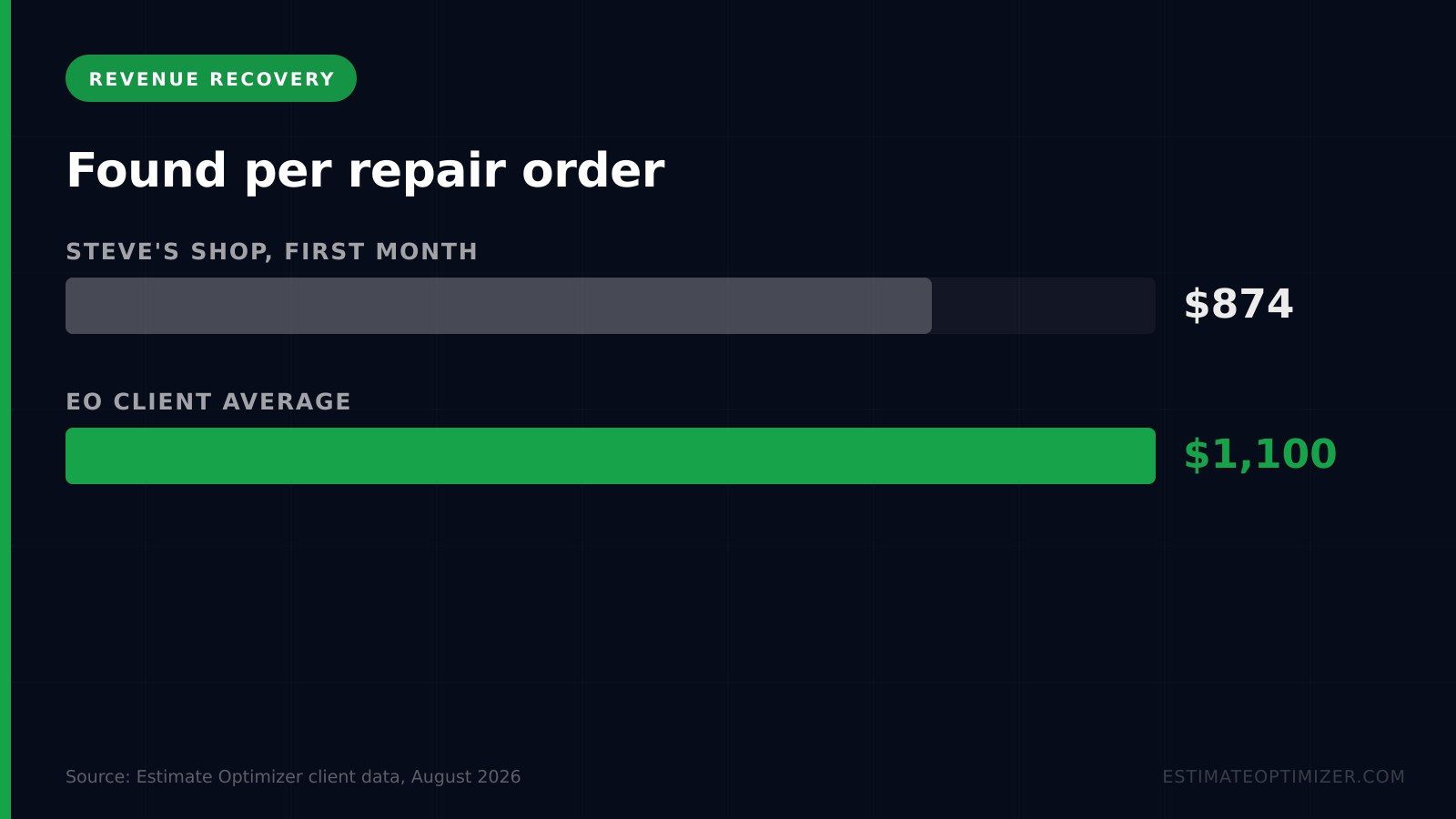
Sixteen thousand dollars in opportunities found. That's $874 per repair order average. For context, EO's per-estimate average across all current clients runs around $1,100. Steve's shop is earlier in the documentation build. The average will move as the documentation layer gets tighter.

One of the repair orders in the audit was a 2023 Honda Accord, a rear bumper replacement with a blind spot monitoring sensor in the impact zone. The line note said "calibration required." No OEM anchor. That single operation, documented properly, shifts from a probable supplement hold to a cleared first-submission line item. That pattern repeated across more than a dozen of the 18 estimates.

The "You can just use ChatGPT" objection came up on that same industry call. Someone in the room said it. Steve answered it without being prompted. "There's a human in the loop." Four words. He didn't sell the tool. He explained what makes the output defensible.

An AI output that isn't anchored to OEM documentation doesn't change the adjuster's obligation. A properly documented estimate that cites the manufacturer procedure, references the not-included language, and is reviewed by a human who understands the claim creates an obligation the carrier is already on the hook for. That's the distinction. Steve understood it before he saw the numbers. The numbers confirmed it.

Green bar chart comparing $874 found per repair order at Steve's shop in month one against the $1,100 Estimate Optimizer client average
Steve's first month against the current Estimate Optimizer client average. The gap is what the documentation layer closes as the standard gets applied.

The Bottom Line

Steve told 50 shop owners that the documentation standard matters before he could show them a single number from his own shop. That's not a sales conversion story. That's a shop owner who already understood the mechanism, and then had the numbers confirm what he knew.

The first-month audit result is $16,000 on 18 estimates. That number will grow. The documentation layer compounds across every estimate your shop produces once the standard is in place.

Estimate Optimizer ran the audit on Steve's estimates and flagged the documentation gaps before anyone had to argue about them. That's the job. Build the file before the question gets asked.

Related Articles

Frequently Asked Questions

What does an auto body shop estimate audit typically find in the first month?
First-month audit results vary by shop size and documentation habits, but EO clients average approximately $1,100 per estimate in found opportunities across the current pilot group. One Tennessee shop found $16,000 across 18 estimates, averaging $874 per repair order in the first period of use. Earlier audits tend to find more because the documentation gaps are larger before the standard is applied.
How do I know if my shop's estimates are missing documented opportunities?
The clearest indicator is your first-submission supplement approval rate. If you don't know that number, start there. A rate below 70% means your files are generating manual holds and supplement rounds that shouldn't be happening. An audit of 3 to 5 recent estimates from your shop will show where the documentation gaps are and how much they're costing per repair order.
What does 'a human in the loop' mean for supplement documentation?
An AI output that isn't reviewed and anchored to OEM documentation doesn't create carrier obligation. A properly documented estimate requires a human reviewer who understands the repair and can verify that the citation matches the vehicle and the operation. The documentation is what creates the obligation. The human review is what makes the documentation defensible.
Why does the estimate audit average get better over time?
The first audit typically finds the largest gaps because the documentation standard hasn't been applied yet. As the shop builds the documentation habit, the initial estimate captures more correctly and the supplement rounds decrease. The per-estimate average can shift in either direction: down as first-submission captures more, or up as the shop's documentation precision improves and surfaces more carrier-obligated operations.
Is the ChatGPT objection a valid alternative to a proper estimate audit?
A general AI tool like ChatGPT doesn't access the OEM documentation databases, the estimating platform's not-included language, or the carrier's obligation structure for specific vehicle makes and procedures. It can generate text, but it can't produce a defensible citation that anchors a specific line item to a manufacturer requirement. The documentation has to be traceable to a source the carrier is already obligated to respect.
Share this article
revenue recoverysupplementsshop ownerscollision repairestimate scrubbinginsurance claimsOEM procedures
Back to Blog
Follow us