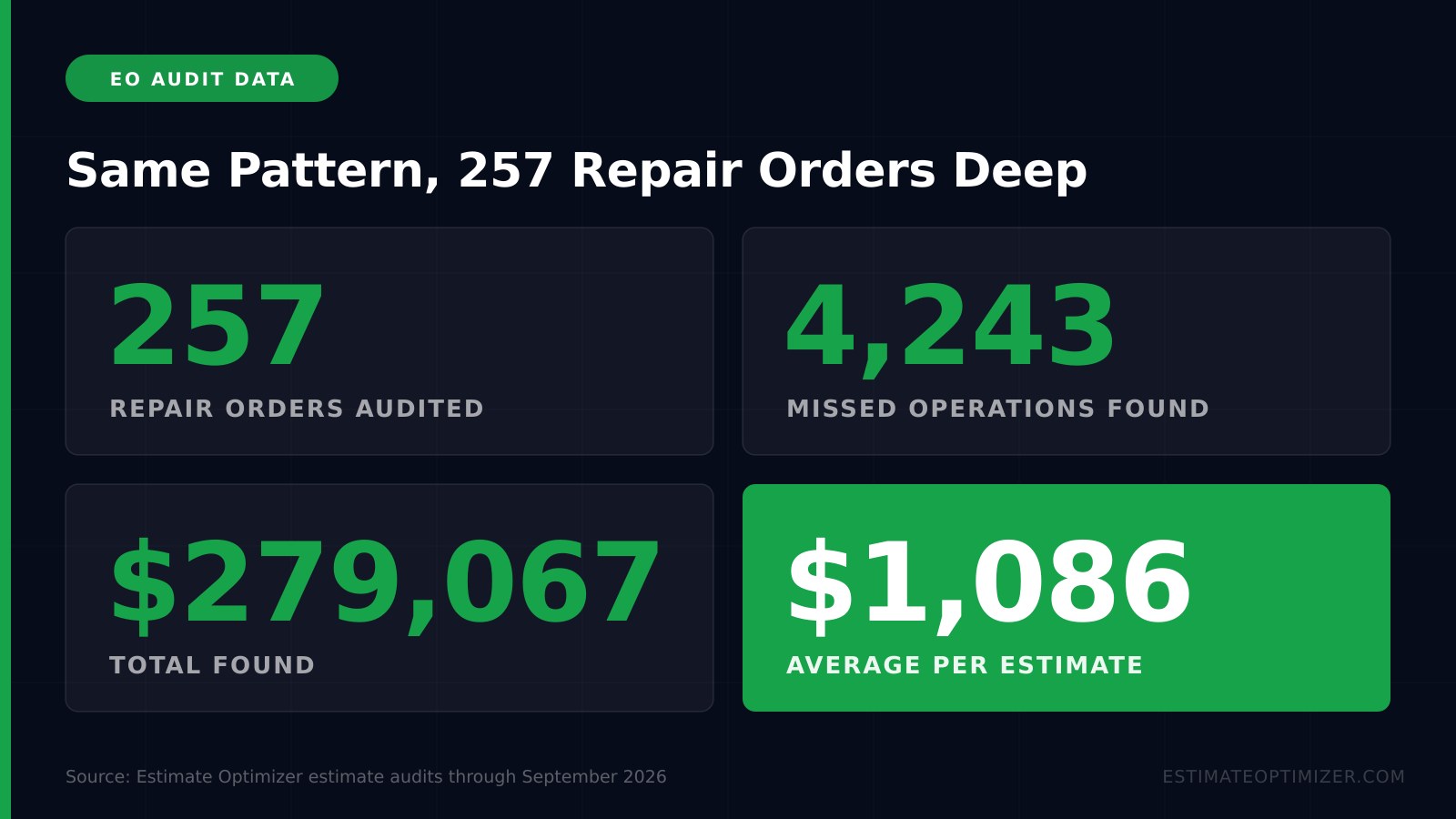
The auto body shop insurance underpayment pattern shows up in the same way, on the same kinds of operations, regardless of shop size, vehicle mix, or estimating platform. That is not an opinion. Across 257 repair orders audited in EO's system through September 2026, 4,243 operations were found missing from the original estimates. Total found: $279,067. Average per estimate: $1,086.
One shop's numbers are easy to dismiss. Maybe they have a great process. Maybe they got a good batch of complex vehicles. Maybe their estimator happened to be weaker than average, so there was more to find. Any of those explanations works for one shop.
None of them work for 257 repair orders across multiple shops.
What 257 Repair Orders Actually Tells You
The insurance underpayment pattern in collision repair does not vary the way people expect it to. Shop owners often assume that the gap is a function of their market, their carrier relationships, or their estimator's skill level. When you look at a dataset large enough to control for those variables, the average lands in nearly the same place every time.
At $1,086 per estimate, a shop running 30 jobs a month is leaving $32,580 on the table every month. Twelve months of that is $390,960. Not because the work wasn't done. Because the operations weren't documented in a way that required payment on first submission.
CCC's own data shows that 63% of collision repairs require a supplement after the initial estimate. That figure has held consistent across years of CCC reporting. The question is not whether your shop will generate supplements. It's whether the supplement closes the gap or fights over it.
Where Your Shop Sits in This Pattern
Here is the self-diagnostic. Take your shop's total billed revenue for the last quarter. Divide it by the number of closed repair orders. That is your average ticket.
Now ask: if your average ticket is currently $3,800, and the documented gap across 257 audited ROs is $1,086, what would your average ticket be if that gap were closed? Not because you changed your labor rate, not because you added cars, but because the operations you're already performing were fully documented and billed on first submission.
If your average ticket is already close to or above your market average, you may have a tighter gap than most. If your average ticket is $500 to $1,000 below what CCC's data shows as the industry average for your vehicle complexity range, the gap is telling you something.
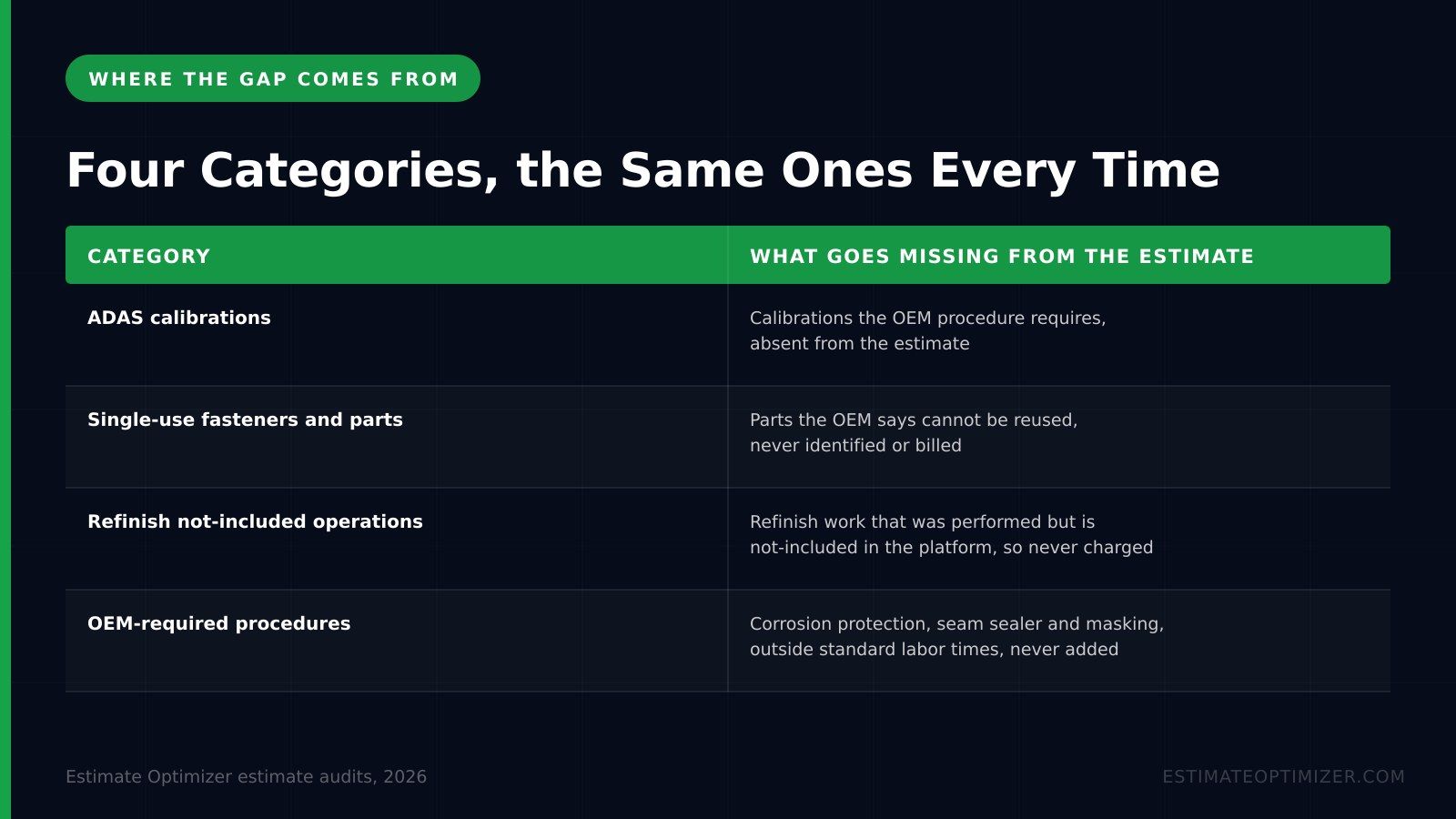
The pattern across 257 ROs breaks down into four operation categories. ADAS calibrations that were required by OEM procedures but absent from the estimate. Single-use fasteners and parts that were not identified and billed. Refinish operations classified as not-included in the platform that were performed but not charged. And OEM-required procedures, corrosion protection, seam sealer, masking, that fall outside standard labor times and were never added.
Take a 2023 Ram 1500 with a cab corner and quarter repair. If the estimate doesn't include corrosion protection on the exposed metal, additional seam sealer on the replaced panel, masking for the seam sealer, and an ADAS radar recalibration if the rear sensors were in the affected zone, four operations are missing before the file even leaves the building. Each one is documented and billable. None of them appear in the default software output.