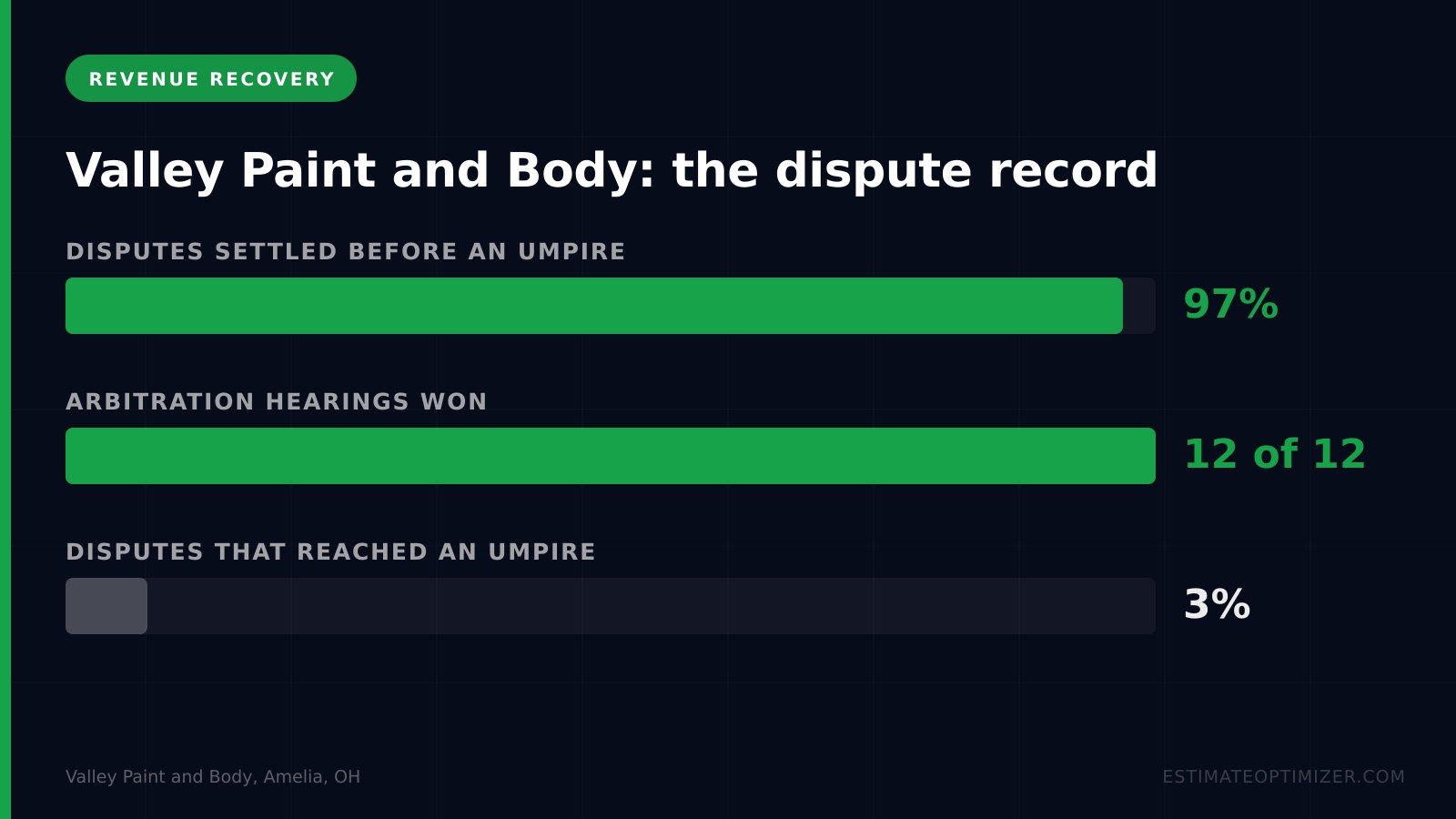
Auto body shop insurance dispute arbitration is a last resort for most shops. For Phil at Valley Paint and Body in Amelia, Ohio, it happened 12 times. He won all 12. And in 97% of his disputes overall, the carrier settled before anyone ever reached an umpire. That number deserves an honest look, because it doesn't come from being aggressive. It comes from what was in the file.
12 for 12: Why That Number Matters
A 12-for-12 arbitration record is not about finding a good appraiser. It's not about having a lawyer. It's about building a file that removes every argument a carrier can make before the dispute formally begins.
The appraisal clause process (what most shops call arbitration) works like this: the shop and the carrier each hire an independent appraiser. If the two appraisers don't agree, they select an umpire. Any two of the three parties agreeing on a number makes it final. It's a process that is supposed to resolve disagreements about value and scope. What Phil's 97% pre-umpire settlement rate tells you is that when his independent appraiser walked in with his file, the carrier's appraiser looked at it and decided the number in the file was defensible.
They weren't settling because Phil was difficult. They were settling because the documentation gave them no room to argue.
Valley Paint and Body, Amelia, OH. 12-for-12 in arbitration hearings, with 97% of disputes settled before an umpire was ever needed.
How Many of Your Disputes Go to a Third Party?
Before we get into the file mechanics, run this number for yourself. How many of your supplement disputes or claim disagreements in the last 12 months required a third party to resolve? A formal appraisal clause invocation, a state insurance department complaint, a formal demand letter?
Any number above zero means your documentation left room for the carrier to disagree. That's not a judgment. It's a diagnostic. Phil's 97% settlement rate means 97 out of 100 carriers looked at the file and decided not to fight. The file made fighting more expensive than settling. That's the standard worth understanding.
Five states (Washington, Texas, Alaska, Rhode Island, and Massachusetts) now require insurers to include appraisal clauses in auto policies. That's a legislative trend that will expand. More shops will have this option. The question is whether the file they bring into that process is the one Phil brought, or something thinner.
What Was Actually in the File
Phil's documentation standard is built on one principle: by the time the estimate leaves the shop, every line item the carrier might dispute has supporting evidence attached. Not as a response to denial. As a starting condition.
On a 2023 Ford F-150 with cab corner damage and a sensor in the strike zone, that file includes the Ford OEM position statement on ADAS sensors, the procedure pages for the required pre- and post-repair scans, the scan report from both, and detailed photos documenting the damage zone and the required repair sequence. A carrier appraiser reviewing that file cannot credibly argue the calibration was optional, or that the repair sequence was the shop's preference. The OEM said so. The documentation proves it.
On a 2022 Subaru Outback with EyeSight camera damage behind the windshield, the Subaru position statement on EyeSight calibration requirements goes in the file. The OEM-required windshield replacement procedure goes in the file. The calibration documentation goes in the file. Each line item the carrier might dispute has a paper trail that leads back to a manufacturer's documented requirement, not a shop's opinion about what is owed.
That is what makes pre-trial settlement happen. The carrier's appraiser cannot counter-argue a documented OEM requirement. They can argue with the shop's word. They cannot argue with the manufacturer's published standard.
The appraisal file is only as strong as what was in the estimate before the dispute started. Phil built the file at estimate time, not after denial.
The Bottom Line
Phil's record is 12-for-12 because the dispute was effectively over before it formally began. That's what a complete documentation file does. It forces the carrier's position into contact with documented manufacturer requirements, and documented requirements are hard to argue with in front of a neutral umpire. Tools like Estimate Optimizer build that file at estimate time, flagging disputed line items and attaching the relevant OEM documentation before the estimate is submitted. The shops that never need to invoke arbitration are the ones whose files make the carrier decide that settling is easier than fighting. If you can prove it, you can bill it. Phil proved it 12 times.
How does the insurance appraisal clause work for auto body shops?
The appraisal clause is a dispute resolution process in insurance policies. When a shop and carrier disagree on the value or scope of a claim, each party hires an independent appraiser. If the two appraisers disagree, they select a neutral umpire. Any two of the three agreeing on a number makes it binding. Shops with strong documentation often reach settlement before the umpire is needed.
What documentation do I need to win an insurance arbitration dispute?
The most effective arbitration files include OEM procedure pages for every disputed operation, OEM position statements on required parts or repair methods, pre- and post-repair scan reports where calibrations are required, and detailed photo documentation of the damage zone and repair sequence. Every line item the carrier might dispute needs a paper trail that leads to a manufacturer's documented requirement.
Why do most auto body shop insurance disputes settle before arbitration?
Carriers settle pre-arbitration when the shop's documentation leaves them no credible counter-argument. An independent appraiser reviewing a file with OEM procedure pages, position statements, and scan documentation cannot effectively dispute a line item that a manufacturer requires. The cost of fighting a well-documented file in front of a neutral umpire exceeds the cost of settling.
Do all states require insurance policies to include an appraisal clause?
Not all states, but the trend is expanding. As of 2025, Washington, Texas, Alaska, Rhode Island, and Massachusetts require insurers to include appraisal clauses in auto policies. Texas proposed mandatory disclosure at policy renewal starting November 2026. Shops in states with mandatory appraisal clauses have a formal dispute resolution path regardless of whether the carrier chooses to cooperate.
Is arbitration the same as the insurance appraisal clause process?
They are related but distinct. The appraisal clause is a contractually embedded process in the insurance policy for resolving physical damage valuation disputes, using two independent appraisers and potentially a neutral umpire. Formal arbitration is a separate legal process. Most shops use 'arbitration' loosely to mean any formal dispute resolution with the carrier, which often means the appraisal clause process.