Back to Blog
Revenue Recovery

$1,062 per Estimate. 4,025 Missed Operations. 244 Repair Orders Later, the Pattern Doesn't Move.

6 min read
Share
Bar chart comparing the value of missed operations at $1,062 per estimate, $15,930 per week and $63,720 per month across EO's 244-RO client dataset

The average amount of missed operations per estimate in our client base right now is $1,062. Not one shop. Not one lucky audit. Across 244 repair orders, we found 4,025 missed operations worth $259,250.53. That figure compounds every single week those jobs are written the old way.

What "Missed Operations Per Estimate" Means for Your Shop in Dollars

A missed operation is a procedure that belongs on the estimate, is required by the vehicle, is documented in OEM materials, and is not there. It's not debatable. It's not a negotiating position. The documentation says it's required, and the estimate doesn't have it.

The SCRS Guide to Complete Repair Planning catalogs more than 1,000 not-included procedures across the major estimating platforms. These are operations the software either defaults to "not included," never calculates, or leaves entirely to the estimator's judgment. When an estimator misses one, it doesn't show up as an error. The estimate goes out short.

At $1,062 per job, a shop doing 15 estimates a week is leaving roughly $15,930 on the table every week. Per month, that's over $63,000. That's not a rounding error. That's a staffing problem disguised as an estimating problem.
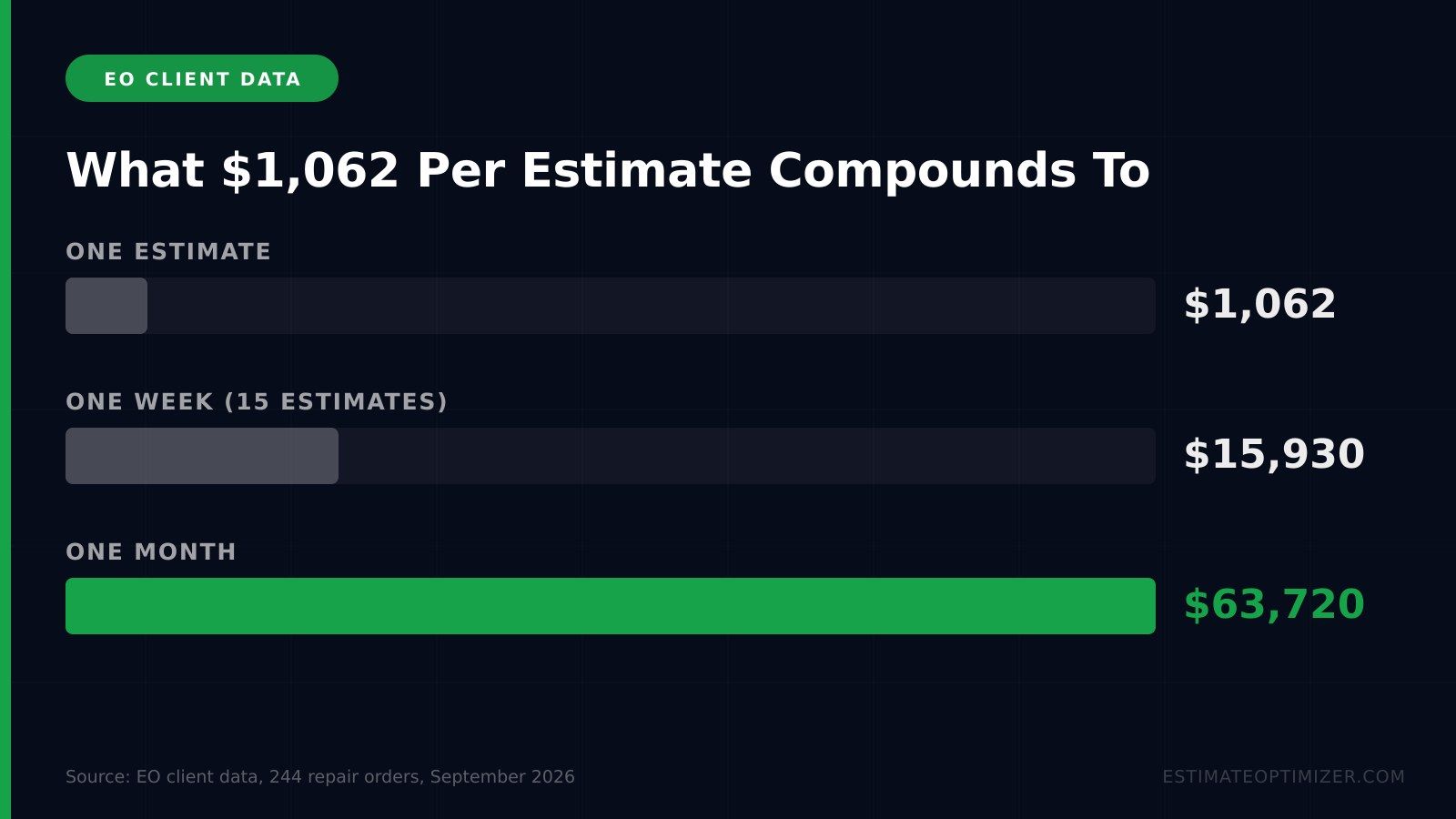
Bar chart comparing the value of missed operations at $1,062 per estimate, $15,930 per week across 15 estimates, and $63,720 per month
At the $1,062 average from EO's 244-RO client dataset, a shop writing 15 estimates a week leaves $63,720 unbilled every month.

What's Driving the $1,062 Average: The Four Categories That Keep Showing Up

The $1,062 average is not random. The same categories show up on nearly every audit. Once you know what they are, you stop wondering why your supplements keep getting pushed back.

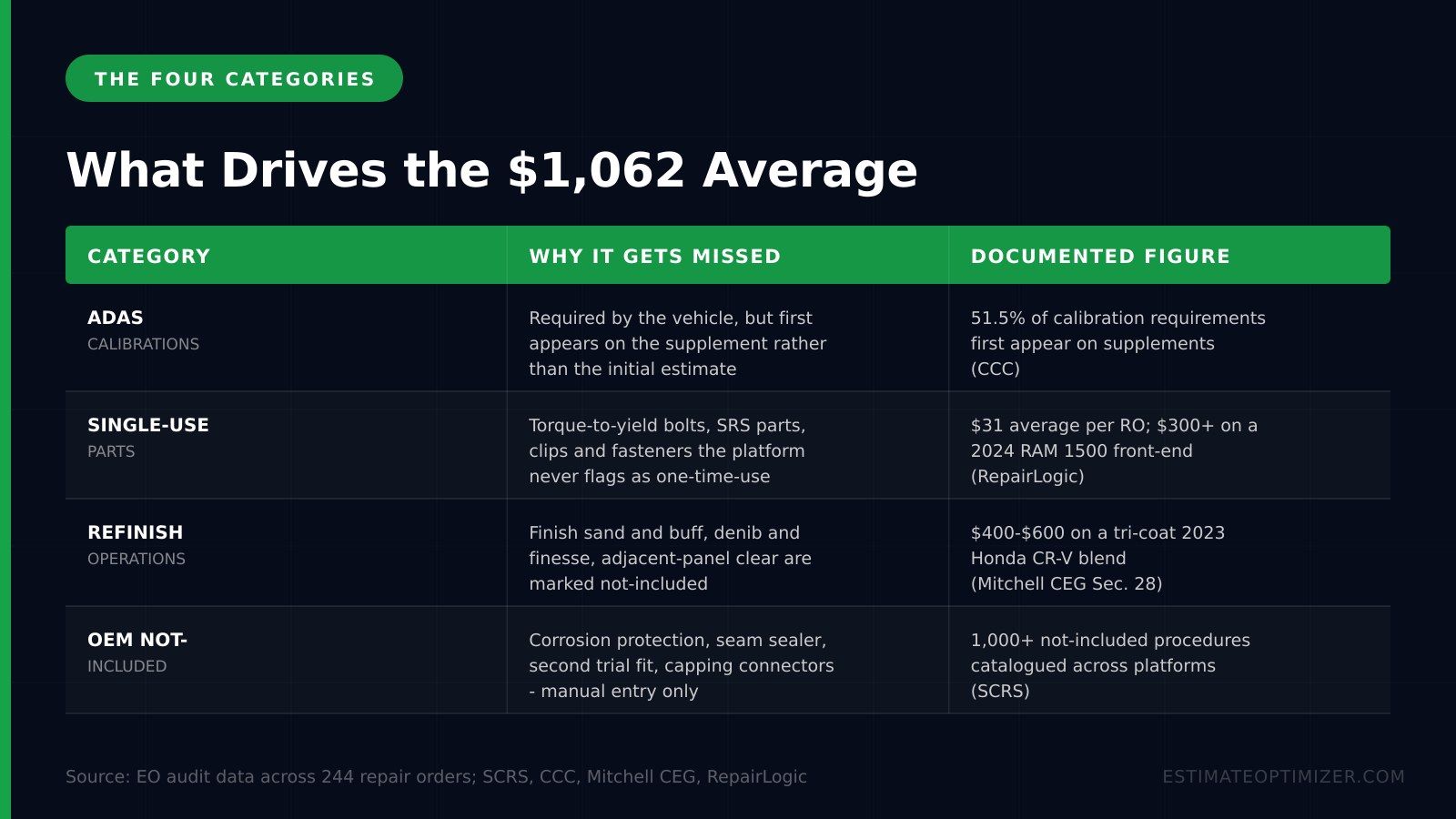
ADAS calibrations. According to CCC's own data, 28.3% of repairable estimates now include calibration. But 51.5% of calibration requirements first appear on supplements, not initial estimates. That gap is a billing problem. The calibration was always required. The estimate never said so.

Single-use parts. Torque-to-yield bolts, SRS components, certain clips and fasteners. These are one-time-use by OEM specification and have to be replaced. Every major manufacturer has published position statements on this. On a 2024 RAM 1500 with front-end structural damage, the single-use fastener count alone can run $300 or more before labor. RepairLogic data puts the average miss at $31 per repair order across all vehicles, and that average is pulled down by smaller jobs. Stellantis platforms skew significantly higher.

Refinish operations. Finish sand and buff, denib and finesse, clearcoat on adjacent panels. The estimating platforms mark many of these as not-included but shops routinely don't add them back. A 2023 Honda CR-V with a tri-coat color requiring blend work on the door and quarter panel can easily have $400 to $600 in refinish operations that never appear on the initial estimate. The Mitchell CEG, Section 28, is explicit: "The performance of finish sand and buff operation is NOT INCLUDED in the Mitchell refinish labor time." The documentation is there. The line items are not.

OEM not-included procedures. Corrosion protection application, seam sealer on new parts, second trial fit operations, capping electrical connectors. The P-pages and SCRS guide document all of them. They don't show up in calculated times. They require manual entry. And most estimators are moving too fast to catch them.
Is Your Shop Above or Below the $1,062 Average? What That Number Is Telling You

Here's the self-check. Take your last 10 repair orders. Add up what your supplements recovered on each one. Divide by 10. That's your per-estimate recovery average. If you don't track supplements by RO, that's already the answer.

Under $500 per RO: your estimates are going out materially incomplete. The gap isn't your supplement process. It's what's getting caught before submission.

$500 to $900 per RO: you're capturing some of it. But the categories above are almost certainly still leaking. Calibrations not on initial submissions. Refinish operations not itemized. Single-use parts not called out with OEM documentation attached.

Over $1,000 per RO: you're in the range where proactive documentation is making a difference. The question is whether you're doing it consistently on every estimate, or only on the ones where something feels off.

63% of collision repairs require a supplement after the initial estimate, according to CCC's own published data. If your shop is in that majority, you're doing two rounds of work to get paid for what should have been captured in one.

Table of the four missed operation categories - ADAS calibrations, single-use parts, refinish operations and OEM not-included procedures - with why each gets missed and its documented figure
The four categories responsible for the bulk of missed operations across EO's 244-RO client dataset.

Proactive Audit vs. Waiting for Pushback: What Changes

A shop that audits every estimate before submission is catching the $1,062 in the same 20 minutes an estimator spends on initial write-up. A shop that waits for the adjuster to push back is spending five hours per job fighting for money that a documented submission would have captured on first pass.

The math on that is simple. 15 estimates a week, five hours of supplement fighting each, across a crew of three estimators. That's hundreds of hours a year spent on work that proactive documentation eliminates.

What changes in the shops that get consistent approvals isn't that their adjusters are friendlier. It's that their first submissions stop looking like opening offers. When the OEM documentation is attached, the calibration is itemized with the scan report, and the single-use part is called out by part number and OEM position statement, there's no negotiating position for the carrier. The documentation is already the answer to the objection they were going to raise.

Estimate Optimizer runs this audit on every estimate automatically, cross-referencing OEM procedure databases and flagging every operation the estimate is missing based on what the vehicle requires. The shops in our client base averaging $1,062 per estimate are not doing anything heroic. They're letting the documentation do the work their estimates used to leave undone.

The Bottom Line

4,025 missed operations across 244 jobs is not a sampling error. It's a pattern. And patterns don't fix themselves by knowing they exist. They fix when the process changes. The $1,062 average is already on your estimates. The question is whether it's showing up in your revenue or staying in the carrier's pocket.

Related Articles

Frequently Asked Questions

How many missed operations does the average auto body shop have per estimate?
Based on EO's aggregate data across 244 repair orders, the average missed operations per estimate comes to $1,062 in unbilled value, with 4,025 total missed operations found. The most common categories are ADAS calibrations, single-use parts, refinish operations, and OEM not-included procedures that estimating platforms don't calculate automatically.
Why do auto body shops miss operations on estimates?
Most missed operations happen because estimating platforms default to 'not included' for hundreds of legitimate procedures, and estimators are working too fast to add them back manually. The SCRS Guide to Complete Repair Planning documents more than 1,000 procedures that platforms either don't calculate or leave to manual entry. Without a systematic audit process, these gaps go out on every estimate.
What percentage of collision repairs require a supplement?
According to CCC's own published data, 63% of collision repairs require a supplement after the initial estimate. This means the majority of shops are doing two rounds of billing work to recover revenue that a complete initial estimate would have captured in one submission.
What are the most commonly missed line items on auto body estimates?
The four categories that consistently appear in audits are: ADAS calibrations (51.5% of calibration requirements first appear on supplements per CCC data), single-use OEM parts averaging $31 per RO, refinish operations like finish sand and buff that platforms mark as not-included, and OEM not-included procedures like corrosion protection and seam sealing.
How do I know if my shop is leaving money on the table on estimates?
Take your last 10 repair orders and calculate your average supplement recovery per RO. If that average is under $500, your estimates are going out materially incomplete. If you don't track supplements by RO, that's already the answer. An audit process that checks every estimate against OEM procedures before submission is the structural fix.
Share this article
revenue recoverysupplementsestimate scrubbingshop ownerscollision repairOEM proceduresADAS calibration
Back to Blog
Follow us