Back to Blog
Labor Rate Disputes

How to Build a Labor Rate Position File That Ends the Argument Before It Starts

5 min read
Share
Quote card showing the carrier phrase reasonable rates beside published NABR and CRASH Network figures on shop labor rates

When a carrier questions your labor rate, most shops respond the same way: a verbal pushback, maybe a mention that other shops charge more, and then a slow retreat when the adjuster doesn't move. The problem isn't the argument. It's that the argument lives only in your head. Auto body shop labor rate documentation built from neutral third-party sources changes that dynamic entirely.

This week's pillar post covered why the prevailing rate is a documentable market figure and how to establish it proactively before any dispute. This post is the next level down: building the standing file that makes your position permanent, not something you reconstruct every time an adjuster pushes back.

What Is LaborRateHero and What Does It Actually Produce?
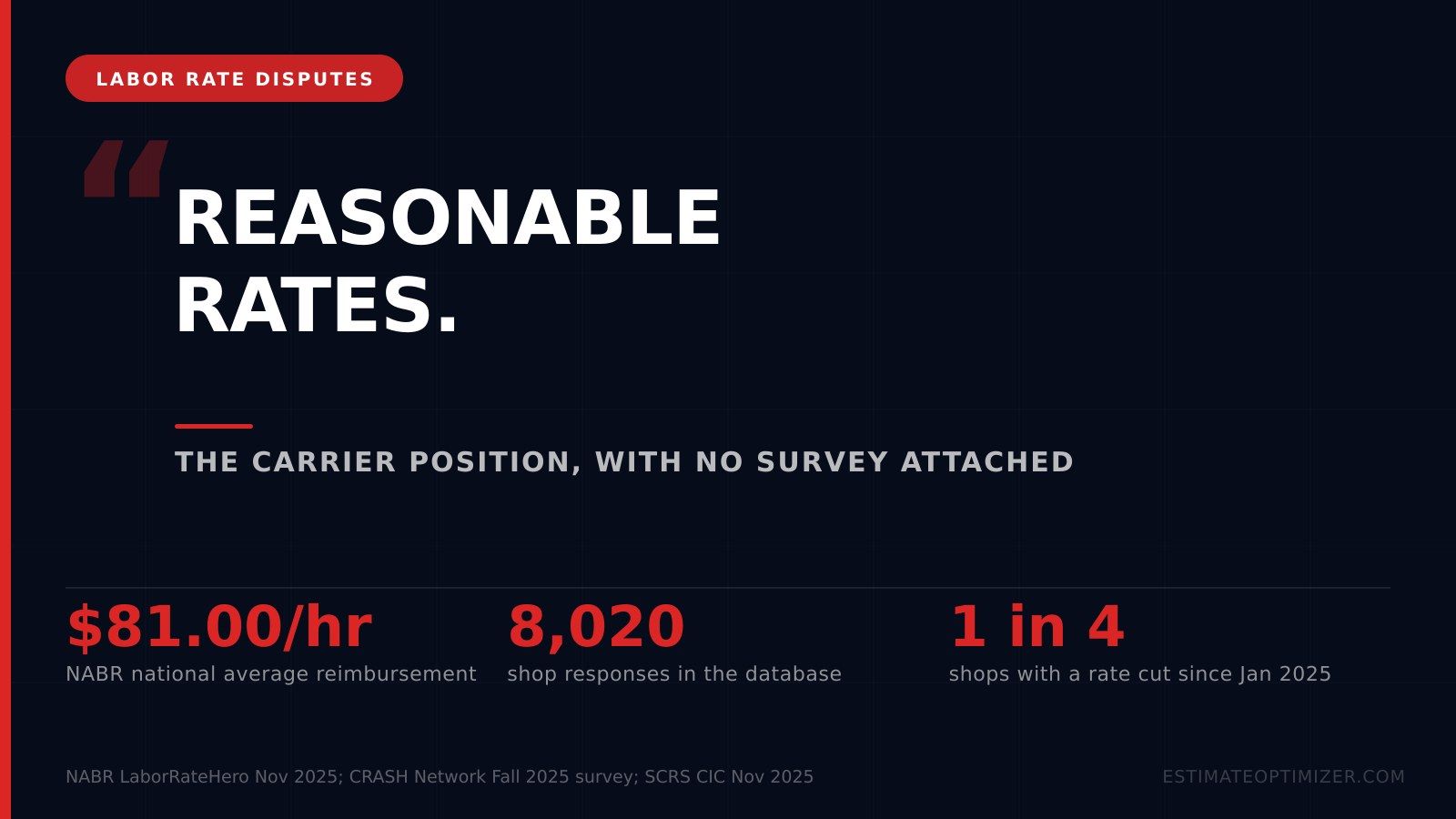
Quote card showing the carrier phrase reasonable rates beside published NABR and CRASH Network figures on shop labor rates
The carrier position arrives as an assertion. The published third-party figures sitting beside it are documented.

NABR's LaborRateHero is a neutral database. Every shop that participates submits their own posted rate. NABR aggregates those submissions and reports back market-level data: what shops in your zip code area actually post for body labor, filtered by geography. As of November 2025, the platform reflects 8,020 shop responses with a national average reimbursement rate of $81 per hour.

When you submit your posted rate to LaborRateHero, two things happen. First, your rate becomes part of the documented market record. Second, you can query that record for your area, getting a range that shows where your posted rate sits relative to your market. That range is a third-party output from a neutral source. Not your opinion. Not an informal check. A queried market dataset.

NABR also publishes a Variable Rate Survey, or VRS, which filters results by shop certifications, equipment, and training. If your shop has OEM certifications, the VRS lets you pull comparables at your capability level, not just your geography. A certified shop's market is not the same as an uncertified shop two miles away.

Does Your Shop Have a Rate Position Document, or Are You Starting From Zero Every Time?

Here is the diagnostic question worth sitting with: does your shop have a standing rate position document right now? Or do you build the argument fresh every time a carrier questions your rate?

If the answer is "from scratch each time," you are at a structural disadvantage on every dispute. The carrier's adjuster handles rate pushback regularly. They have a script. You're improvising. A Chevrolet Silverado comes in with 40 labor hours of structural repair and the carrier is 18% below your posted rate. If you have no file, you have a feeling. If you have a LaborRateHero report and two published survey data points, you have documentation they have to respond to in writing.

The CRASH Network Fall 2025 survey found that 1 in 4 of 300-plus shops had at least one insurer cut their labor rate compared to January 2025. That is not a one-shop problem. And SCRS documented at the November 2025 Collision Industry Conference open mic that carriers are shifting from "prevailing competitive price" language to "reasonable rates" with no statistical basis, no survey, and no justification to shops. They are asserting, not documenting. Your file is what forces the symmetry.
What Goes Into the Rate Position File

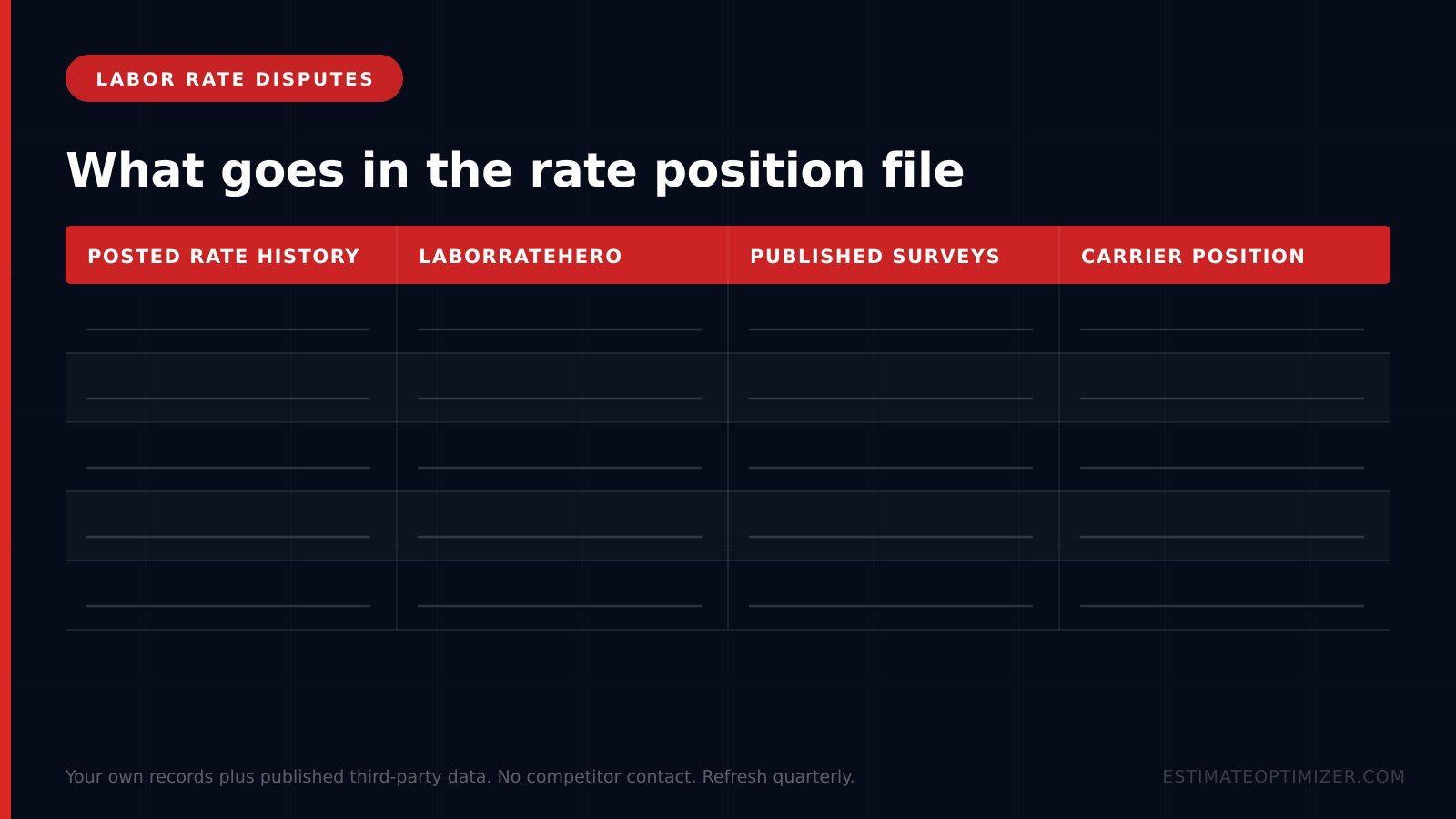
Blank four column worksheet headed posted rate history, LaborRateHero, published surveys and carrier position for building a rate file
The four columns of a standing rate position file, each one filled from your own records or published third-party data.

A rate position file has four components:

  • Your posted rate history. Your shop's documented rate over time. At minimum, the current posted rate and the date it was set. Ideally, a two-to-three year record showing consistency or documented increases tied to cost inputs.
  • Your LaborRateHero submission confirmation. A record that you have submitted your posted rate to the neutral NABR database and the date of submission. This establishes you as a participant in the documented market record, not a shop asserting a number with no reference point.
  • NABR and published survey data for your market. Your most recent LaborRateHero market query for your zip code area. NABR's published sustainable floor ($100.44 per hour as of current data). CRASH Network survey data showing the pattern of carrier rate behavior nationally. SCRS position statements where applicable. These are independently published figures, not shop assertions.
  • A summary of any written carrier position on your rate. If a carrier has ever sent you their rate in writing, that document goes in the file. Their written position sits next to your documented market data. The gap speaks for itself.

A Toyota RAV4 with rear quarter, bumper, and ADAS recalibration comes through. Thirty-two labor hours. The carrier offers a rate 15% below your posted rate. You pull your rate position file, attach the relevant pages, and request their documented basis for the rate in writing. They are now the party without documentation. That asymmetry is the point of the file.

The Bottom Line

The shops getting paid closer to their posted rates are not winning because they are louder or more persistent. They have documentation carriers have to respond to, not feelings carriers can ignore. Building your rate position file takes a few hours the first time. After that, it is a quarterly update: confirm your LaborRateHero submission is current, pull a fresh market query, and add any new carrier written positions to the record. The file protects every job that comes through after you build it.

Related Articles

Frequently Asked Questions

What is NABR LaborRateHero and how does it work for auto body shops?
NABR LaborRateHero is a neutral database where collision repair shops submit their own posted labor rates. NABR aggregates those submissions and reports market-level data by geographic area. Any shop can query the database for their zip code to see what qualified shops in their market actually post. As of November 2025, the platform reflects 8,020 shop responses with a national average of $81 per hour.
How do I document my labor rate for insurance disputes without calling other shops?
Submit your posted rate to NABR LaborRateHero at nationalautobodyresearch.com. You become part of the documented market record, and you can query that record for your area. Pair your LaborRateHero market data with published CRASH Network and SCRS survey figures and your own posted rate history. Together, these form a rate position file built from neutral third-party sources, not competitor contact.
What is a labor rate position file for an auto body shop?
A labor rate position file is a standing document that compiles: your shop's posted rate history, your LaborRateHero submission confirmation, NABR and published survey data for your market, and any written carrier position on your rate. When a carrier questions your rate, you reference the file rather than rebuilding the argument from scratch. It makes your position documented and forces the carrier to produce their own documentation.
What does NABR's Variable Rate Survey show auto body shops?
NABR's VRS filters labor rate data by shop certifications, equipment, and training rather than just geography. An OEM-certified shop can pull market comparables from shops with similar capability levels, not just shops in the same zip code. This matters because a certified shop's market is different from an uncertified shop nearby, and the VRS makes that distinction documented.
How often should I update my labor rate documentation?
Quarterly is the standard. Confirm your LaborRateHero submission is current, run a fresh market query for your area, and add any new written carrier rate positions to your file. A rate position file that is more than 12 months old can be dismissed as stale. Quarterly updates take less than an hour once the file is built.
Share this article
labor ratesshop ownerscollision repairauto bodyinsurance claimsindependent shops
Back to Blog
Follow us