The carrier quotes you a labor rate. You probably take it. And that's the problem, because the prevailing labor rate your market charges is a documented, demonstrable figure, not a number a carrier gets to pick out of the air and hand to you as a starting offer.
Most shops accept whatever the insurer puts on the estimate. Then they spend the rest of the job arguing about supplements. That argument could be avoided entirely if the rate were established proactively, in writing, before a single supplement is filed.
Why Shops Accept Rates They Shouldn't
There's a reason this keeps happening. Carriers have spent years making labor rate disputes feel like an exercise in futility. You push back, they say the rate is "prevailing" or "reasonable" for your market, and without a competing number on paper, you fold. The fight isn't worth the relationship.
But here's what SCRS documented at the November 2025 Collision Industry Conference open mic: carriers are now shifting from "prevailing competitive price" language to "reasonable rates" without providing any documentation or valid statistical basis for the change. They're not citing a survey. They're not showing their math. They're just telling you the rate is reasonable, and waiting to see if you accept it.
You probably do. Most shops do. That's the bet.
And in August 2025, CCC publicly reaffirmed that it does not conduct labor rate surveys and does not report on prevailing rates. Carriers have been representing CCC benchmark data as labor rate justification. CCC has said publicly that their data is not that. If a carrier is citing CCC to justify cutting your rate, they are citing a source that has explicitly said it is not a prevailing rate source.
What the Prevailing Labor Rate Actually Is (And Isn't)
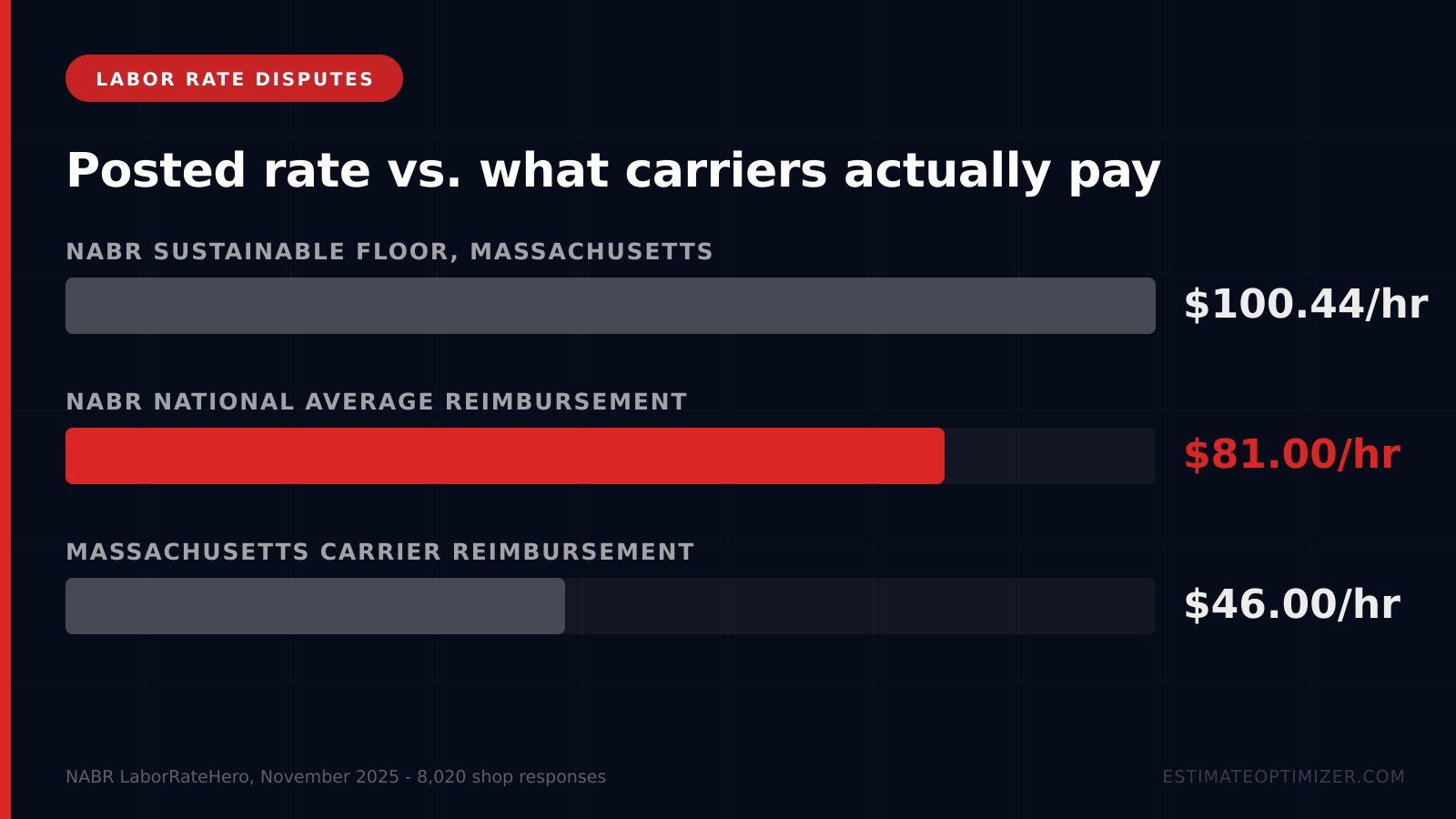
The NABR national average reimbursement rate as of November 2025, based on 8,020 shop responses, not carrier estimates.
The prevailing labor rate is what licensed, qualified repair facilities in your local market actually charge for body and refinish labor. It is not what carriers say they pay. It is not what CCC reports in its benchmark data. And it is not a single number. It is a range, filtered by shop capability, certifications, equipment investment, and location.
The National AutoBody Research (NABR) LaborRateHero platform reports a national average reimbursement rate of $81 per hour as of November 2025, based on 8,020 shop responses. That's what shops across the country actually post. And in some markets, shops are collecting far more. In others, carriers are paying far less. Massachusetts shops are being reimbursed approximately $46 per hour (a rate frozen for more than 20 years) while NABR calculates the sustainable floor at $100.44 per hour for that market.
The gap between what shops post and what carriers pay is not a mystery. It is documented. The question is whether your shop's posted rate is in the record.
How You Document Your Market Rate Before Any Dispute
What rate is your shop posting on estimates right now? Is it your actual posted rate, the number on your shop's rate sheet, the one you'd charge a customer paying out of pocket? Or is it the number the carrier told you to use?
If you can't answer that without hesitating, you're already operating at a disadvantage. The shop that documents its posted rate has a foundation to stand on. The shop that never posted one is arguing from memory.
Here's how you build the record before you ever need to use it.
Submit your posted rate to LaborRateHero. NABR's LaborRateHero is free. Every shop in the country can submit their posted labor rate, and the data becomes part of the searchable national database. When a carrier questions your rate, you can pull a 15-mile radius report showing what other qualified shops in your market charge. That's a documented third-party source. Their "reasonable rates" claim is not.
Use CRASH Network data as a reference frame. The CRASH Network Fall 2025 survey found that 1 in 4 of 300+ shops surveyed had at least one insurer paying a lower rate than it was paying in January 2025. That's not anecdotal. That's a surveyed pattern, and it's a documented baseline for what carriers are doing in the market broadly.
Use NABR's Variable Rate Survey to filter comps by your shop's certifications. The VRS filters market results by certifications, equipment investment, and I-CAR training level, so a certified shop pulls comparables that match their actual capability, not just geography. When your shop has OEM certifications and aluminum capability, an uncertified-average market number understates your position. The VRS corrects for that.
Put your posted rate on every estimate. Not what the carrier pays. Your posted rate. And the difference as a line item. When that gap is visible on every job, every carrier, every week, it stops being a negotiating position and starts being a documented pattern.
Documenting your posted rate once protects every job that comes through the door after it.
What Happens When You Have the Documentation and They Don't
A 2022 Ford F-250 Super Duty comes in with front-end collision damage. Structural repair, frame checks, OEM calibration on the collision avoidance system. The carrier comes back with a labor rate 18% below your posted rate. You ask for their documentation. They cite "local market conditions."
If you have a LaborRateHero report showing your zip code's range, CRASH Network survey data documenting what carriers are doing in the market broadly, and a posted rate on your shop's rate sheet that's been consistent for two years, you have something they don't: a paper trail. They have an assertion. You have evidence.
A Honda Odyssey with sliding door, rear quarter, and structural pillar damage goes through the same shop the following week. Same insurer, different adjuster, same rate dispute. Because the rate documentation exists and is current, the response is the same both times. Not a custom argument for every job. A standing record that applies to every job.
That's what shifts the labor rate fight from reactive to proactive. The documentation is built once and deployed every time.
Carriers aren't required to pay your posted rate on every claim in every state. But they are required to document why they don't. When you have no documentation of your market rate and they have none either, the dispute is just two people with opinions. When you have a third-party-sourced market record and they're still citing "reasonable rates" with no survey behind it, the asymmetry shifts.
Tools like Estimate Optimizer audit estimates against documented labor rate discrepancies and flag the gap between your posted rate and the carrier's offered rate as a line item, not a footnote. That makes the disparity visible in every job file, which is a different kind of leverage than a phone call ever produces.
The rate your shop accepts doesn't have to be the rate your market charges. But it will be, until you document the difference.
What is the prevailing labor rate for auto body shops?
The prevailing labor rate is what licensed, qualified collision repair facilities in your local market actually charge for body and refinish labor. It is not what carriers pay. It is what shops post. NABR's LaborRateHero reports a national average reimbursement rate of $81 per hour as of November 2025, based on 8,020 shop responses. Rates vary by market, certifications, and equipment.
How do I find out what the prevailing labor rate is in my area?
The fastest way is NABR's free LaborRateHero tool at laborratehero.com. You can search posted rates within a 15-mile radius of your zip code, filtered by shop type and certifications. Supplement that with NABR's Variable Rate Survey, which filters comparables by certification and equipment level, and with published CRASH Network survey data for national context.
Can insurance companies use CCC data to justify a labor rate cut?
CCC reaffirmed in August 2025 that it does not conduct labor rate surveys and does not report on prevailing rates. If a carrier is citing CCC data to justify cutting your shop's rate, they are citing a source that has publicly stated it is not a prevailing rate source. Request the actual survey or documentation behind their rate in writing.
How do I document my labor rate for insurance disputes?
Submit your posted rate to NABR's LaborRateHero database, pull a current market query for your zip code alongside published CRASH Network and SCRS survey data, and put your posted rate as a line item on every estimate next to what the carrier is offering. This creates a standing record built from neutral third-party sources rather than a one-time argument.
What is prevailing wage in collision repair and how does it differ from what insurance pays?
In collision repair, prevailing wage or prevailing rate refers to what qualified local shops actually charge. Insurance reimbursement is what carriers are willing to pay, which is frequently below posted market rates. NABR calculates a sustainable labor rate floor for markets like Massachusetts at $100.44 per hour while carriers in that state reimburse approximately $46 per hour, a gap that has been frozen for more than 20 years.