Back to Blog
Revenue Recovery

He Saw His Own Numbers and Said 'I'll Do It'

4 min read
Share
Shop owner in his 50s studying a stack of printed collision repair estimates at a cluttered desk with coffee cup

If your auto body shop is losing money on estimates, you already know it. What you don't know is exactly where, or exactly how much. That's the gap the audit closes.

James West was skeptical. He'd been fighting supplements on most of his jobs, running two and three rounds per repair, getting partial approvals, and wearing down his estimators in the process. He had the instinct. He didn't have the documentation to back it up.

Four estimates. Thirty minutes. $3,144 found.

He said he'd do it before the call ended.

Why Multiple Supplement Rounds Mean You're Fighting the Wrong Way

When you submit a supplement and get a partial approval, that's not a win. That's confirmation that your documentation didn't make the case on the first submission.

Adjusters work patterns. They learn what a given shop will push on and what it will drop. Over time, shops that fight from emotion rather than documentation get treated accordingly. Partial payments become the expected outcome because the shop has trained the adjuster to expect a negotiation, not a requirement.

That's not an accusation about adjuster intent. That's a description of how any repeated interaction develops a pattern. Your submission style teaches them what to expect from you.

James had that pattern. Good instincts, incomplete files. His Dodge Durango had $521 in undocumented operations. His Toyota Sienna had $553. His Chevrolet Trailblazer had roughly $1,200 sitting in undocumented scope. His Ford F-150 had $815. That's $3,144 across four estimates he thought were already reasonably complete.

Shop owner in his 50s studying a stack of printed collision repair estimates at a cluttered desk with coffee cup
Four estimates, four vehicles. The gap between what was billed and what was owed was visible in under thirty minutes.

Is Your Shop Losing Money on Estimates Because of Supplement Rounds?

Here's a useful diagnostic. Think about your last ten jobs that required a supplement. How many needed one round to close? How many needed two or three?

If most of your supplements close in one round, your documentation is doing its job. If you're routinely running two or three rounds before the job closes, the documentation isn't carrying the argument. You're negotiating, not proving.

This is the difference. A properly documented supplement presents a carrier obligation backed by OEM procedure, photo evidence, and labor data. There's no room to negotiate. Either the procedure is required by the manufacturer or it isn't. Either the documentation is present or it isn't.

Industry data from CCC shows 63% of collision repairs require a supplement after detailed inspection. The gap between original estimate and final repair cost runs $1,200 to $1,800 per job on average. That gap doesn't close by arguing harder. It closes by submitting better documentation the first time.

If you're a shop doing 30 jobs a month and running two or three supplement rounds per job, do the math on what that's costing in estimator time alone, before you count the partial approvals.
What the Live Audit Actually Shows

The audit worked on James because it used his own estimates. His vehicles. His undocumented operations. There was nothing abstract about it.

When you see $521 on a Durango you wrote yourself, you don't argue with the number. You ask how to fix it. That's the highest-trust proof format available, because the gap is impossible to dismiss when it's your own car in your own shop.

The four vehicles James brought to the audit had one thing in common: operations the shop was performing but not capturing in documentation. Not fraud. Not inflating estimates. Just work that was being done and not being billed, because the file didn't include the OEM procedures that made those operations required rather than optional.

Once the documentation is present, the carrier obligation exists before anyone can argue. The supplement isn't a request. It's a proof package.

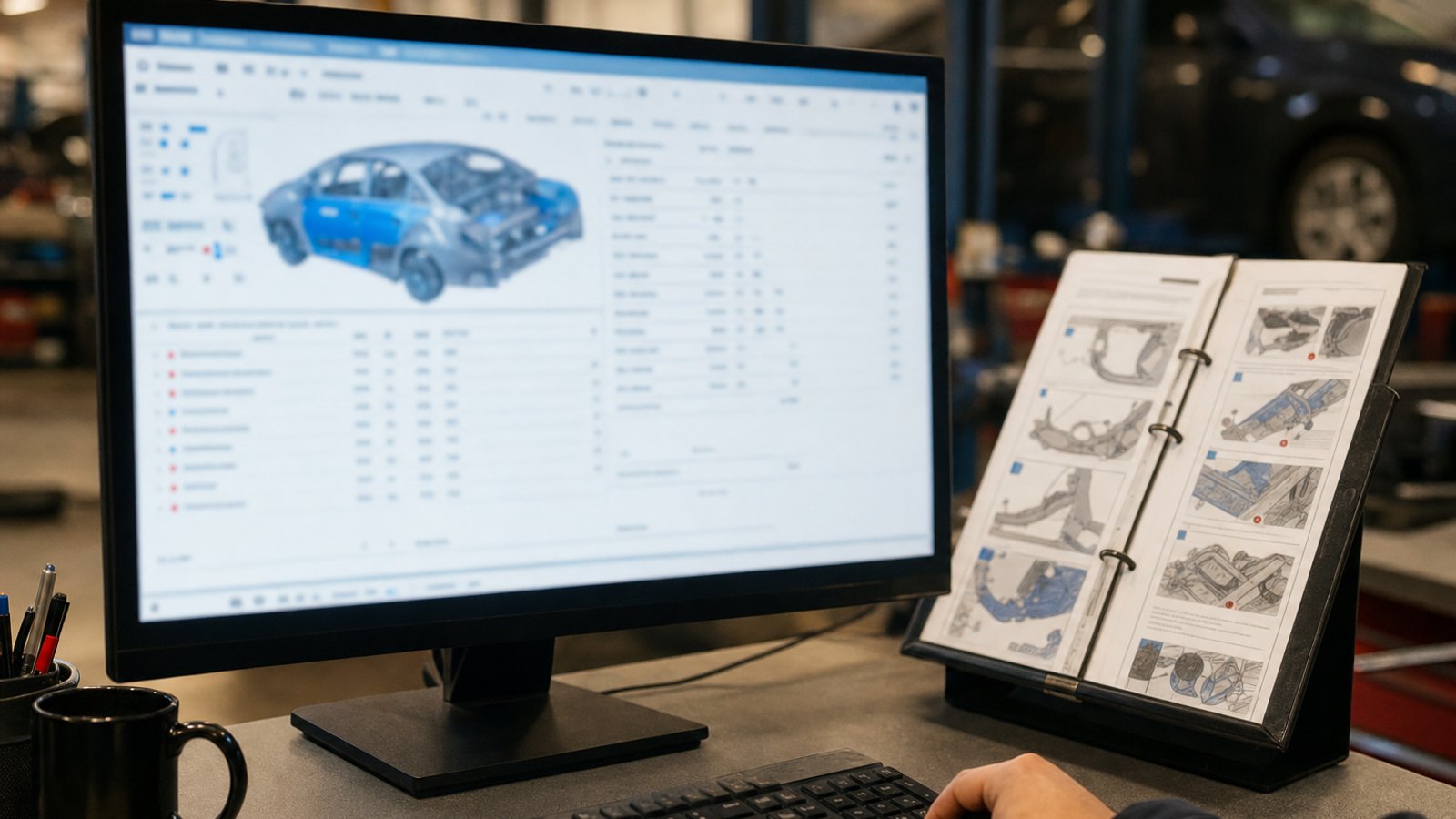
Close-up of a computer screen showing a collision repair estimate with a printed OEM procedure page open beside it
When OEM procedure documentation sits beside an estimate, undocumented operations become visible line by line.

The Bottom Line

James West is one data point. But his four estimates reflect a pattern every independent shop owner should check against their own files. Skeeter's Body Shop in Garden City, Kansas found $97,000 in documented recovery over three months, with a 99% internal approval rate. His volume went down and his bills got paid. He stopped robbing Peter to pay Paul.

The common thread isn't shop size or market or carrier mix. The common thread is that showing your own numbers, on your own estimates, changes the conversation from "I think I'm owed this" to "here's the documentation that proves it." Tools like Estimate Optimizer™ run this audit automatically, cross-referencing estimates against OEM procedures and flagging every undocumented operation before the file goes out the door.

If you're losing money on estimates, the answer isn't more supplement fights. It's better documentation on the first submission.

Related Articles

Frequently Asked Questions

How much money does a body shop typically lose on estimates?
Industry data from CCC shows the gap between original estimate and final repair cost runs $1,200 to $1,800 per job on average. When an estimate audit is run against OEM procedures, shops frequently find $500 to $1,200 in undocumented operations per estimate. Across a month of repairs, that adds up fast.
Why do I keep running multiple supplement rounds on the same job?
Multiple supplement rounds usually mean the documentation isn't making the case on first submission. When a supplement is backed by OEM procedure, photo evidence, and labor documentation, the carrier obligation is clear and there's less room for negotiation. Shops that fight from instinct without strong documentation train adjusters to expect a back-and-forth.
What does a collision repair estimate audit actually find?
An estimate audit cross-references your estimate against OEM procedures for that specific vehicle. It finds operations the shop is performing but not capturing in documentation, such as required scans, corrosion protection steps, one-time-use fasteners, and OEM-required procedures that don't appear as default line items in estimating software.
How do I know if my shop is leaving money on the table with supplements?
Count how many supplement rounds your last ten jobs required. If most close in one round, your documentation is working. If you're routinely running two or three rounds, the documentation isn't carrying the argument. A shop auditing three to five estimates typically finds $3,000 or more in undocumented operations.
Does better documentation actually change what adjusters approve?
It does, and the data backs it. Shops that submit supplements with full OEM procedure documentation, photos, and labor justification see significantly higher first-submission approval rates. The EO client benchmark currently runs over 80% approval on properly documented submissions. One Kansas shop hit 99% approval over three months.
Share this article
revenue recoverysupplementsinsurance claimsshop ownersauto bodyestimate scrubbingindependent shops
Back to Blog
Follow us