Back to Blog
Revenue Recovery

It Gives You Ammo: What Happened When This Shop Owner Saw His Own Numbers for the First Time

5 min read
Share
Quote card reading it gives you ammo from Grant, a shop owner, beside 1,150 dollars average found per estimate and 16 missed operations on a RAM 2500

Grant, a shop owner, used three words after seeing his own estimate audit: "it gives you ammo." That's not marketing language. That's a shop owner describing what changes when you stop walking into an adjuster call with frustration and start walking in with a document.

The auto body shop insurance underpayment problem isn't new to Grant. He's been in the trade long enough to know when an estimate is short. What was new was having the line-item breakdown in front of him: what was missing, why it was required, and what the carrier was already on the hook for. The argument didn't change. His position in the argument did.

What the Numbers Actually Showed
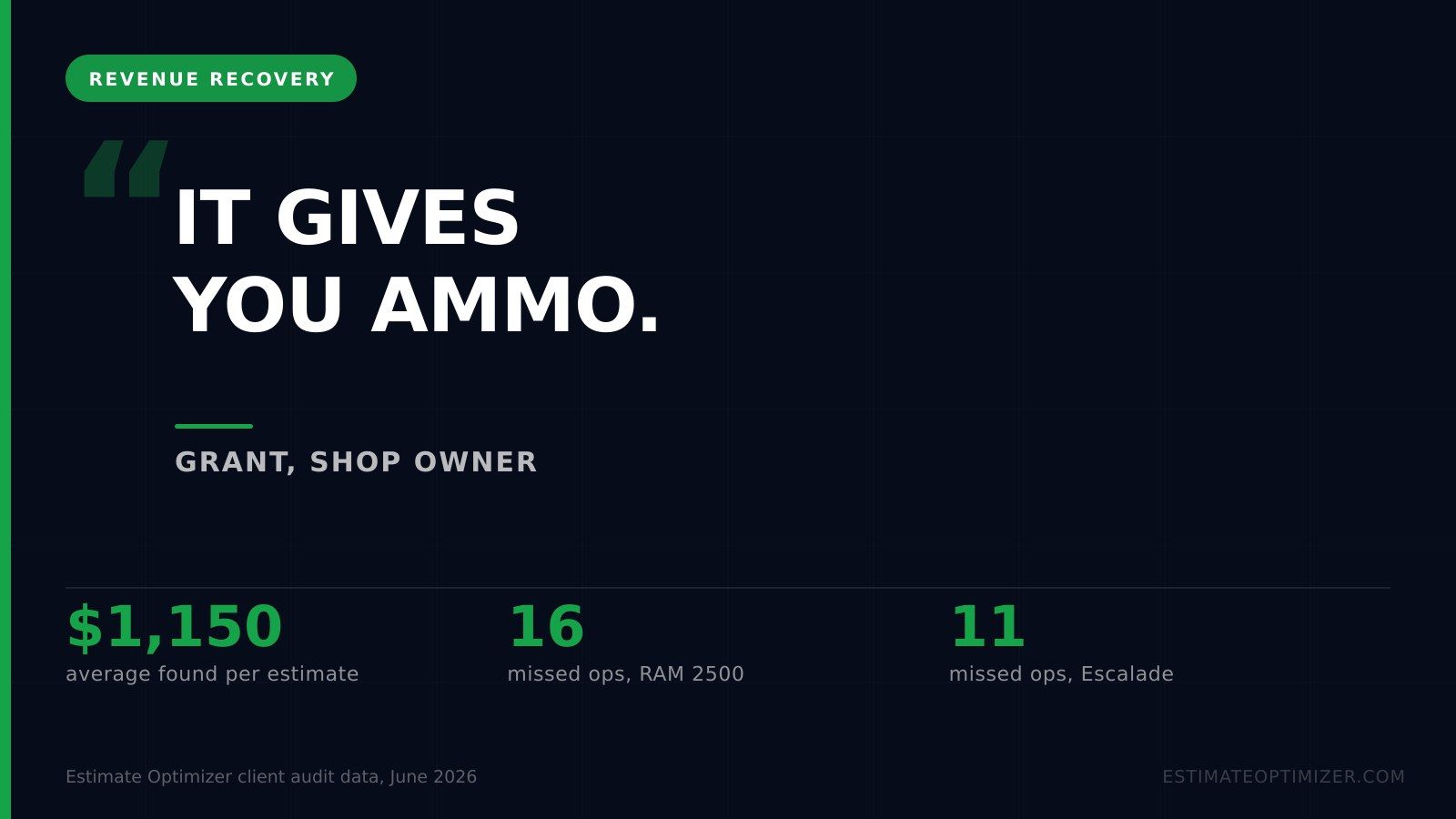
Quote card reading it gives you ammo from Grant, a shop owner, beside 1,150 dollars average found per estimate and 16 missed operations on a RAM 2500
Grant's result across his jobs: $1,150 per estimate on average, including 16 missed operations on a single RAM 2500.

Across Grant's jobs, the per-estimate average came out to $1,150 in operations that were owed but not on the estimate. That's not a lucky outlier. That's the number. And two vehicles in particular made it concrete.

A RAM 2500 came through with 16 missed operations. Not 16 line items the shop added hoping the carrier would accept, but 16 procedures that OEM documentation required for that specific vehicle and that weren't on the initial estimate at all. A Cadillac Escalade behind it had 11. These aren't obscure procedures buried in a footnote. They're work the shop did or needed to do, documented as required by the manufacturer.

When you see it laid out by line item, with the OEM reference attached to each one, the feeling of "we're probably missing money" becomes a specific dollar amount on a specific vehicle with a specific documentation trail. That's the difference between a grievance and a file.

What Does Your Shop Have in Hand When You Call the Adjuster?

Here's the diagnostic question worth sitting with: what's in your hand when you pick up the phone for an adjuster call? Knowledge or a document?

Knowledge is valuable. Twenty years of doing this work builds a sense of what's right and what's short. But knowledge doesn't hold a line item when the adjuster pushes back. A document does. CCC's own data shows 63% of collision repairs require a supplement after initial submission. That means the initial estimate is incomplete on the majority of jobs that come through your door. The question isn't whether something was missed. The question is whether what was missed is documented when the call happens.

Grant's adjuster calls changed after the audit. Not because he learned something new about the trade. He already knew the work was required. They changed because he had the breakdown in writing, by vehicle, by line item, with OEM references attached. That's a different conversation than "I think you're shorting us on this one."

The Part That Surprised Him Most

Shop owner on the phone with one hand resting on a tabbed stack of printed repair documentation at a shop counter
The shift from supplement-by-supplement fighting to a standing documentation file changes the nature of every adjuster call.

After seeing the audit, Grant didn't just adjust how he talked to adjusters on existing files. He started building his own Word document templates for labor rate challenges. He took the structure of the audit output and adapted it to his shop's workflow, a systematic record for rate disputes formatted so the documentation was consistent across jobs and adjusters.

That's a behavioral shift, not just a revenue win. He didn't need someone to tell him the rate was too low. He already knew. What he didn't have was a documentation format that made his position harder to push off. Once he saw how the audit organized the evidence, he built a version for his rate challenges himself.

That's the part most shops miss when they think about the underpayment problem. The revenue is recoverable. But the way you recover it repeatedly, job after job, without re-inventing the argument every time. That's a documentation system, not a one-time find.

Grant is not the only shop owner to react this way to his own numbers. James West had four of his estimates audited live and reached the same conclusion. Neither of them learned something new about the trade. Both of them got a document they did not have before.

The Bottom Line

Grant's $1,150 per-estimate average isn't the story. The story is what he did with it. He didn't just collect the money he was owed on those jobs. He changed how he prepares for every adjuster call that comes after. Estimate Optimizer produced the audit that showed Grant his numbers (the RAM 2500's 16 missed operations, the Escalade's 11) and the format gave him a template he could adapt to his own shop's documentation approach. That's what "ammo" actually means: a file, not a feeling.

Related Articles

Frequently Asked Questions

How much money is my auto body shop losing to insurance underpayment?
Based on EO client data as of June 2026, the average auto body shop is missing $1,100 to $1,150 per estimate in operations that are owed but not captured. This varies by vehicle complexity, OEM requirements, and how thoroughly estimates are compared against manufacturer documentation. A structured audit against OEM procedures is the only way to know your shop's specific number.
What are missed operations on an auto body estimate?
Missed operations are repair procedures required by OEM documentation for a specific vehicle that don't appear on the initial insurance estimate. They are not additions or upgrades. They are procedures the manufacturer specifies as required for that repair on that vehicle. When they're absent from the estimate, the shop either eats the cost or supplements for them later, often facing pushback.
How do I document insurance underpayment for adjuster calls?
The most effective approach is a line-item breakdown by operation, with the OEM documentation reference attached to each item. This converts a verbal argument into a file the adjuster has to respond to in writing. Carriers have to either pay the documented operations or deny them in writing, which creates the paper trail for escalation.
Why do auto body shops keep getting underpaid on estimates?
CCC data shows 63% of collision repairs require a supplement after initial submission, which means the initial estimate is incomplete on the majority of jobs. The gap isn't always intentional. Initial estimates often miss OEM-required procedures that don't appear without a detailed comparison against manufacturer documentation. The shops closing the gap are running that comparison before the estimate leaves the building, not after the carrier denies it.
How do I get insurance to pay for operations they left off my estimate?
Document each missing operation with the OEM procedure reference, the CCC or Mitchell not-included notation if applicable, and the specific vehicle year, make, and model it applies to. Submit it as a structured file, not a verbal request. When the adjuster can see the documented basis for each operation alongside the carrier's own estimating system's language, the conversation shifts from opinion to documentation.
Share this article
revenue recoveryshop ownersinsurance claimssupplementscollision repairauto bodyindependent shops
Back to Blog
Follow us