Back to Blog
Supplement Process

You Can Fight Every Supplement. Or You Can Stop Needing To.

5 min read
Share
Bar chart comparing 15 hours a week spent fighting three supplement disputes after denial against 1 hour reviewing the same three estimates before submission

Auto body shop supplement disputes with insurance don't have to be the primary activity in your back office. Some shops have made them almost irrelevant. The difference isn't a better adjuster relationship. It's which direction the work flows.

Two Shops, Same Carriers, Different Outcomes

In our work with shops across the country, a pattern shows up reliably. Two shops can be working with the same carriers, in the same region, writing estimates on the same types of vehicles. One spends several hours a week on rebuttal letters, phone calls, and supplement re-submissions. The other almost never does.

The shops spending hours on reactive supplement defense aren't worse estimators. They're working the process in the wrong sequence. They write the estimate, submit it, wait for the denial or short pay, then build the argument. By that point, the carrier has already issued a position. Reversing it costs everyone time.

The shops that rarely fight supplements aren't winning arguments. They're eliminating the argument before it starts. The OEM documentation is in the file before the estimate leaves the building. The calibration is itemized with the scan report attached. The single-use parts are called out by part number with the position statement. There's no opening offer. There's a documented claim.
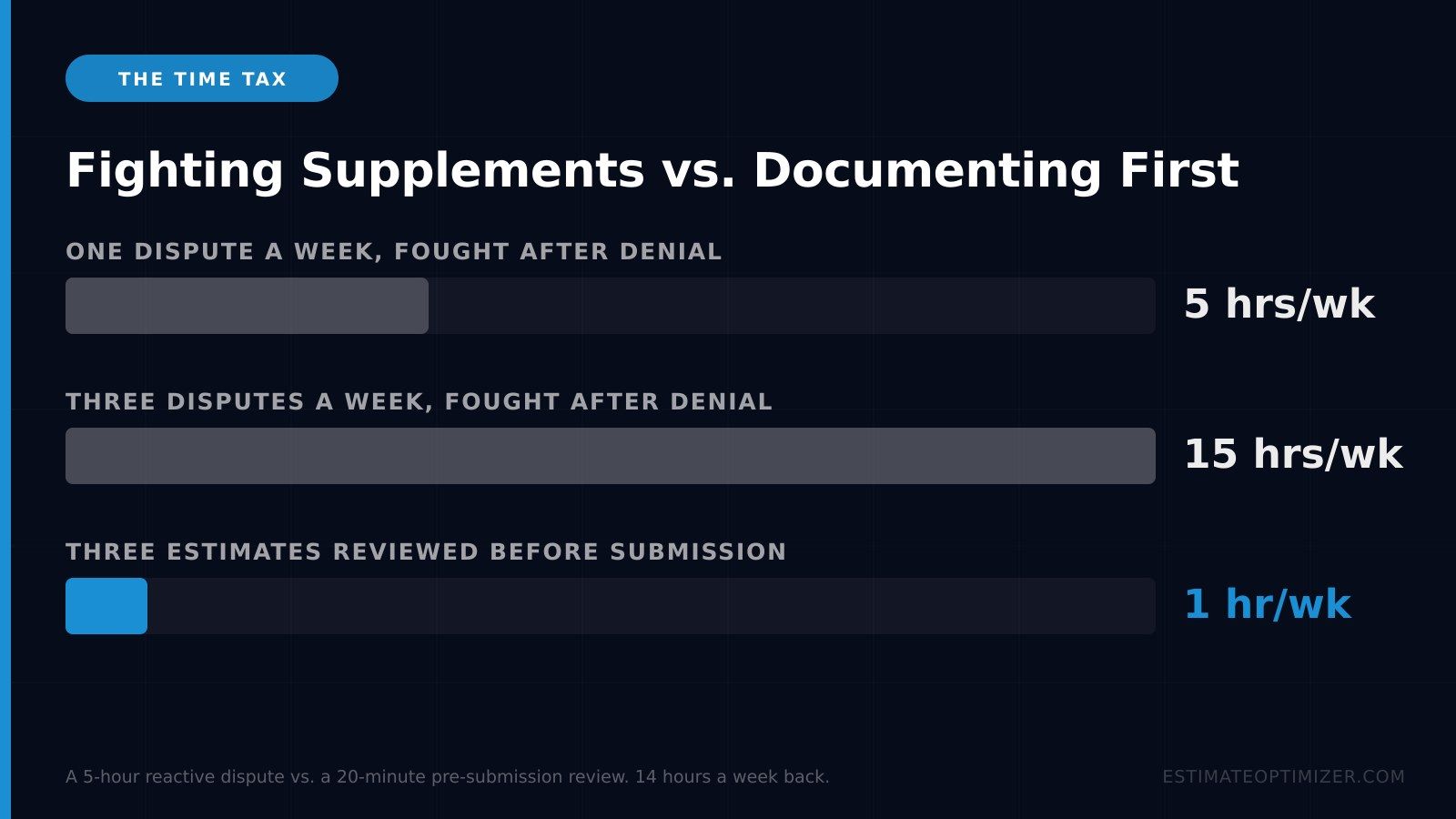
Bar chart comparing weekly hours: 5 hours for one supplement dispute fought after denial, 15 hours for three, versus 1 hour for three estimates reviewed before submission
Three disputes fought after denial cost 15 hours a week. The same three estimates reviewed before submission cost one.

What Auto Body Shop Supplement Disputes With Insurance Cost in Time

A supplement dispute that gets resolved costs, conservatively, five hours. Phone calls to the adjuster. A rebuttal letter with documentation assembled after the fact. Follow-up calls. Re-submission. Waiting for the second response. And the job in question is often something as standard as a 2022 Chevrolet Silverado with ADAS sensors on a front clip, or a 2024 Toyota Camry where the calibration requirement wasn't on the initial write-up.

A proactive review of that same estimate before submission takes 20 minutes when the process is documented and the OEM materials are already organized. The same operations get identified. The same documentation gets attached. The outcome is the same or better. The time spent is a fraction.

Do the math on your own shop. How many supplement disputes does your team handle in a week? Multiply that by five hours. Now ask: how many of those disputes started because the documentation that would have resolved the objection wasn't in the original submission?

If you're handling three supplement disputes a week, you're spending 15 hours on reactive work that a documentation-first process reduces to about an hour of proactive review. That's 14 hours a week reclaimed. That's not a small efficiency gain. That's a part-time position worth of time spent on work that proactive documentation makes unnecessary.

63% of collision repairs require a supplement, according to CCC's own data. That figure doesn't have to translate into 63% of your work generating a dispute cycle. The supplement trigger is often legitimate. The multi-round fight is not.
What Phil's 12-for-12 Record Is Telling You

Phil runs Valley Paint and Body in Amelia, Ohio. His arbitration record is 12 wins and 0 losses. His pre-trial settlement rate is 97%. That record doesn't come from being a better arguer. It comes from building the file before the dispute, not in response to it.

When a carrier sees a file where the OEM position statement is already attached, the calibration requirement is already documented, and the not-included operations are already itemized with supporting citations, the cost-benefit calculation on contesting that claim shifts. Settling before arbitration becomes the rational move. Not because the shop got lucky, but because the documentation removed the carrier's viable counter-argument before they made it.

That's offense. That's what documentation-first estimate management produces at scale. Phil's 12-for-12 record isn't a courtroom story. It's a process story. The wins were decided when the estimate was written, not when the dispute was filed.

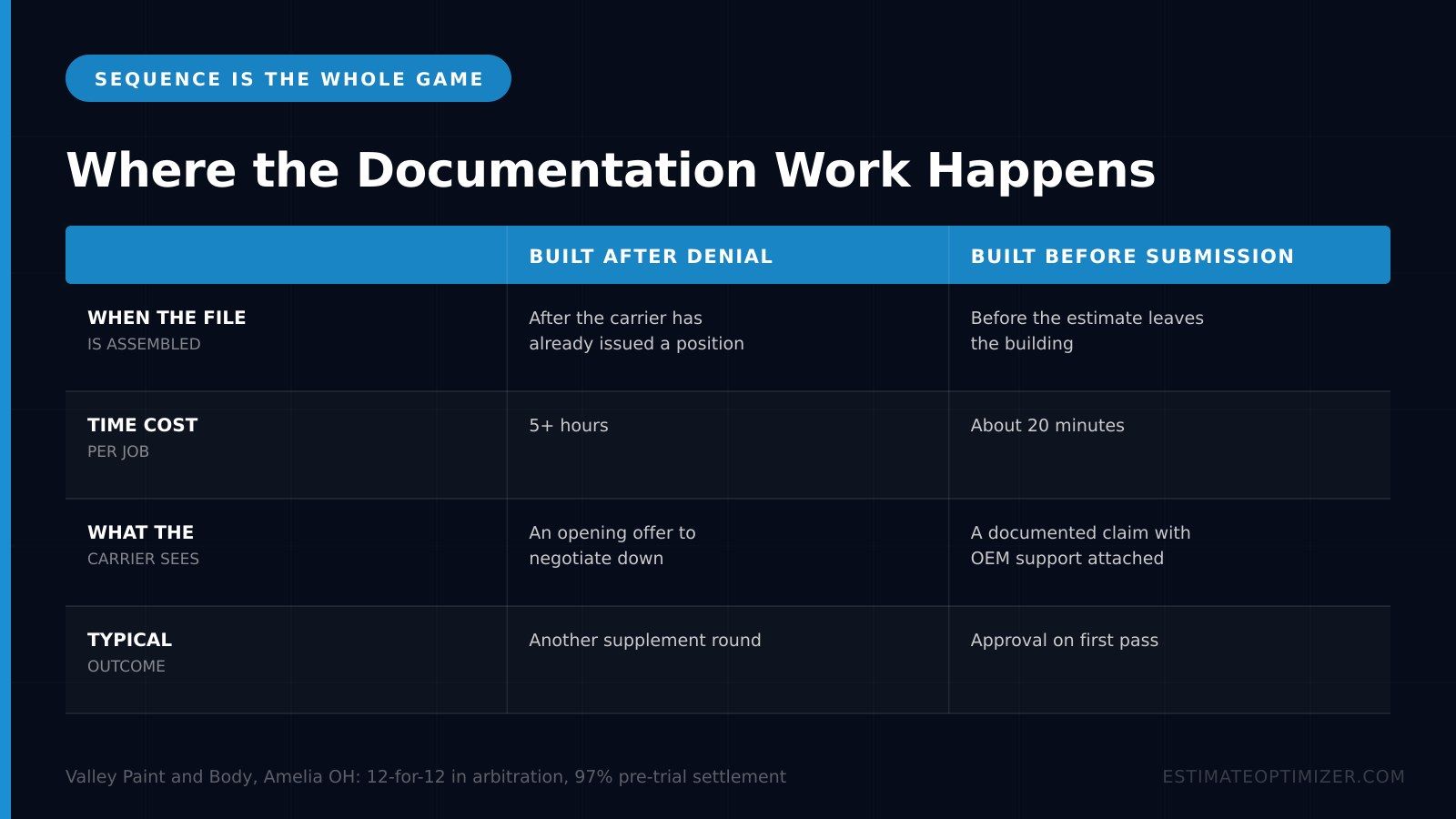
Comparison table showing when the file is assembled, time cost per job, what the carrier sees and the typical outcome, for documentation built after denial versus before submission
Documentation built before submission converts a 5-hour dispute into a first-pass approval. The sequence is the whole game.

The Bottom Line

Shops that use their estimate management process as a defensive tool, responding to denials and building arguments after the fact, are doing more work for the same result a proactive process delivers on first submission. Tools like Estimate Optimizer audit every estimate against OEM procedure databases before submission, flagging the operations that belong on the file before the carrier ever sees it. The shops in our client base that run this process consistently aren't better fighters. They stopped needing to be.

Related Articles

Frequently Asked Questions

How do I stop fighting so many supplement disputes with insurance companies?
The supplement dispute cycle shortens when the documentation that resolves the objection is in the original submission rather than assembled after the denial. That means attaching OEM documentation for calibrations, calling out single-use parts with position statements, and itemizing not-included operations before the estimate leaves the building. Most disputes start because the carrier's objection was answerable from the beginning.
Is it worth fighting every supplement denial from insurance?
Fighting every denial reactively is the most expensive version of the same outcome proactive documentation produces more efficiently. A dispute that gets resolved through a rebuttal letter costs five or more hours. The same documentation attached before first submission takes 20 minutes. The revenue recovered is the same. The time spent is not.
What does a proactive supplement process look like in an auto body shop?
A proactive process audits every estimate against OEM procedure requirements before submission. Calibrations are itemized with scan reports attached. Single-use parts are called out by OEM position statement. Not-included operations are added with supporting P-page citations. The file is complete before it reaches the carrier, not assembled in response to what the carrier denies.
Can good documentation prevent supplement disputes?
Yes. When a carrier receives a file where OEM documentation already supports every line item, the cost-benefit of contesting the claim shifts. Valley Paint and Body in Amelia, Ohio holds a 12-for-12 arbitration record with a 97% pre-trial settlement rate, built on documentation-first estimate management. The disputes don't win in arbitration because the documentation was built before the dispute, not after.
How long does it take to write a proactive supplement versus fight a reactive one?
A proactive review of an estimate before submission takes approximately 20 minutes when the OEM materials are organized and the process is documented. A reactive supplement dispute, from initial denial through rebuttal letter, follow-up calls, and re-submission, averages five or more hours. The proactive process costs less than 10% of the time while producing approvals on first submission.
Share this article
supplementsshop ownerscollision repairrevenue recoveryinsurance claimsOEM procedures
Back to Blog
Follow us