Back to Blog
Supplement Process

What the AI Checks in Your Supplement File Before a Human Adjuster Reads It

4 min read
Share
Shop owner at cluttered desk reviewing printed supplement file with teardown photos spread across the surface next to a laptop

Your supplement file hits an AI scoring system before any human reads it. We covered how the routing system works in this week's post on AI auto body claims review. The short version: documentation completeness determines whether your file clears automatically or gets held for manual reinspection. This post gets specific about what "completeness" means inside a supplement.

Adding Lines Is Not the Same as Documenting What Changed

Most supplement files look like this: the estimator opens the RO after teardown, adds the operations that weren't visible on the initial estimate, and submits. The hidden damage is real. The added lines are legitimate. And the file still gets flagged.

Here's why. A supplement is not just a list of additional operations. It's a documented explanation of what changed between the original estimate and teardown. The AI scoring system CCC launched in 2024 uses computer vision to match your submitted photos against the line items in the estimate. If the photo doesn't connect to the operation, or the operation doesn't have an OEM citation attached, the file doesn't score as complete.

On a 2022 Toyota RAV4 rear-end repair, you open the bumper and find the absorber is cracked and the mounting bracket is bent. Neither showed on the initial estimate. That's normal. The supplement adds both. But if the file doesn't include a photo of the cracked absorber labeled to match the line item, and doesn't cite the Toyota OEM procedure requiring replacement, the scoring system has no way to confirm the line is supported. It gets routed for manual review. That adds days, not hours.

Shop owner at cluttered desk reviewing printed supplement file with teardown photos spread across the surface next to a laptop
A supplement file without labeled teardown photos gives the scoring system nothing to match against the line items.

Does Your Supplement File Explain Why It Wasn't on the Original Estimate?

This is the specific question the system is designed to answer. And it's the question most shops never address in writing.

Ask yourself: how many of your supplement submissions include a written explanation of what was discovered at teardown. Not just the new line items. A documented reason why the original estimate couldn't have captured them.

Red: none of your supplements include this explanation. You add lines and submit. Denials and manual-review delays are a regular part of your supplement cycle.

Yellow: some do, when the damage is obviously hidden. You write notes when you remember. Approval rates are inconsistent depending on who built the supplement.

Green: every supplement file includes a documented teardown discovery section. Each added operation is tied to a photo, an OEM citation, and a one-sentence note explaining what was found and why it wasn't visible at initial estimate.

63% of collision repairs require a supplement, according to CCC's own published data. The shops stuck in the red zone are the ones grinding through two and three supplement rounds on jobs that should close in one.
The Three Elements the AI Needs to Score Your File as Complete

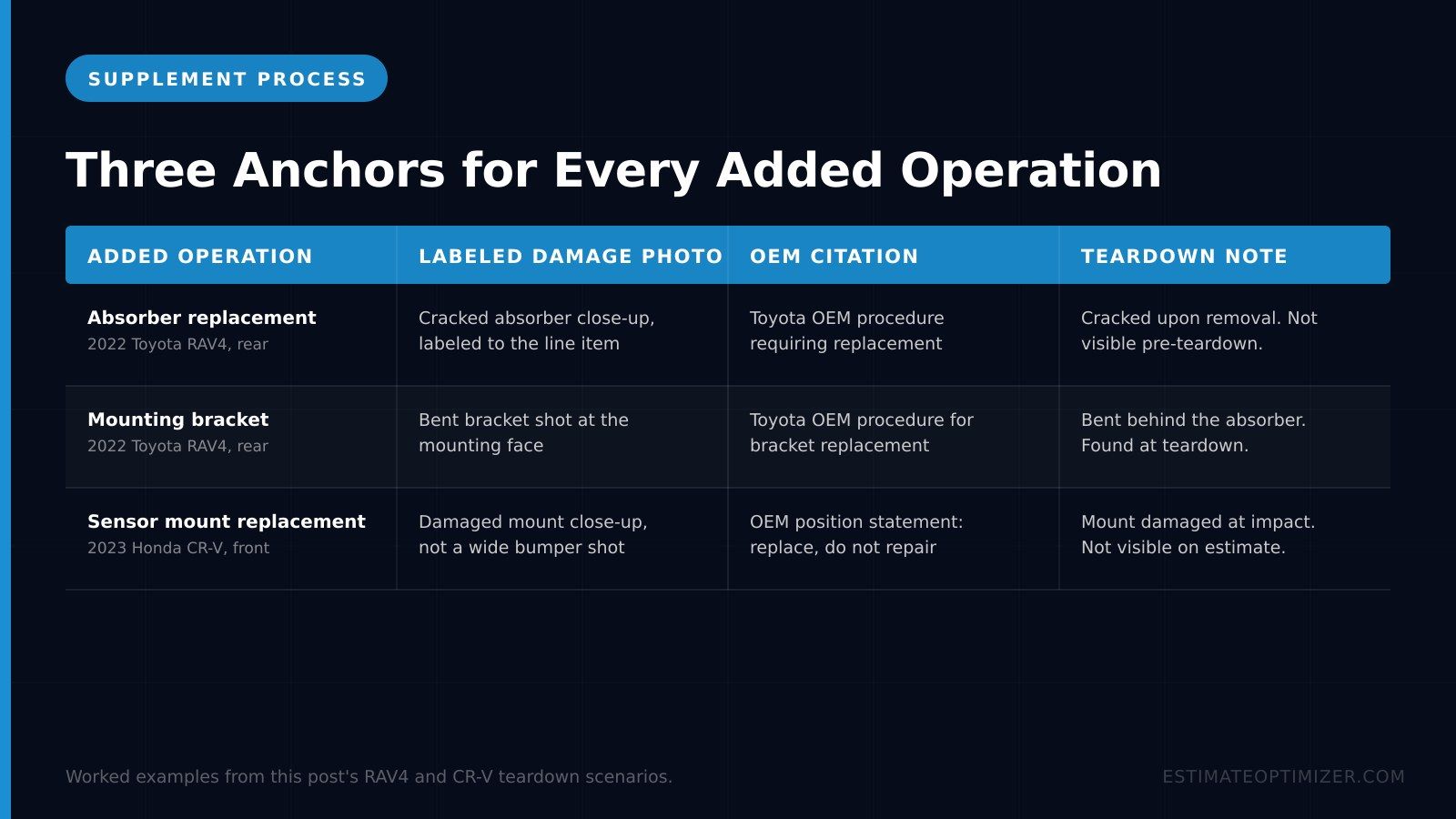
Based on how CCC Intelligent Reinspection scores files against insurer-configured rules, a supplement file that clears automated review needs three things attached to each added operation.

Photo tied to the damage description. Not a general shot of the repair bay. A photo of the specific damage: absorber, reinforcement, wiring harness, sensor mounting tab. Labeled so the system can match it to the line item. On a 2023 Honda CR-V with a front impact, if you're adding a blind spot sensor mount replacement, the photo needs to show the damaged mount. A wide-angle bumper shot doesn't do it.

OEM citation attached to the added operation. The procedure number, the position statement, or the documented OEM requirement that requires the operation. This is what converts the line item from a request to an obligation. Without it, the scoring system has no anchor for the added operation.

A line note explaining what was discovered and why it wasn't on the original estimate. One sentence. "Absorber cracked upon removal. Not visible on pre-teardown inspection." That note is what distinguishes a legitimate teardown discovery from an attempt to add unapproved operations after the fact. The system is looking for that distinction. So is the adjuster behind it.

Four-column supplement documentation table filled with worked examples: absorber and mounting bracket replacement on a 2022 Toyota RAV4 and a sensor mount replacement on a 2023 Honda CR-V, each row showing the labeled damage photo, the OEM citation, and the teardown discovery note
Each added operation in a supplement file needs three anchors: a matched photo, an OEM citation, and a teardown discovery note.

The Bottom Line

A supplement that just adds lines without explaining what changed gets flagged. Not because the damage isn't real, but because the file doesn't prove it was a legitimate teardown discovery. The AI scoring system doesn't give you credit for knowing. It gives you credit for documenting. Tools like Estimate Optimizer™ produce the teardown discovery explanation, photo labeling guidance, and OEM citations per added operation automatically, so the file scores as complete before submission, not after a denial. Get that right, and you're not fighting for approvals. You're collecting them.

Related Articles

Frequently Asked Questions

What does the AI check in my auto body supplement file?
AI claims review systems like CCC Intelligent Reinspection match your submitted photos against the line items in your estimate and check whether each added operation has an OEM citation attached. They also look for documentation explaining why the damage wasn't captured on the original estimate. Missing any of these elements routes the file to manual review.
Why does my supplement keep going to manual review instead of getting approved?
The most common reason is that the supplement adds line items without explaining what changed between the original estimate and teardown. AI scoring systems need a photo tied to each added operation, an OEM procedure citation, and a note documenting what was discovered and why it wasn't visible initially. Without all three, the file doesn't score as complete.
Do I need to explain why damage wasn't on my original estimate?
Yes. A supplement that just adds lines without a documented reason for why the damage wasn't captured initially is harder to score as a legitimate teardown discovery. One sentence per added operation stating what was found and why it wasn't visible on pre-teardown inspection is what separates a clear file from one that gets flagged.
What photos do I need to include in a supplement file?
Specific, labeled photos of the exact damage tied to each added operation. A wide-angle shot of the repair bay doesn't help. The AI system needs a photo of the cracked absorber, the bent bracket, or the damaged sensor mount, labeled to match the specific line item it supports. General documentation photos don't satisfy the matching requirement.
How do I write OEM citations in a supplement?
Reference the specific OEM procedure number, position statement, or documented requirement that applies to the added operation. For example, if you're replacing a blind spot sensor mount after a rear impact, cite the manufacturer's position statement requiring replacement rather than repair. That citation converts the line item from a request to a documented obligation the carrier is already on the hook for.
Share this article
supplementsinsurance claimsauto bodyshop ownersOEM proceduresCCC ONErevenue recovery
Back to Blog
Follow us