Back to Blog
Supplement Process

The Supplement Round That Never Should Have Happened

5 min read
Share
Shop owner reviewing a printed supplement file at a desk with a calendar and sticky notes showing multiple job follow-up dates

Every auto body shop multiple supplement round after the first is telling you something specific. Not that the carrier is unreasonable. Not that adjusters are getting worse. It's telling you what was missing from your documentation the first time the file went out the door.

The Round Count Is Your Diagnostic

One supplement per job is the target. You complete teardown, you find the real scope, you document it completely, you submit it once, and it gets approved. That's the standard.

Two rounds means something was absent from round one. Three rounds means you're discovering scope in sequence instead of all at once. And if you're averaging two or more supplement rounds per job, you have a documentation process problem, not a carrier problem.

The CRASH Network 2026 Insurer Report Card surveyed more than 1,100 collision repair shops and graded 91 insurance companies. None of the top ten largest national insurers received an overall grade higher than C+. More than 60 other carriers ranked higher. The shops doing the grading cited poor claims personnel and refusal to pay for OEM repair procedures as the biggest factors.

Here's the thing about that data: carriers with poor grades aren't going to get better grades while they're processing your supplements. If the file you submitted wasn't airtight on the first round, a poorly rated carrier is the worst possible place to find out.

Shop owner reviewing a printed supplement file at a desk with a calendar and sticky notes showing multiple job follow-up dates
Multiple supplement rounds represent time, friction, and delayed cash flow on every affected job in your pipeline.

What Multiple Supplement Rounds Are Actually Telling You

A 2023 Honda Accord with quarter panel replacement, adjacent blend panels, and a damaged blind spot sensor. First submission goes out with the structural repair documented but no OEM position statement attached on the sensor replacement. Carrier comes back on the sensor. Second submission goes out with the OEM document. Carrier approves the sensor but pushes back on the blend time. Third round.

None of those rounds were about a difficult carrier. Every one of them was about something missing from the prior submission. The OEM citation. The blend documentation. The photo sequence that shows why the adjacent panels required work. Each round was a delayed signal about what the first file didn't prove.

The "Who Pays for What?" 2026 survey found that only 25% of shops billing for destructive weld testing are getting paid for it, down 37% from two years prior. The share of shops reporting insurers "never" pay for weld testing rose from 32% to 44% in the same period. That's not a payment trend. That's a documentation trend. Weld testing that can't be proven with photos and a documented procedure is a supplement waiting to be denied.

On a Ford F-150 cab corner replacement with structural weld-through sealer and corrosion protection, four to six distinct documented operations need to be in the first file or you're going back. Most shops know they performed the work. Not all of them documented it before the car left.

Here's the self-diagnostic: look at your last ten jobs with a second or third supplement round and ask what was added in round two that wasn't in round one. Write that down. That list is your documentation gap. It's not randomized. It's the same categories, on different cars, every time.
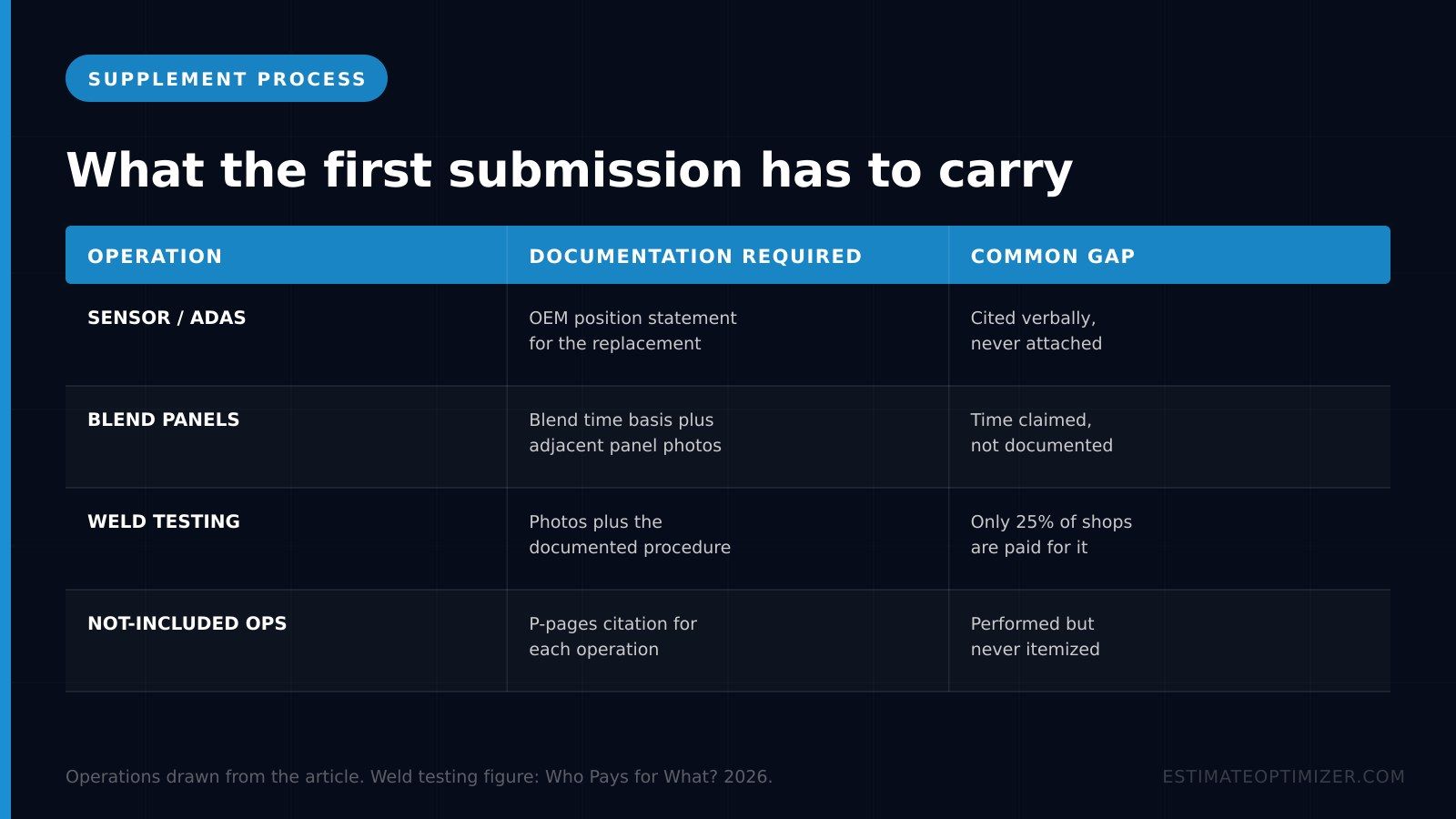
What Changes When the First File Is Complete

Phil at Valley Paint and Body in Amelia, Ohio has a 12-for-12 arbitration record. Ninety-seven percent pre-trial settlement rate. He's not winning those on the strength of his arguments. He's winning because by the time a dispute reaches that stage, his file has already made the counter-argument impossible. Every OEM procedure, every photo, every operation documented before the car moved out of teardown.

The carriers graded lowest in the 2026 Insurer Report Card didn't get those grades because the shops grading them were building complete files. They got those grades because incomplete documentation gave the carrier room to operate.

Table listing four operations, the documentation each requires on first submission, and the common gap that triggers a second supplement round
A complete first-submission file closes the room the carrier needs to push back on a second round.

This week we covered how carriers changed the language around what they owe you, and how the platforms encode the wrong number before you even start. The supplement round is where both of those problems show up on your receivables. When your documentation is complete on first submission, the language game doesn't matter and the platform gap is documented and disputed rather than accepted quietly.

The Bottom Line

The shops running one supplement round per job aren't luckier or working with friendlier carriers. They built a documentation standard that removes the second round before it starts. The teardown is thorough. The OEM procedures are attached. The photos tell the story before the adjuster asks a question.

Estimate Optimizer audits estimate files against this documentation standard before submission, flagging the missing OEM citations and undocumented operations that typically generate the second round. The goal is the same one Phil's file achieves: make the truth undeniable before anyone can argue. One round. Full scope. Approved.

Related Articles

Frequently Asked Questions

How many supplement rounds is normal for a collision repair job?
One is the target. A complete teardown with full documentation should capture all necessary scope in a single supplement submission. Two or more rounds typically indicate something was missing from the prior submission, whether an OEM procedure citation, a photo sequence, or a documented operation. Shops consistently running two or more rounds per job have a documentation process gap, not a carrier problem.
Why does insurance keep making me do multiple supplement rounds?
Each supplement round is triggered by something missing or undocumented in the prior submission. If the carrier asks for an OEM procedure citation and you send it in round two, round two was caused by the missing citation in round one. Tracking what gets added in each subsequent round shows the specific documentation categories your shop's process doesn't capture on first submission.
How do I get my supplement approved on the first submission?
Complete teardown before submitting, attach OEM procedure citations for every operation that might draw a question, include a photo sequence that shows damage scope, and document all not-included operations from the P-pages before the file leaves your shop. The CRASH Network 2026 Insurer Report Card confirmed the shops with the best carrier relationships are those that pay for OEM repair procedures and have more experienced claims personnel. Complete documentation is what that relationship runs on.
What do insurance companies look for when reviewing a supplement?
Carriers review supplements for documented evidence that the work is required, that the operation is not included in standard labor times, and that the procedure follows OEM requirements for the specific vehicle. Operations without photo evidence, OEM citations, or documented procedure steps are the most common targets for denial or reduction. The 2026 "Who Pays for What?" survey found weld testing payments dropped 37% over two years, largely tracking documentation quality.
Does the number of supplement rounds affect how much my shop gets paid?
Yes, in two ways. First, delayed approval on any supplement round delays payment on the affected operations for the duration of that round. Second, shops that routinely require multiple rounds tend to have lower first-submission approval rates, which means more staff time spent on follow-up per job. Each round that could have been the first round represents both direct revenue delay and indirect labor cost.
Share this article
supplementsinsurance claimsshop ownerscollision repairrevenue recoveryOEM proceduresindependent shops
Back to Blog
Follow us