I was in the back office at 9:40 on a Thursday night, CCC open on one monitor, a stack of ROs on the desk that needed blueprinting before Monday, and my wife had texted an hour earlier asking if I was coming home for dinner. I didn't answer the text. I was doing math instead. Car count was up over the same month last year. Revenue was up too. And when I pulled my own paycheck, the number hadn't moved. Not down. Flat. Flat while everything around it was supposedly growing.
That's the moment I started asking the question this whole piece is built around: if the shop is busier and the top line is bigger, where did the money go. Not in a bitter way. In a real, show-me-the-ledger way.
If you own a shop, you already know the feeling I'm describing. You're the last one in the building most nights. You're the estimator of last resort on every structural hit, every comeback, every "the adjuster wants a word with you personally" call. Your techs are productive. Your bays are full. Your front counter person can barely keep the schedule straight because there's that much work coming through the door. And your own pay, the thing you actually take home after the shop eats its bills, looks almost exactly like it did three years ago.
Busiest person in the room. Worst-paid person in the room. That's not a complaint. That's a diagnosis.
Here's the trap. Gross sales is the number everyone, including you, watches first. It's on the monthly report. It's what you tell your accountant when he asks how the year's going. And it climbs because you're writing more ROs, your average ticket's a little higher, you added a tech, whatever. Gross sales climbing feels like proof the shop is healthy.
But gross sales isn't cash in your pocket. It's a number that includes parts you fronted and haven't been reimbursed for yet, labor you paid out before the supplement that covers it ever got approved, and comebacks that ate three hours of unbillable time last week. Gross sales looks healthy. Cash flow says otherwise. And the gap between those two numbers is where a shop owner's actual paycheck lives or dies.
I used to think I had a pricing problem. Or a staffing problem. Or, on the worst nights, a me problem, like I wasn't running the business tight enough. What I had was a documentation problem wearing a disguise. And once I saw it, I couldn't stop seeing it.
The Category Problem Nobody Names
Here's the thing almost nobody in this industry says out loud, and it changed how I look at every estimate I write.
Collision repair is a documentation business pretending to be a repair business. We think of ourselves as people who fix cars. And we are. But the carrier doesn't pay you for fixing the car. The carrier pays you for what you can prove you did, in language their system recognizes as owed. Two completely different jobs living inside one piece of paper.
I call the gap between those two jobs Receipt Writer's Syndrome, and here's the plain version of it: your shop is producing a receipt and getting paid receipt rates, when the actual work performed, the OEM procedure, the labor operation it triggers, the documentation trail it requires, qualifies for an approved, citation-backed record. Same piece of paper. Two different documents. To you, the estimate is a record of what you did. To the carrier, it's a contract proposal they're going to counter at the lowest number they think you'll accept.
You're losing a negotiation you didn't know you were in.
And this is not a competence problem. I want to be careful here because it's easy to hear this and think it means shops are sloppy or estimators are bad at their jobs. That's not it. Most of the estimators I know are sharp, trade-literate people who've been fighting this exact fight for fifteen or twenty years. The problem is structural. The system was built so that proving the work is a separate skill from doing the work, and nobody taught us the first one. We learned the trade. Nobody handed us the proof.
One Set of Eyes Isn't Enough
For years I checked my own work the only way I knew how. I wrote the estimate, I looked it over once more before I sent it, and I trusted my own trained eye because it had never let me down in any way I could see. That's one source verifying one source. Me, checking me.
One estimator checking his own estimate is one source verifying one source.
The carrier doesn't work that way. Their system cross-checks your estimate against labor-time databases, against internal approval thresholds, against whatever the adjuster was told last quarter about what gets flagged for review. That's not one source. That's a stack of them, built by people whose job depends on finding reasons to pay less, not more.
So the fight was never really about who negotiates better. It's about how many independent authorities are checking the paper before it goes out the door. One estimator against three systems isn't a fight you win on instinct alone, no matter how good that instinct is. You need something checking your own estimate against the OEM procedure, the labor-time standard, and the documentation trail, all three, before the carrier ever sees it. Not instead of your judgment. Alongside it.
The Question That Matters
So here's the question I'd ask you to sit with for a second, because I think it's the only honest starting point.
Is your gut right that you're leaking profit somewhere in this process, or are you imagining it?
Most owners I talk to already know the answer in their body before they say it out loud. They've felt it on the drive home. They've felt it reading a year-end P&L where labor sales didn't move even after a rate increase. They've felt it the fourth time in a month an adjuster kicked back a supplement for a missing citation they didn't even know they needed. The gut is rarely wrong here. What's usually missing isn't the instinct. It's proof fast enough to act on before the moment passes.
That's the real cost of this whole category problem. Not that you don't know something's wrong. It's that knowing isn't enough. You can be completely right about where the money went and still lose the argument because you couldn't produce the citation in the time the adjuster gave you.
What This Cost Me, Specifically
I'm not going to pretend I figured this out from a textbook. I figured it out by running my own shop's estimates through a process built to catch exactly this gap, and watching the number climb.
Over about six months, running this process against real repair orders that had already gone through my own shop, it found close to four hundred thousand dollars in documented, owed work that either never got submitted or got submitted wrong and quietly written off. Four hundred thousand dollars. Not hypothetical. Not "could have." Already earned, sitting on paper we'd already produced, never collected because nobody caught the gap in time.
And I want to be honest about what that number did to me when I first saw it add up. It wasn't relief. It was something closer to anger. This was after years as a good estimator, and the money wasn't gone because I was bad at my job. It was gone because I was checking my own work against one source, my own trained eye, when the carrier was checking it against a completely different set of rules I'd never been handed.
A shop owner out in Garden City, Kansas, Skeeter, ran his estimates through the same kind of process. At Skeeter's, that's 157 estimates audited and $138,992.52 in potential additional repair dollars identified (as of Nov 22, 2026), with a ninety-nine percent first-submission approval rate on what came back.
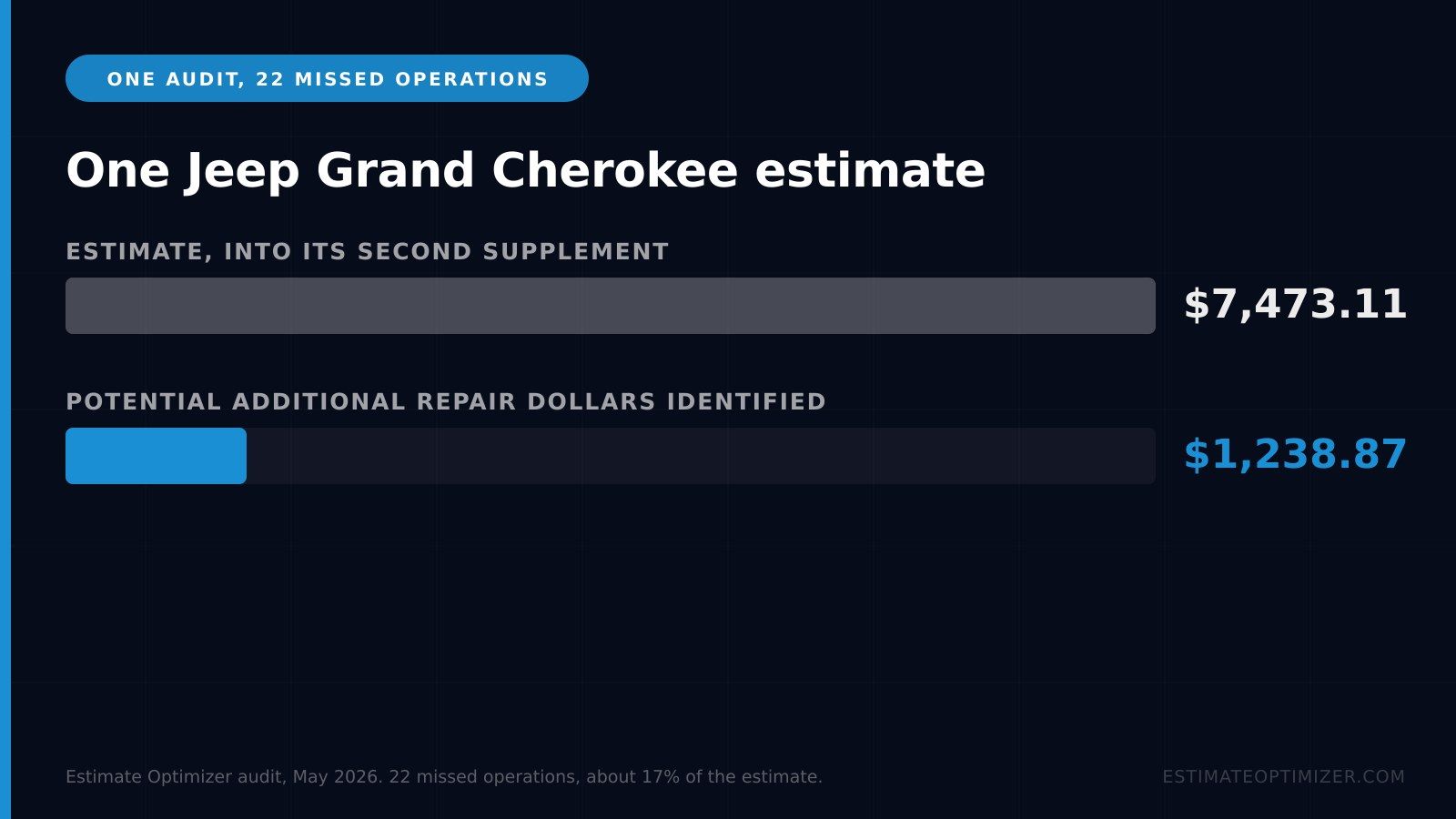
One audit of a Jeep Grand Cherokee identified 22 missed operations, $1,238.87 in potential additional repair dollars, on a $7,473.11 estimate. About seventeen percent, on an estimate already into its second supplement.
One Jeep Grand Cherokee audit: 22 missed operations, $1,238.87 in potential additional repair dollars identified on a $7,473.11 estimate.
That's not luck. That's the gap between a receipt and a record, measured on real repair orders.
Do the Math on Your Own Shop Before You Do Anything Else
Before you read another word of this, I want you to do one thing. Pull last month's RO count. Here's a rule of thumb, not a promise: if you're running forty estimates a month and even a conservative five hundred dollars a car is sitting uncaught in missed operations, that's twenty thousand dollars a month. Not a year. A month. Run your own number. Yours may be higher, because I picked a small one on purpose. Across the 324 estimates we've audited, the average is about $961 per estimate in potential additional repair dollars identified (as of Nov 22, 2026).
Now sit with that number next to the one on your own paycheck. That's the actual cost of staying on your current plan, whatever that plan is right now: eating the loss outright, hoping the next rate increase quietly covers the gap, hiring a supplement specialist who burns out in eight months because the volume never lets up no matter how good they are, working the relationship with an adjuster right up until he gets transferred to a new territory and you're starting over with a stranger. None of those are wrong to try. I tried most of them myself. None of them close the gap, because the gap was never a relationship problem or a staffing problem. It's a proof problem.
The Plan, Not a Freebie Bolted Onto the End
So here's where I landed, and it's the only reason I'm telling you any of this.
The process I built to catch the gap on my own shop's estimates is the same one we turned into Estimate Optimizer. What it produces for you is called a Loss Recovery Audit, and it's not a platform you install, not another course or a binder added to the stack you already have. You send three to five of your own recent estimates, the ones already sitting in your system, and the audit shows you exactly what's documented, owed, and missing a citation, with the OEM procedure and labor operation attached so you can see it and use it right away. No install. No workflow change. You see your own money, on your own paper, before you decide anything.
Every estimate is a legal document. Most shops are writing them like receipts. The audit doesn't ask you to trust a pitch. It shows you what your own last few estimates are actually worth and lets you decide from there.
This isn't a trick to beat the carrier at their own game. We're not trying to game the carrier. We're trying to make the truth hard to argue with. That's the whole premise. Nothing cleverer than that.
The Work Is the Accountability
Here's the part I keep coming back to, on the nights when it's 9:40 and I'm the only one still in the building.
You didn't get into this trade to become a documentation specialist. You got into it because you were good with your hands and you liked fixing things that were broken and you didn't want a boss standing over you telling you how to do it. Twenty years later you are the boss, the estimator, the HR department, and the person arguing with an insurance company at seven at night over a scan charge they don't think they should have to pay.
None of that makes you bad at this. It makes you exactly the kind of operator who built something real enough that it's worth protecting. The work is the accountability. You already did it. The only question left is whether you can prove it fast enough for it to matter, before the moment passes and the carrier's number becomes the only number anybody remembers.
Your gut was probably right all along. Go find out for sure.
Gross sales and cash flow are two different numbers. Gross sales climbs as you write more ROs, but it includes parts you fronted and haven't been reimbursed for, labor paid out before a supplement was approved, and unbillable comeback time. The owner's take-home lives in the gap between the two, and documented work that never makes it onto the estimate with a citation widens that gap.
What is Receipt Writer's Syndrome?
It's JD Greenhalgh's name for a shop writing its estimate like a receipt, a record of what was done, when the work performed (the OEM procedure, the labor operation it triggers and the documentation trail it requires) qualifies for an approved, citation-backed record. To the carrier, the estimate is a contract proposal it will counter at the lowest number it thinks the shop will accept.
How much could missed operations cost a collision shop each month?
As a rule of thumb, not a promise: a shop writing forty estimates a month with five hundred dollars a car left uncaught in missed operations is looking at twenty thousand dollars a month. Across the 324 estimates Estimate Optimizer has audited, the average is about $961 per estimate in potential additional repair dollars identified (as of Nov 22, 2026). Your own number depends on your own estimates.
How much can one estimate audit find on a single repair?
One audit of a Jeep Grand Cherokee identified 22 missed operations, $1,238.87 in potential additional repair dollars, on a $7,473.11 estimate that was already into its second supplement. That's about seventeen percent.
What is a Loss Recovery Audit?
It's Estimate Optimizer's audit of three to five of your own recent estimates. It shows what's documented, owed and missing a citation, with the OEM procedure and labor operation attached. There's nothing to install and no workflow change, so you see what your own estimates are worth before you decide anything.