Back to Blog
Revenue Recovery

Decades of Experience. The Money Didn't Show Up Until the Documentation Did.

5 min read
Share
A collision estimator photographing the rear door and quarter panel of a masked silver SUV with a tablet in a refinish prep area, documenting the blend.

How much do body shops lose to insurance scrubbing when the estimators writing the files have been doing this for years? At Skeeter's Body Shop in Garden City, Kansas, the answer had nothing to do with how well the team reads a car. It came down to what was attached to each line when the estimate left the building.

How Much Do Body Shops Lose to Insurance Scrubbing With Veterans on the File?

Skeeter runs a 25-person independent shop with zero DRP contracts. His estimators are experienced people who have been writing estimates for years. None of that kept the scrub off his files.

As of Oct 31, 2026, Skeeter's Body Shop has had 146 estimates audited, with $133,445 in potential additional repair dollars identified. Each estimate is counted once, using its latest audit. That money wasn't hiding in damage the estimators failed to see. Think of the calls a veteran gets right every week: the frame rail pull on a lifted Ford F-150, the adjacent panel blend on a Toyota Highlander. The calls are right. What goes missing is the proof attached to them.

Years in the trade tell an estimator when a bumper absorber is cracked and when a seam sealer line has to go back on after a weld. They have never been able to tell a scrubbing algorithm that the call is correct. The software doesn't weigh tenure. It weighs what's sitting in the file when the estimate leaves the building.

RepairLogic puts the average missed single-use part at $31 a repair order. Supplements are routine after teardown. Neither of those facts asks how long the estimator has been in the trade. Both come down to what was attached to the line before anyone on the carrier side looked at it.

Zoom out past one shop and the same pattern shows up. Across all 288 estimates EO has audited, the average works out to about $989 in potential additional repair dollars identified per estimate (as of Oct 24, 2026).
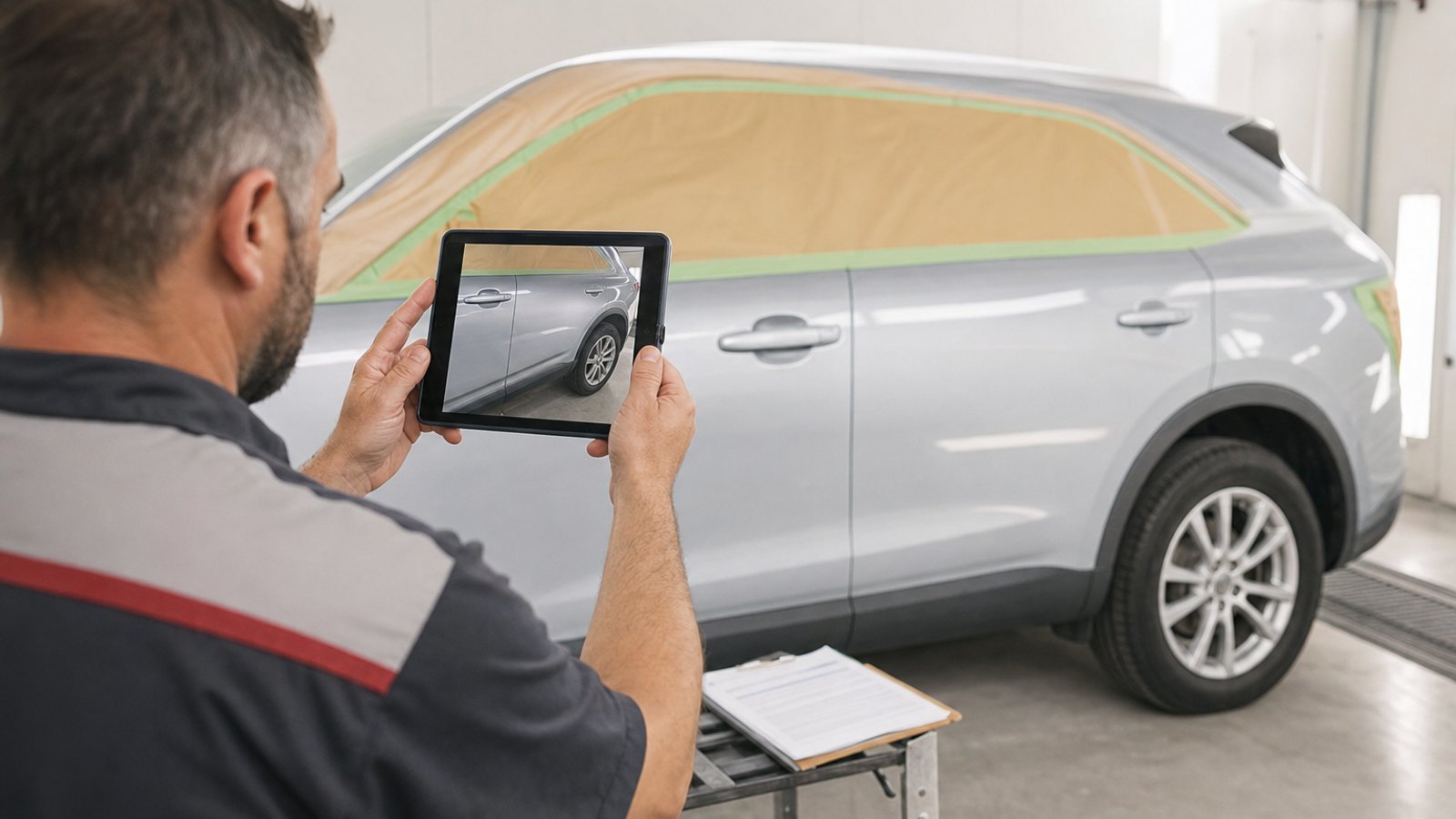
A collision estimator photographing the rear door and quarter panel of a masked silver SUV with a tablet in a refinish prep area, documenting the blend.
The photo of the panel transition goes in the file every time, not only when the adjuster has pushed back before.

Is Documentation a Habit in Your Shop, or an Event?

Before the audits, Skeeter's shop was hitting about 20% on documentation compliance. Not because the estimators didn't know better, but because researching OEM position statements for every vehicle on every repair order takes hours a file, and a busy shop doesn't have those hours.

Most shops that run a documentation audit find a stack of estimates with real money sitting in them that nobody caught. The question is what happens next. If the shop treats the audit as a one-time event, the old way of writing estimates comes right back with the next car in the door. If the shop treats it as a new way of writing every estimate, the proof keeps showing up on every new file.

Here's the self-check. Pull ten estimates your shop wrote the first month after any documentation push, then ten from month three. Count the lines that carry an OEM citation, a photo, and a line note. Did the share hold, or did it slide back once the easy wins were found? A slide means the habit didn't stick and somebody went back to trusting the estimator's reputation instead of building the proof packet every time. A steady share means the documentation became routine instead of an event.
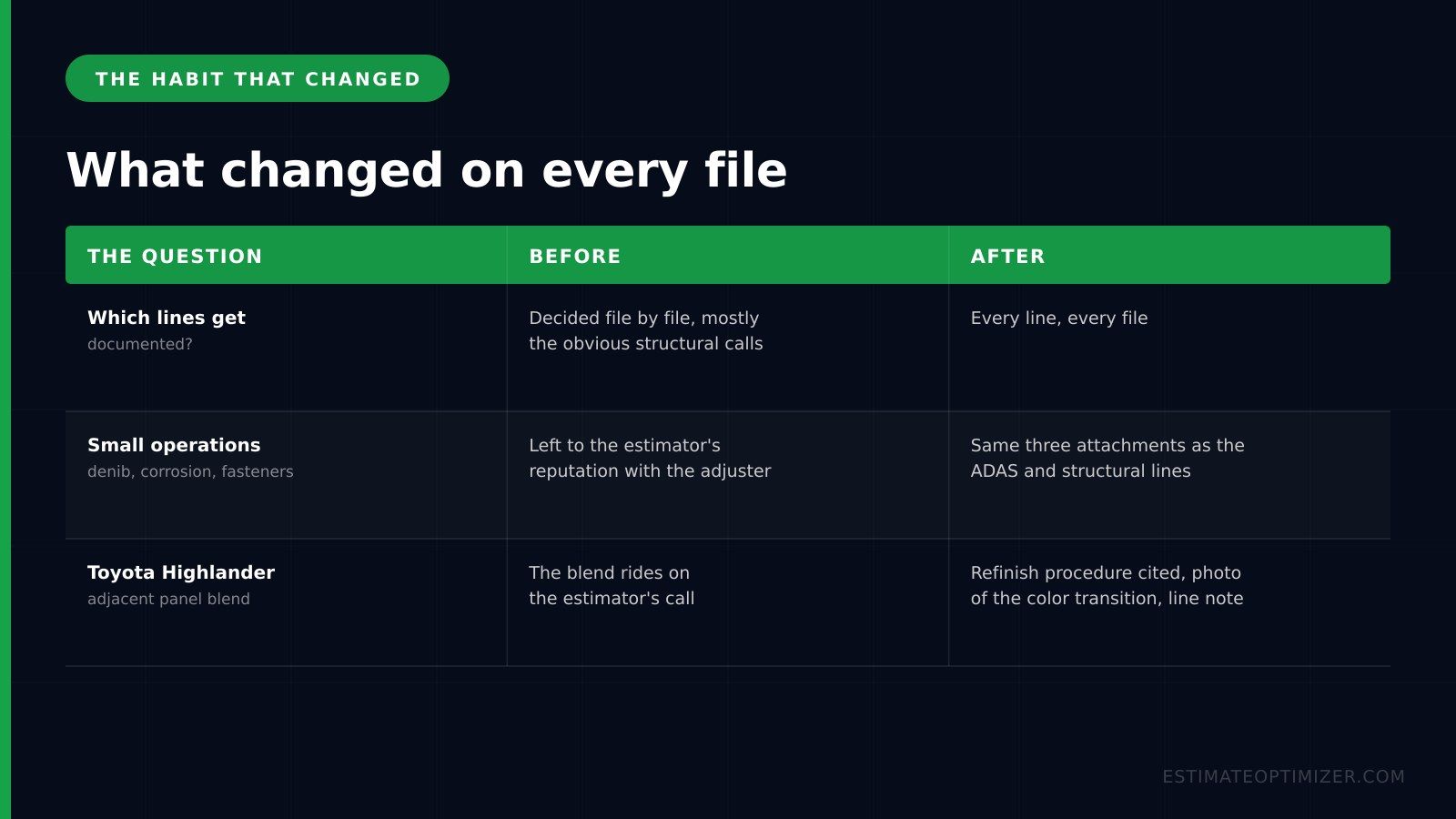
What Changed About Every File

The estimators didn't need a crash course in OEM procedures. They already knew the cars. What changed is they stopped deciding, file by file, which lines were worth the extra documentation and which ones could ride on reputation with an adjuster they'd dealt with for a decade.

Every line now gets the same three things attached before it leaves the shop: the OEM citation, a photo, and a line note explaining why the operation applies to this specific repair. Not only the ADAS calibration or the obvious structural call. The denib, the corrosion protection, the single-use fastener too. On a Toyota Highlander blend, that means the refinish procedure citation goes on the adjacent panel line, with a photo of the color transition, every single time, whether or not this week's adjuster has ever pushed back on it before.

Tools like Estimate Optimizer™ pull the citation and attach it automatically, so the habit doesn't depend on the estimator remembering to do it on a Friday afternoon with six cars still in the queue and an adjuster on hold.

Table of what changed on every file: which lines get documented, small operations like denib and corrosion protection, and a Toyota Highlander blend, before and after.
Before, the documentation was decided file by file. After, every line carries the citation, the photo, and the line note.

Years of reading a car never stopped being valuable. They stopped being the thing that got the carrier to pay.

The Bottom Line

Experience built Skeeter's shop. It didn't build the number. His estimators were right about the F-150 and the Highlander the same way they'd have been right five years ago. The difference is that 146 estimates audited and $133,445 in potential additional repair dollars identified (as of Oct 31, 2026) now have the paperwork behind them, file by file, every time, not only the times somebody remembered to attach it.

Related Articles

Frequently Asked Questions

How much do body shops lose to insurance scrubbing?
Across 288 estimates audited by Estimate Optimizer, the average works out to about $989 in potential additional repair dollars identified per estimate, with 4,441 missed operations and $284,849.24 identified in total (as of Oct 24, 2026). That gap shows up regardless of how experienced the estimator writing the file is. It closes with documentation, not tenure.
Does estimator experience reduce insurance scrubbing on an estimate?
Not by itself. Estimating software defaults apply the same not-included rules to every file whether the estimator has two years or twenty in the trade. What changes the outcome is whether an OEM citation, a photo, and a line note are attached to the line before it's submitted.
What did Skeeter's Body Shop change about its estimates?
Skeeter's estimators started attaching the same OEM citation, photo, and line note to every line on every file, not just the ones they expected an adjuster to question. That consistency, not a change in their trade knowledge, is the habit behind the shop's audit results.
How much has Estimate Optimizer identified for Skeeter's Body Shop?
As of Oct 31, 2026, Skeeter's Body Shop in Garden City, Kansas has had 146 estimates audited, with $133,445 in potential additional repair dollars identified. Each estimate is counted once, using its latest audit.
Can a veteran estimator alone fix insurance scrubbing losses?
No. A veteran estimator's trade knowledge tells the shop what the car needs, but insurance scrubbing software removes or reduces lines based on what's documented, not on who wrote the estimate. The number moves when documentation becomes consistent across every file, not when a more experienced estimator takes over.
Share this article
revenue recoveryestimate scrubbinginsurance claimsOEM proceduresshop ownerscollision repair
Back to Blog
Follow us