Back to Blog
Revenue Recovery

Shop Owners Don't Believe a $50K Projection. They Believe What Shows Up in Their Own Estimate.

4 min read
Share
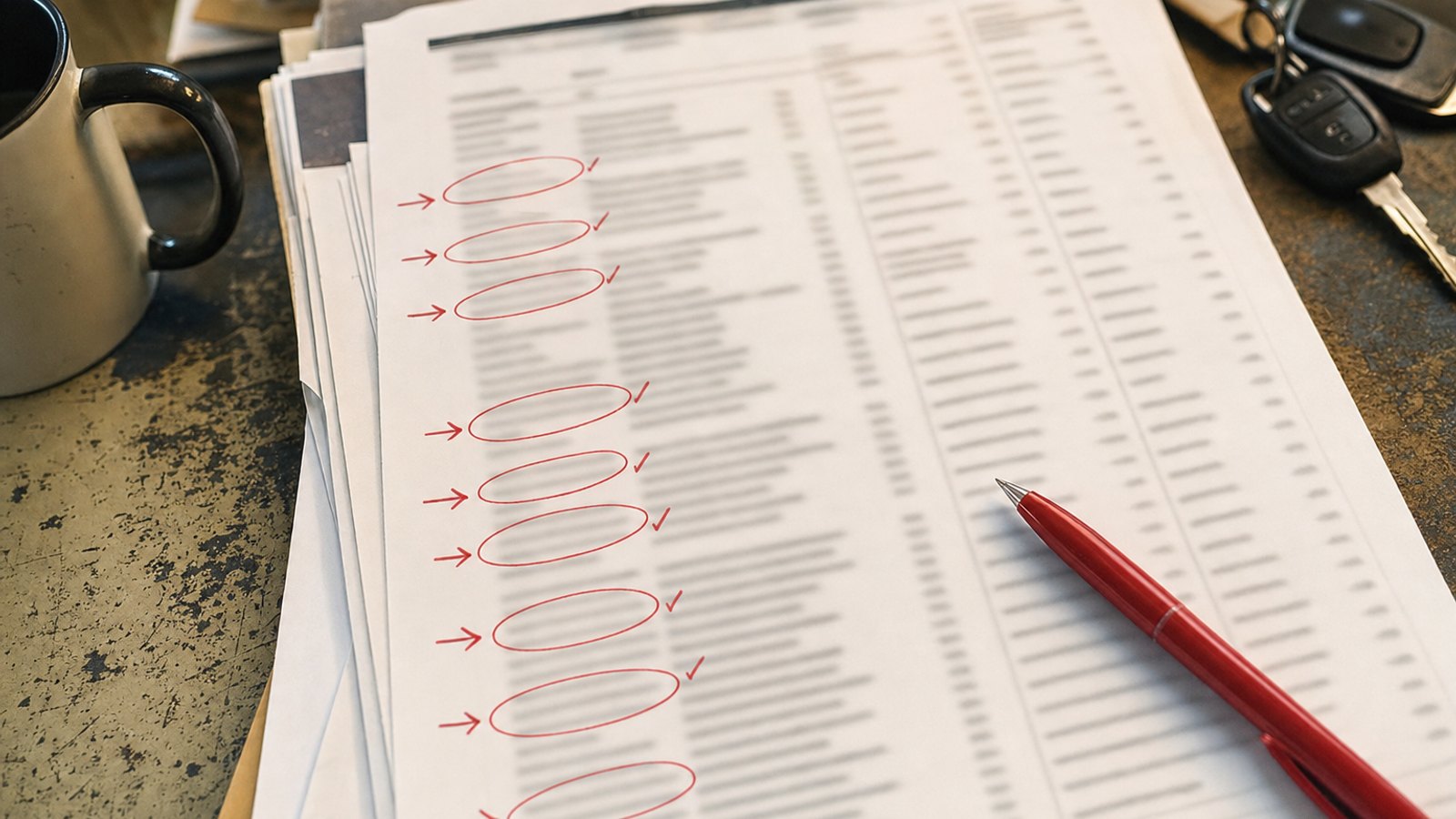
A printed collision repair estimate on a shop desk with several line items circled in red pen and marked with arrows and check marks, a red pen resting on the page.

Show a shop owner a $50,000 projection and he says the same thing every time. "Let me think about it." Run a free collision repair estimate audit on one of his own estimates instead, and that sentence stops coming up.

There's a reason for that. An abstract number sits in your head as a claim someone else is making. A number with your RO number stamped on it sits in your head as a fact about your own shop.

Why a $50,000 Projection Never Closes Anything

A projection is industry math. Average missed operations per estimate, multiplied by your estimate volume, equals a big round figure that sounds great on a call and means nothing by Tuesday. Shop owners have heard big round figures before. Every piece of software, every consultant, every "proven system" showed up with one, and most of them never produced a single dollar that landed in the bank.

So the instinct to stall is correct, not stubborn. A shop owner who's spent twenty years fighting adjusters isn't being difficult when he says "let me think about it" to a $50,000 number. He's being smart. He's heard "you're leaving six figures on the table" from people who never looked at a single one of his files, and he's paid for that mistake before.

And the math doesn't change that. The gap is real. The number is still the wrong thing to lead with, because it was never built from his estimates in the first place.

Take a shop running mostly Ford F-250s and Silverados through structural work. Run an industry average for what shops leave on every job against that owner's volume, and the math lands somewhere near fifty grand a year. It might even be close. Doesn't move him an inch. His trucks aren't in that number. Trucks in general are, and he knows the difference.

What a Free Collision Repair Estimate Audit Shows That a Projection Can't

Here's the test. Pull the last estimate you closed, the one still sitting in your system right now. Don't guess at a percentage. Picture someone circling the specific lines that should have been there and weren't, with the OEM citation attached to each one.

That's the whole gap between a projection and a free collision repair estimate audit. One is a stranger's average. The other is your file, with your RO number, your vehicle, your missed lines, circled in front of you.

Where does your shop sit right now? If the only revenue numbers you've ever seen tied to documentation are industry averages someone handed you on a call, that's red territory. You're trusting math you can't check. If you've watched someone mark up one of your own closed estimates, line by line, with a citation behind every mark, that's green territory. You're not trusting anymore. You're looking at it.

Across the 311 estimates we've audited, $304,324.39 in potential additional repair dollars has been identified, about $979 per estimate (as of Nov 7, 2026). On a handful of your own files, that lands around $3,000 to $5,000. Smaller than $50,000. Shop owners believe it more, because it isn't a forecast. It's an itemized list from their own file.
A printed collision repair estimate on a shop desk with several line items circled in red pen and marked with arrows and check marks, a red pen resting on the page.
A circled line on your own estimate reads as proof. A projection on a slide reads as a pitch.

The Only Number That Moves a Shop Owner Is the One Circled On His Own File

The audit itself is simple on purpose. Three to five of your own estimates, reviewed against OEM procedures and labor data, with every missed operation flagged and cited. No projection math. No "based on shops like yours." Your Silverado, your Camry, your own lines, with the obligation language attached to each one.

That's the difference between knowing you're owed money and proving it. Every shop owner already knows, somewhere, that he's not capturing everything he's entitled to. Knowing isn't what gets a decision made. Seeing the specific dollar figure, tied to a specific line, on a file he submitted himself, is what gets a decision made. The projection asks for trust. The audit asks for nothing. It shows you the file and lets the file argue for itself.

Tools like Estimate Optimizer™ run that exact audit automatically, scanning your real estimates against OEM procedure requirements and flagging the missed lines with the citation already attached, so the number you see is your number, not an average.

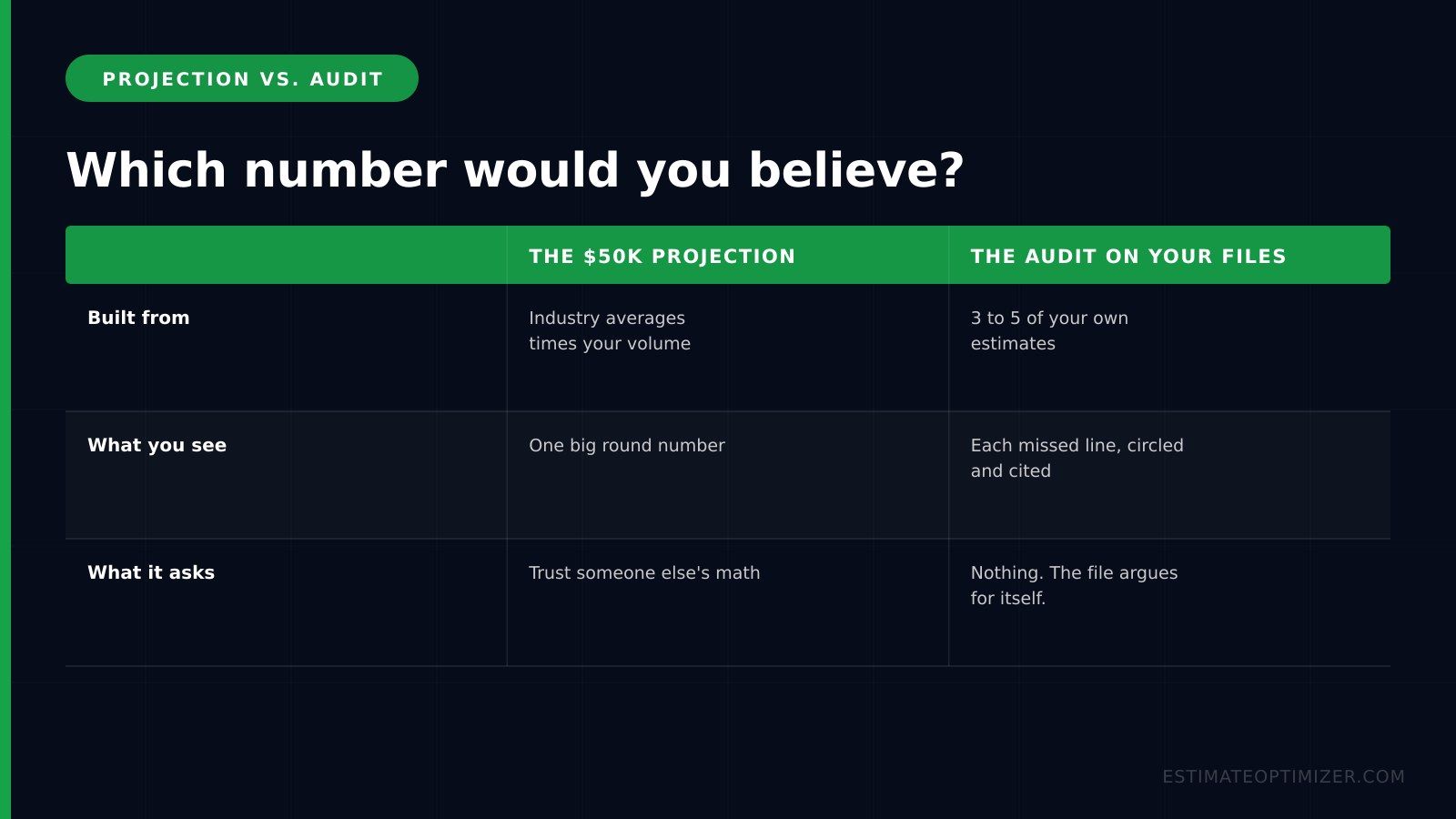
Comparison table titled Which number would you believe: the $50K projection is built from industry averages times your volume, shows one big round number and asks you to trust someone else's math, while the audit on your files uses 3 to 5 of your own estimates, shows each missed line circled and cited, and asks nothing.
A projection asks you to trust the math. An audit on your own files shows you the lines.

The Bottom Line

A $50,000 projection asks you to trust somebody else's math about shops like yours. A free collision repair estimate audit shows you the dollar figure sitting inside your own estimate, cited and circled, with nothing left to take on faith.

Stop weighing the projection. Pull the estimate.

Related Articles

Frequently Asked Questions

What is a free collision repair estimate audit?
A free collision repair estimate audit reviews three to five of your own closed or open estimates against OEM procedures and labor data, flagging the missed operations it finds with the dollar amount and citation attached. It's not a projection built from industry averages. It's a review of your actual files.
How much money does a free estimate audit usually find?
Across the 311 estimates Estimate Optimizer has audited, $304,324.39 in potential additional repair dollars has been identified, about $979 per estimate, as of Nov 7, 2026. On a handful of your own files, that typically lands around $3,000 to $5,000. It's smaller than the industry-wide projections some tools lead with, but it's tied to specific lines on estimates you submitted.
Does a free collision repair estimate audit cost anything?
No. The audit itself carries no cost and no obligation. You provide a handful of your own estimates, the review flags what's missing with OEM citations attached, and you decide afterward whether the documentation gap is worth fixing going forward.
What estimates do I need to provide for a free audit?
Three to five of your own recent estimates work best, ideally a mix of vehicle types and repair complexity. The review is only as useful as the files behind it, so real estimates from your own shop matter more than a sample set.
Why would I trust an estimate audit over an industry recovery projection?
A projection is built from someone else's averages applied to your volume. An audit shows the specific lines missing from a file you submitted yourself. One asks you to trust the math. The other shows you the proof.
Share this article
revenue recoveryinsurance claimsestimate scrubbingshop ownerscollision repairauto bodyindependent shops
Back to Blog
Follow us