Back to Blog
Revenue Recovery

The Carrier Approved It. Then Tried to Take It Back.

4 min read
Share
Table card: line items approved in writing, disputed after approval before the check cleared, and restored within days using the dated approval next to the OEM citation for each item

Scott, a shop owner in New York, found $2,483 in missed operations across four estimates during a routine audit of his files. That part was the easy win. Then the harder number showed up: a five-figure amount in line items the carrier had already approved, and then tried to walk back before the check cleared. Insurance clawback of approved line items is the quiet version of underpayment nobody warns you about, because it doesn't look like a denial. It looks like a reversal.

When an Insurance Clawback Hits Already-Approved Line Items

The $2,483 came first, four estimates, four sets of missed operations an estimator had left off because the system default didn't flag them. That audit is the kind of discovery most shops expect: operations nobody caught, found and billed. It's the second number that caught Scott off guard.

Across those same four estimates, two vehicles carried the bulk of the disputed amount: a Honda Pilot with front radar calibration tied to a bumper replacement, and a Ford F-150 with structural panel work and corrosion protection. Both sets of operations were approved in writing during the claims process, specific line items, specific dollar amounts, documented in the file before the repair even finished.

Then, before either check cleared, the carrier came back. Citing "further review," the adjuster reduced the payment on operations that had already been acknowledged, items the file showed in writing as approved weeks earlier. That's five figures that had already cleared one round of scrutiny and was being disputed a second time, after the fact, with no new information on the table.

This is the part most shops never see coming, because it doesn't arrive as a denial letter. It arrives as a quieter number on the check, a line item missing from the payment that should have matched the written approval sitting in the file.
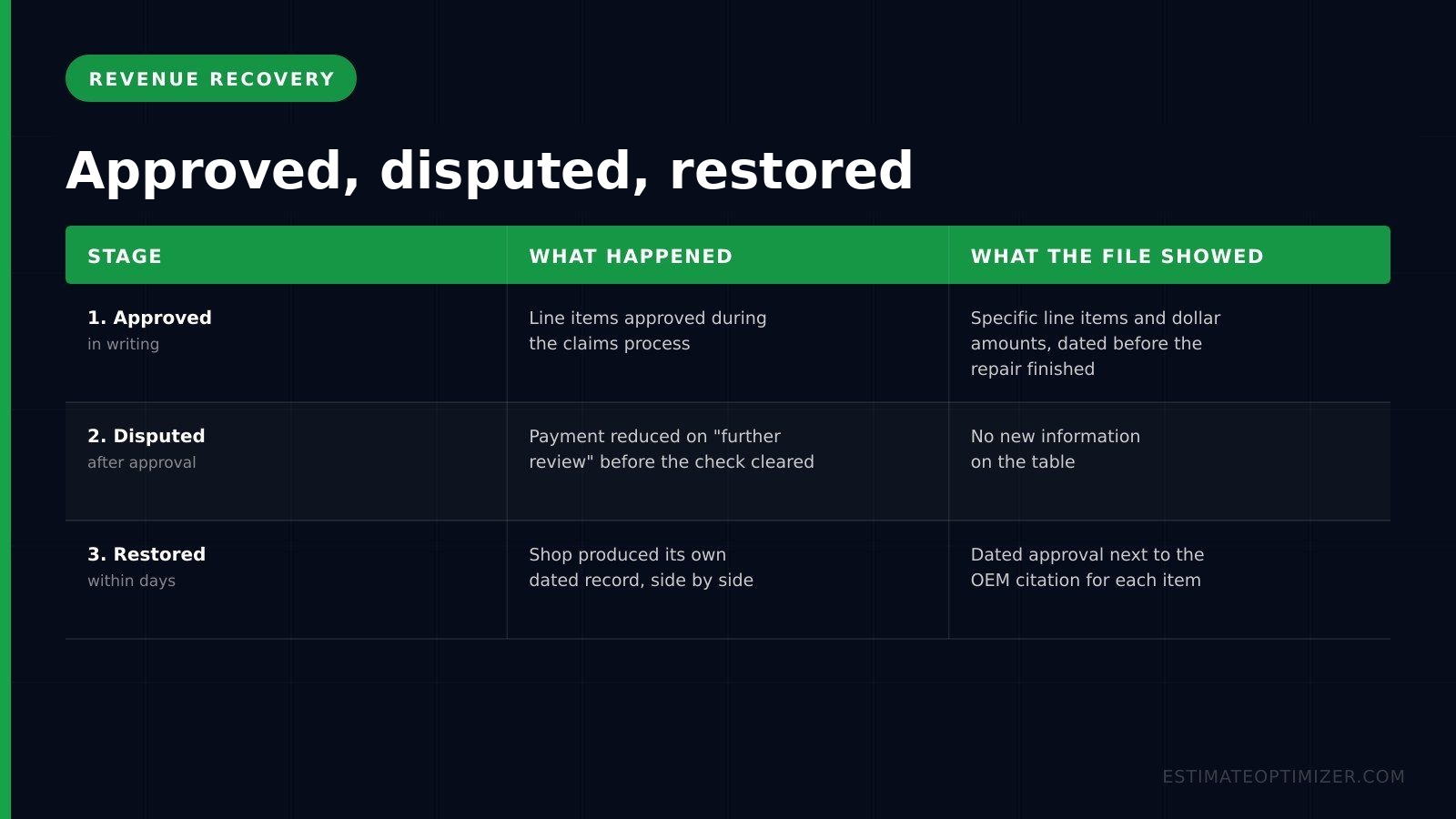
Table card: line items approved in writing, disputed after approval before the check cleared, and restored within days using the dated approval next to the OEM citation for each item
Approved once does not always mean paid once.

Where Your Approved-But-Unpaid Risk Sits

Here's the scoreboard. Pull your last ten approved estimates. For each one, check whether you have a dated, written approval attached to the repair order itself, not a verbal okay a tech remembers getting over the phone three weeks ago. Eight or more out of ten with a dated written record puts you in green territory. Three or fewer puts you in red, and red is exactly where a file sits exposed if a carrier revisits it after the fact.

Scott's four estimates had something most shops don't bother keeping: a dated written approval, tied to the specific OEM citation, saved at the moment the adjuster signed off, not reconstructed after the dispute started. That record is what turned a second dispute into a five-minute conversation instead of a five-figure loss. Without it, Scott would have been arguing his memory of a phone call against a carrier's updated position, and that argument almost never goes the shop's way.

How Scott's File Held Up When the Carrier Came Back

The fix isn't remembering that an adjuster approved something. It's capturing it the moment it happens, in writing, tied to the line item and the OEM procedure that justified it in the first place.

When an adjuster approves a calibration, a structural operation, or a refinish line, save that approval the same day: dated, with the specific dollar amount and the OEM source attached to the repair order. Don't rely on the adjuster's notes in their own claims system. Keep your own copy, in your own file, where you control it.

When the carrier came back on Scott's file, his team didn't argue from memory. They produced the dated approval next to the OEM citation for each disputed item, side by side, and the carrier restored the payment within days. The file did the arguing, not the phone call.

Every Estimate Optimizer™ audit ties each recommended operation to its OEM procedure and a copy-and-paste line note, so the documentation an adjuster approves is already in your file before anyone needs to defend it a second time.

Shop owner at a small office desk comparing a printed email approval next to a repair order with a highlighted OEM citation
The file argued the case. Nobody had to remember anything.

The Bottom Line

An approval isn't the finish line. It's a claim that has to survive a second look, and most shops don't build a file that can survive one. Scott's money came back because the paper trail existed before the dispute did. If your approved estimates only live in an adjuster's notes and your memory, you're carrying the same exposure Scott almost absorbed. Fix that before the next file gets reopened, not after.

Related Articles

Frequently Asked Questions

What is an insurance clawback in auto body repair?
An insurance clawback happens when a carrier disputes or reduces payment on repair line items it already approved in writing, sometimes weeks after the original approval. It is different from a standard denial because the carrier already acknowledged the operation before trying to walk it back.
Can an insurance company take back money it already approved for a repair?
Yes, carriers can revisit approved line items during a later review and reduce or dispute the payment before the check clears. The best defense is a dated, written approval tied to the OEM procedure that justified the operation in the first place.
How do I prove an adjuster already approved a repair line item?
Save the adjuster's written approval the same day it happens, dated, with the specific dollar amount and the OEM citation attached directly to the repair order. Don't rely on notes in the carrier's claims system since you don't control that record.
What happened when this shop had a five-figure amount disputed after approval?
A carrier reduced payment on line items for calibration and structural work it had already approved in writing on four estimates. Because the shop had dated written approvals tied to OEM citations, the carrier restored the full amount within days.
How often do insurance companies dispute already-approved auto body line items?
No published industry-wide study tracks this specific practice, so there's no reliable frequency number to cite. What's documented is the fix: shops with a dated, written approval tied to each line item resolve these disputes quickly, while shops relying on memory or a verbal okay carry ongoing exposure every time a file gets a second look.
Share this article
revenue recoveryinsurance claimsADAS calibrationstructural repairshop ownersauto body
Back to Blog
Follow us