Back to Blog
Estimate Scrubbing

What 'Seven Minutes' Means for Your Estimate

5 min read
Share
Dark quote card with the seven-minute adjuster window quote attributed to a Tennessee shop owner, beside stats for the claim window and AI cycle times

Steve, a shop owner in Tennessee, said something on an industry call that reframes the whole supplement conversation: "Most adjusters have seven minutes to look at a car and get an estimate written through AI." Seven minutes. That's what your file is competing against.

In this week's Monday post on collision repair estimate line notes documentation, we covered why estimator skill isn't what gets you paid. The approval lives in the line notes. This post goes a level deeper: what does the line note look like when it clears in those seven minutes, and what does the one that gets parked for manual review look like?

The Adjuster's Incentive Is to Close, Not to Investigate

Adjusters are measured on closed-claim counts. Files that move through without questions are the ones that help them hit their numbers. A file that requires manual verification, a call to the shop, or a supervisor review is a file that doesn't close on that adjuster's clock.

That's not an accusation. It's the documented incentive structure of claims processing. And AI claims-review tools accelerating across the industry make it sharper, not softer. When a system can assess a qualifying claim 50 to 60 percent faster, the files that require human escalation stand out more, not less.

Your line notes are either answering the review system's questions or generating them. There is no middle ground.
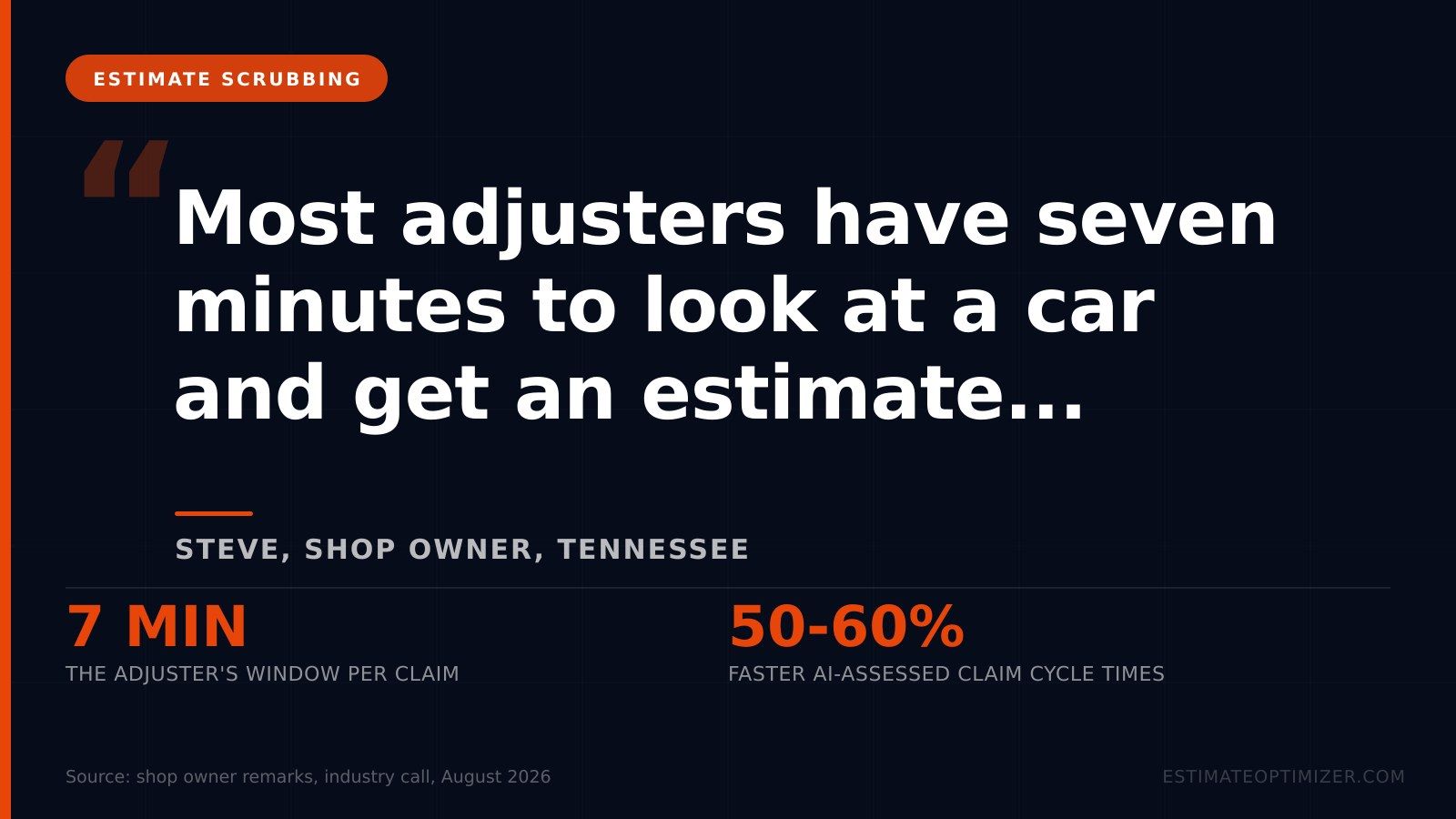
Dark quote card reading Most adjusters have seven minutes to look at a car and get an estimate, attributed to Steve, shop owner, Tennessee
The adjuster's window is fixed. Whether your file fits through it is determined by what's in the line notes before submission.

The Quick Self-Diagnostic: Does Your Line Note Clear or Get Parked?

Pull one estimate you submitted this week. Find the ADAS calibration line, or the corrosion protection line, or the not-included refinish operation. Is there an OEM citation in the note? Not a description of the operation. A citation. A specific document, a section, a reason why this operation is required and why it's not in base labor time.

Yes or no. That single answer tells you whether that line item is in the cleared queue or sitting in the manual-review pile.

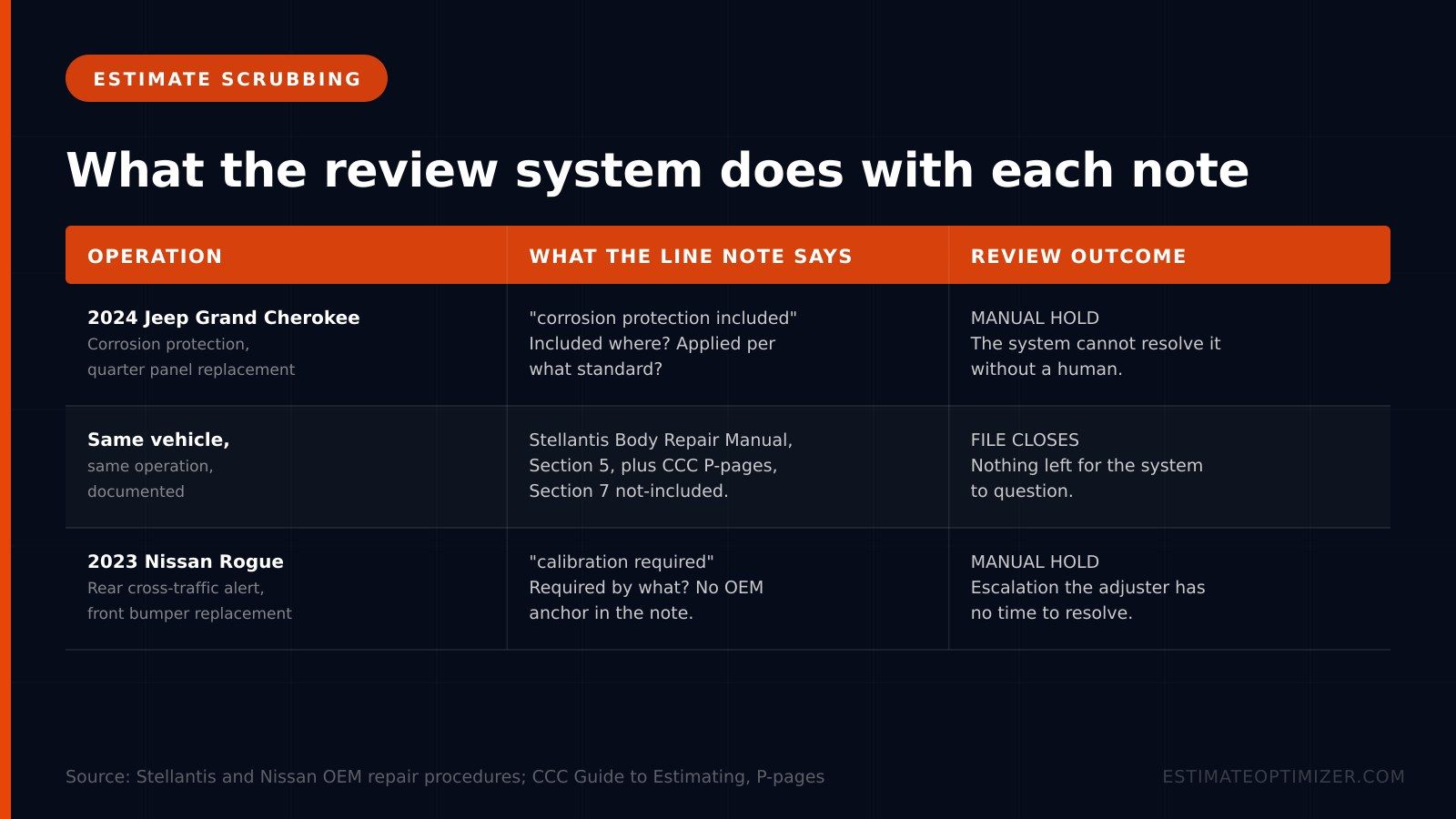
On a 2023 Nissan Rogue with a front bumper replacement, a rear cross-traffic alert calibration is required per Nissan's OEM procedures. If the line note says "calibration required," the adjuster's system has a question it can't resolve without human intervention: required by what? If the line note says "rear cross-traffic alert sensor recalibration required per Nissan Collision Repair Manual following any repair or replacement affecting rear bumper coverage area," the question is already answered. The file closes. The adjuster moves to the next claim.

Now run that test on every supplement-eligible operation in the estimate. That's your documentation rate on the auto body shop supplement line notes the adjuster is reviewing.
What the Cleared Line Note Looks Like in Practice

Two scenarios. Same shop, same week.

Scenario one: a 2024 Jeep Grand Cherokee with a rear quarter panel replacement. Corrosion protection is in the estimate. Line note says: "corrosion protection included." Included where? In base labor? Applied per what standard? The review system flags it. Manual hold.

Scenario two: same vehicle, same operation, different note. "Corrosion protection required per Stellantis Body Repair Manual, Section 5. This operation is not included in calculated labor time per the CCC Guide to Estimating, P-pages, Section 7. Applied to all bare metal surfaces exposed during quarter panel replacement." The file closes.

The difference isn't a different operation. It isn't a different estimator. It's the documentation in the note.

SCRS established a dedicated ADAS Repair Division in June 2026 specifically because documentation gaps on ADAS calibration claims are costing shops money they've already earned. The division's documentation focus isn't accidental. It's because the industry knows where the gap is.

Dark table figure showing three line notes and what the carrier review system does with each, two manual holds and one file that closes on first submission
OEM citation plus not-included language equals nothing for the adjuster's system to question. That's the formula that clears.

The Bottom Line

Seven minutes is the window. That's the documented reality of the adjuster's processing environment. A file built to answer every question in advance moves through that window. A file that requires escalation sits.

Your estimator already knows every operation she's writing. The note is what tells the review system she can prove it. Write for the seven minutes, not for the approval conversation you hope to have afterward.

Related Articles

Frequently Asked Questions

How do adjusters review auto body supplements so quickly?
Many carriers use AI claims-review tools that process files faster than manual review. These systems score line notes based on what documentation is present. Files with OEM citations and not-included references move through automatically. Files with bare descriptions or missing citations get flagged for manual escalation, which slows the entire approval process.
What is the difference between a line note description and an OEM citation?
A line note description tells the adjuster what the operation is. An OEM citation tells the adjuster why the operation is required and which manufacturer document mandates it. The review system can't verify a description. It can anchor against a citation. Shops that include citations in line notes before submission see significantly fewer manual holds.
Why do some supplements get approved instantly and others take weeks?
Supplements that clear quickly contain line notes that answer every question the review system asks: what is the operation, why is it required per OEM, and why is it not already in base labor time. Supplements that take weeks typically have one or more operations that require manual verification because the note doesn't provide enough documentation.
Which operations should always have an OEM citation in the line note?
ADAS calibrations, corrosion protection, not-included refinish operations, and single-use parts are the four categories that generate the most supplement holds without documentation. Start by adding OEM citations to these categories on every estimate. These are the operations most commonly challenged, and a citation is what converts a challenged line from a dispute to a cleared line.
How does the adjuster's seven-minute window affect my supplement approval rate?
When an adjuster has limited time per claim, files that require escalation get deprioritized. A file that needs manual verification to approve one line item delays the entire supplement. Files built with complete documentation move through the queue without interruption. Your supplement approval rate is partly a function of how many holds your file generates before the adjuster can close the claim.
Share this article
estimate scrubbingsupplementsOEM proceduresADAS calibrationshop ownerscollision repairinsurance claims
Back to Blog
Follow us