Every incomplete collision repair estimate that leaves your shop is missing something. Not because your estimator doesn't know the work. Because the software wasn't built to show it to them.
That distinction matters more than most shop owners realize. When a supplement comes back short, the instinct is to call it an adjuster problem. Sometimes it is. But far more often, the adjuster didn't remove anything. The operations weren't there to begin with.
Why Your Estimate Reflects What You Saw, Not What the OEM Requires
Here's what estimating software does: it gives you a starting point based on the damage a technician can observe before teardown. It fills in labor times for the operations that exist in its database as line items. It does not prompt you for operations that fall outside those standard times. It can't. The software doesn't know what vehicle-specific OEM procedures apply to that car.
That is not a flaw in the software. It is how estimating software was designed to work. CCC ONE, Mitchell, Audatex, all of them produce the same kind of output: a visible-damage estimate with a built-in assumption that the shop will layer in everything else the repair requires.
The problem is that "everything else" is substantial. The SCRS Guide to Complete Repair Planning documents over 800 not-included operations across the major estimating platforms. Eight hundred operations that are real, billable, and required by someone's OEM documentation, but do not appear in a standard software output unless an estimator adds them manually.
Most estimates leave the building without them.
What "Complete" Actually Means
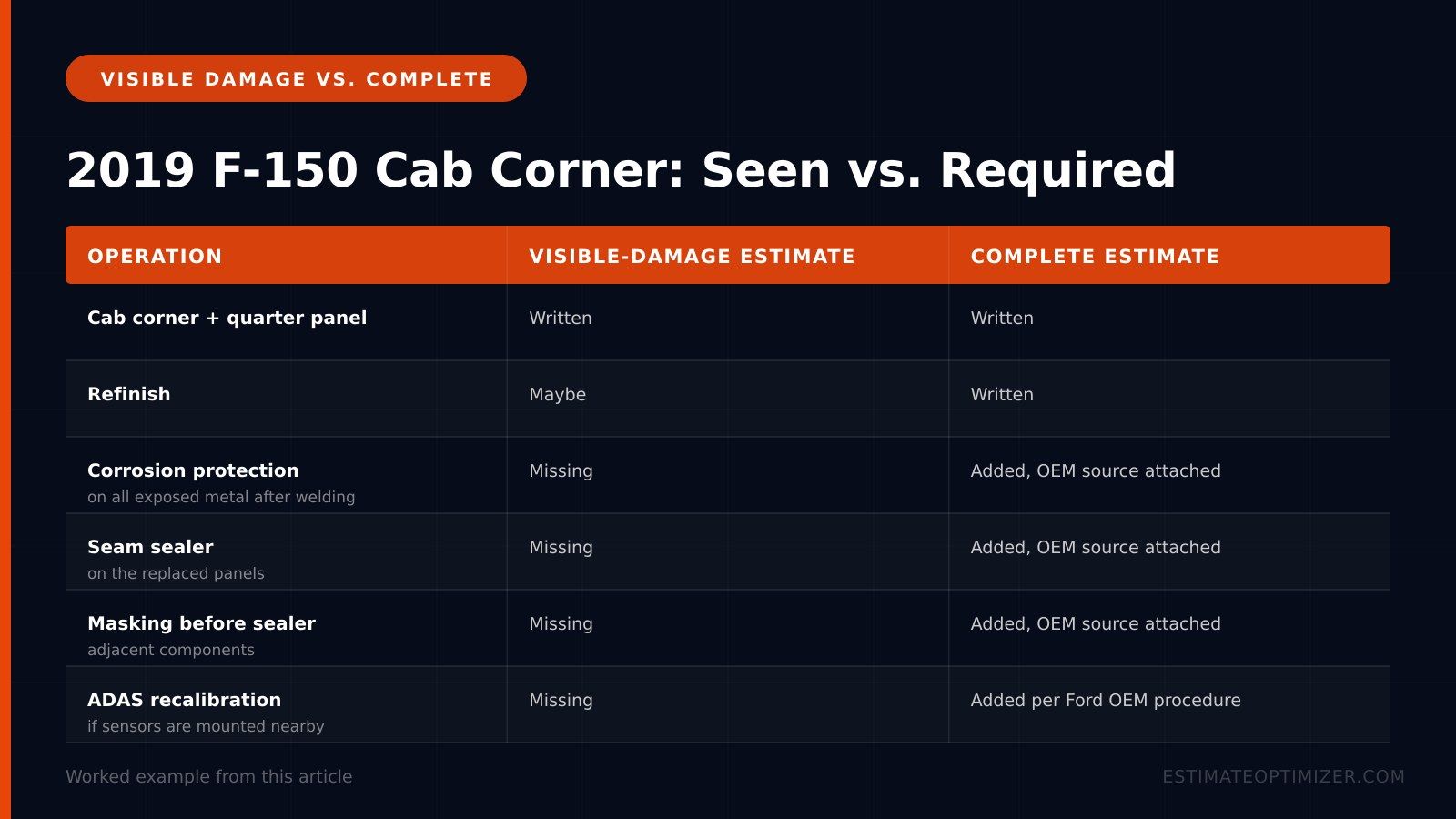
Take a 2019 Ford F-150 with a cab corner and quarter panel repair. The visible damage estimate writes the labor, maybe the refinish. But a complete estimate for that vehicle also includes corrosion protection application on all exposed metal after welding, seam sealer on the replaced panels, masking of adjacent components before sealer application, and if ADAS sensors are mounted nearby, a recalibration that Ford's OEM procedures require after that structural work. None of those operations show up automatically. Every one of them has to be added by hand, tied to a specific source.
Or a 2023 Chevrolet Silverado with a door replacement. The P-pages for door replacement in CCC say the following operations are not included in the R&I time: capping and covering electrical connectors during paint, testing after reconnect, and any seam sealer application on the door jamb where OEM spec applies. Those are three separate billable operations that CCC's own documentation confirms are not in the labor time. If your estimator doesn't know to look for them, the estimate goes out incomplete.
The OEM procedure document and the estimate should tell the same story. When they don't, the gap is what your shop is not billing.
What This Gap Is Costing You on Every Car
CCC's own data shows that 63% of collision repairs require a supplement after the initial estimate is submitted. Nearly two out of three jobs. That figure has held steady for years, and it is not a random distribution. Shops that submit complete estimates on the first pass supplement far less. Shops that submit visible-damage estimates supplement constantly, fight for every line, and lose a percentage of every supplement they submit.
Here is the self-diagnostic question: what is your first-submission denial rate? Track your last 20 supplements. How many came back approved exactly as submitted? How many came back with line items removed, reduced, or "not supported"? If more than 30% of your supplements are denied or reduced on first submission, that is red territory. If you're under 15%, you're building estimates that can stand on their own. Most shops, when they run this number honestly, land closer to the red end than they expect.
Across 244 repair orders audited through EO's system in Q2 and early Q3 2026, the average gap between what was billed and what OEM procedures supported was $1,062 per estimate. That is not the result of extraordinary damage. It is the predictable result of estimates built on visible damage instead of required procedures. The number does not vary much by shop size or vehicle type. It is consistent because the structural gap is consistent.
How to Build an Estimate That's Actually Complete
There is no shortcut to a complete estimate, but the process is learnable and repeatable. It works like this.
First, identify the OEM-specific procedures that apply to this vehicle, this repair. Not general P-page operations, but model-specific position statements. For any vehicle with ADAS components, there will be specific calibration requirements tied to exact conditions. For vehicles with aluminum structural panels, there will be specific welding and corrosion protection procedures. For vehicles with advanced restraint systems, there will be OEM statements about which parts are single-use after deployment. These documents exist. They are public. They are what a court would hold the repair to.
Second, cross-reference those OEM requirements against what the software produced. Every operation the OEM requires that does not appear on the estimate is a line that needs to be added and documented. Not a line that might be approved. A line the carrier is already obligated to pay because the OEM says the operation is required for a proper repair.
Third, attach documentation to every added line before the estimate leaves the building. Not a note that says "per OEM." The actual procedure excerpt, the OEM position statement, the P-page language. Adjusters who receive a documented estimate with sources attached process it differently than adjusters who receive a line item with no support. The file is the argument.
A complete estimate is not finished when it reflects visible damage. It is finished when it reflects what the OEM requires for that specific repair.
The Bottom Line
The supplement battle most shops are fighting is not about adjuster relationships or carrier policies. It is about what was in the file when it arrived. A complete estimate, built to OEM standards and documented before submission, does not need to win an argument. It presents an obligation the carrier cannot ignore without contradicting the manufacturer. That is a different kind of conversation entirely. Tools like Estimate Optimizer scan estimates against OEM procedure databases and flag every operation the repair requires that isn't on the estimate before it leaves your shop.
Why does my collision repair estimate keep getting supplemented?
Most supplements happen because the original estimate was built on visible damage rather than OEM required procedures. Estimating software produces a starting point, not a complete scope. Operations like corrosion protection, seam sealer application, and ADAS recalibrations are not included in standard labor times and must be added manually with documentation. When they're missing from the first estimate, they become supplement line items.
What makes a collision repair estimate complete versus incomplete?
A complete estimate reflects everything the OEM procedure requires for that specific vehicle and repair, not just what an estimator observed on teardown. It includes not-included operations from the P-pages, OEM-specific position statement requirements, and documentation for every added line. An incomplete estimate leaves the building before those operations are identified and supported.
What are not-included operations in collision repair estimating?
Not-included operations are billable repair procedures that fall outside the standard labor times built into estimating software like CCC ONE or Mitchell. The SCRS Guide to Complete Repair Planning documents over 800 of them, including corrosion protection application, seam sealer, masking for sealer, and single-use parts replacement. These operations are real and required but will not appear on an estimate unless an estimator adds them manually.
How do I reduce supplement denials from insurance companies?
The most reliable way to reduce supplement denials is to build a complete estimate on the first submission. That means cross-referencing your software output against OEM procedures for the specific vehicle, adding every required operation that the software missed, and attaching source documentation before the file leaves your shop. Shops that do this consistently report first-submission approval rates above 80%.
Does CCC ONE automatically include all required repair operations?
No. CCC ONE produces estimates based on the damage an estimator inputs, but hundreds of required operations are classified as not-included in the MOTOR Guide to Estimating. These include corrosion protection, additional seam sealer on welded panels, capping electrical connectors during paint, and ADAS recalibrations. An estimator must manually research and add these operations. The software is a starting point, not a complete scope.