Your best estimator knows the work. She can walk around a vehicle and identify every operation before she opens CCC. That's not the problem. The problem is what's in the line notes when the file hits the adjuster's queue.
On an industry call with more than 50 shop owners in August, Steve, a shop owner in Tennessee, said it out loud: "Even my best estimator... she's not the best at the line notes." The room went quiet. Everyone recognized it.
Why Estimator Skill Isn't What Gets You Paid
Shops assume approval is downstream of estimator quality. Better estimator equals better approval rate. That's the logic. It's wrong.
The adjuster reviewing your file doesn't know how many years your estimator has. He doesn't know she can identify a blend panel mismatch by eye or write a supplement before the tech even pulls the quarter. What the adjuster sees, and in many cases what an AI claims-review tool scores, is the documentation attached to each line item.
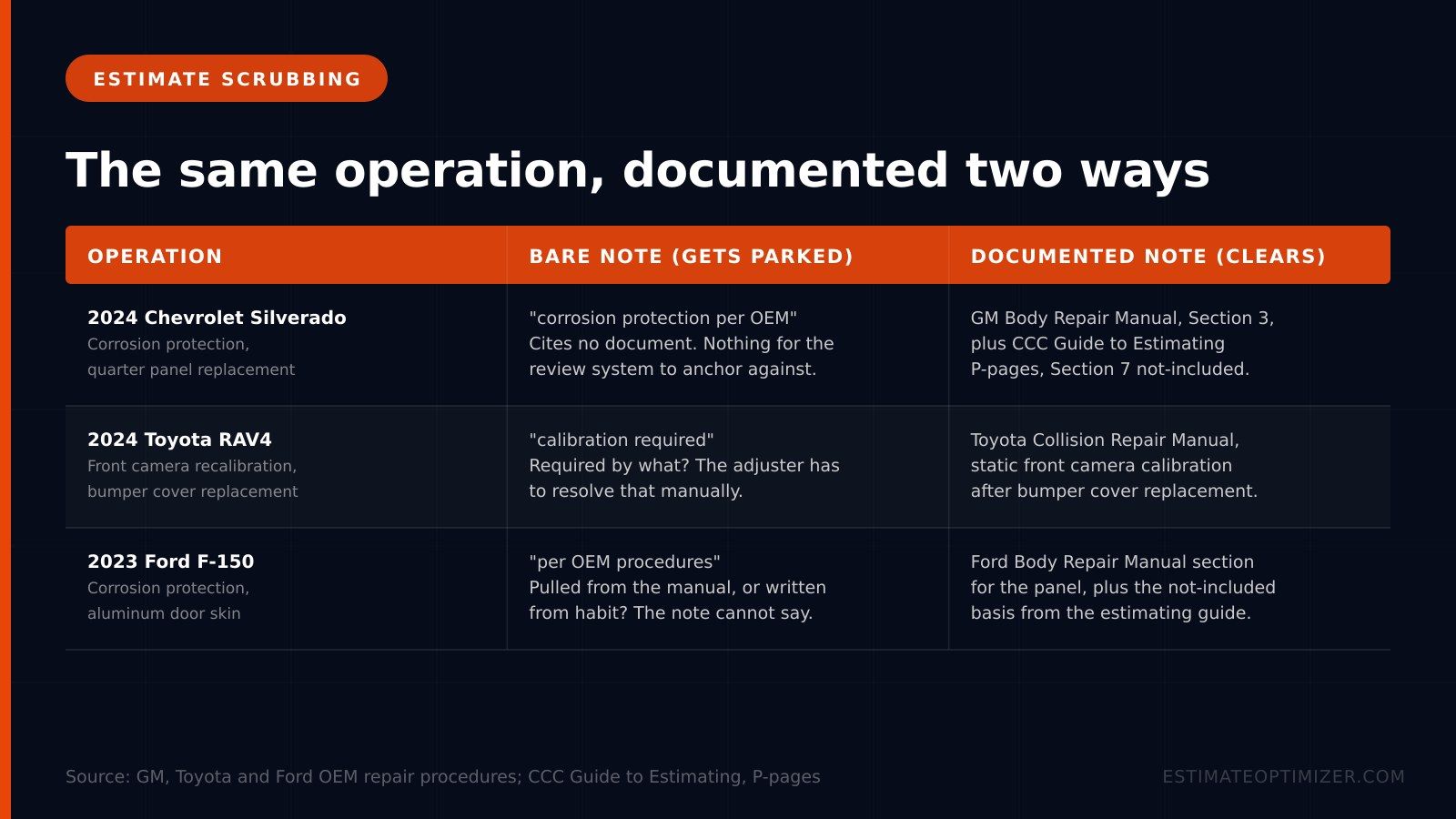
If the corrosion protection operation on a 2023 Ford F-150 aluminum door says "per OEM procedures" with no citation, the AI doesn't know if that means you pulled the Ford Body Repair Manual or you're estimating from habit. It reads the note. If the note doesn't prove the operation, the operation is at risk.
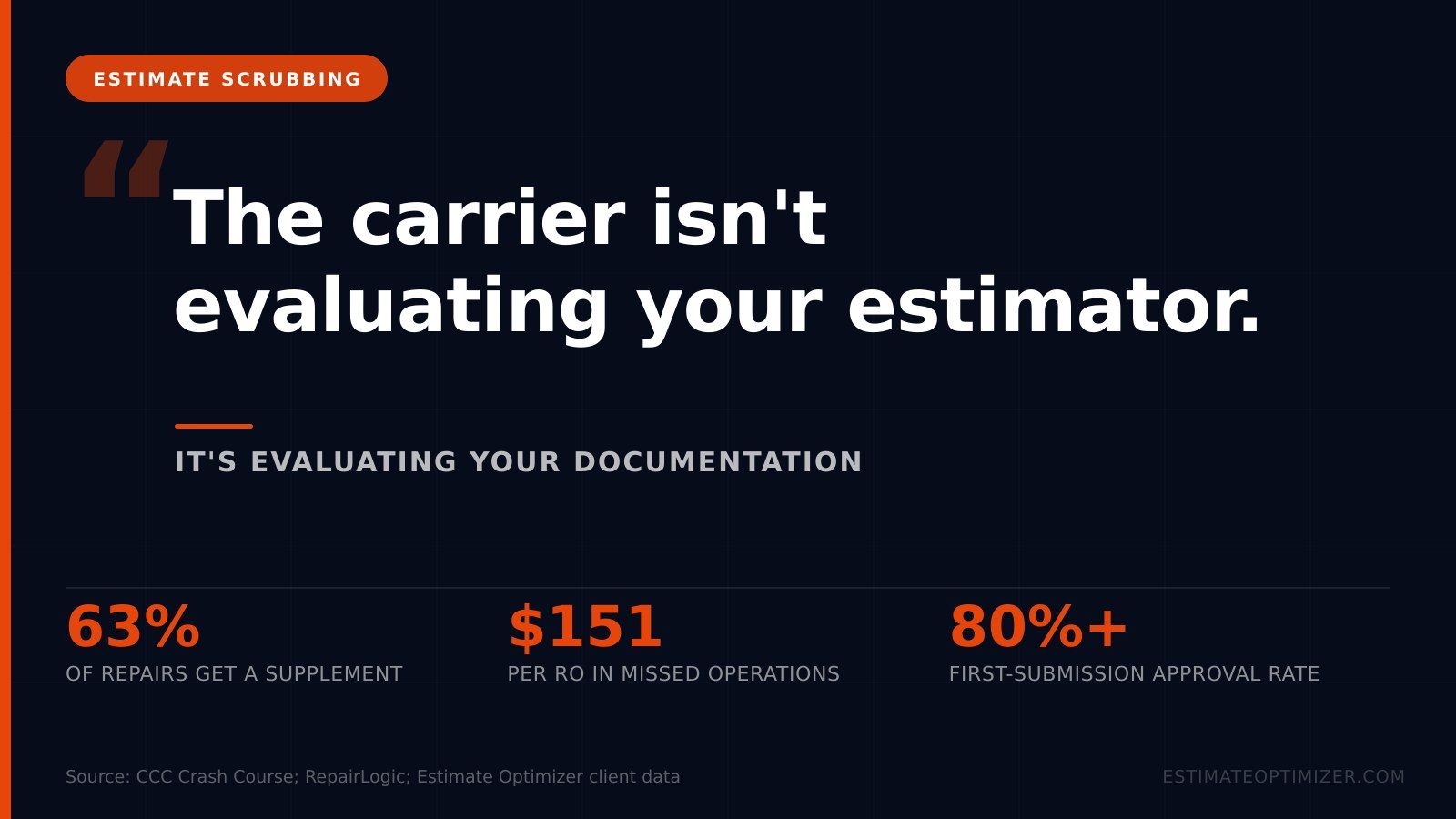
The carrier isn't evaluating your estimator. It's evaluating your documentation.
A line note without an OEM citation attached is a billing entry the carrier's system has no obligation to accept.
What's Your Shop's Actual Documentation Rate on Collision Repair Estimate Line Notes?
Pull the last 10 estimates your shop submitted. Find the operations that typically get challenged: corrosion protection, blend time, not-included refinish ops, calibrations. How many of those line items had an OEM citation in the note before submission? Not after the carrier pushed back. Before.
Under 3 in 10 is red. Seven or more is green.
That number is your documentation rate. It predicts your supplement approval rate more reliably than your estimator's years of experience. CCC's own data shows supplementing occurs on close to 63% of all collision repairs. The gap isn't in the damage discovery. It's in the paper trail that follows it.
Shops that hold 80% or better on first-submission approvals aren't staffed differently. They didn't hire new estimators. They changed what goes into the line note before the estimate leaves the building.
One shop in Tennessee processed 18 estimates over a recent period and found $16,000 in opportunities, averaging $874 per repair order. The estimator was the same person she'd always been. What changed was the documentation layer attached to each operation she already knew was billable.
What a Line Note That Clears Actually Looks Like
Here's the practical version. Your estimator writes a corrosion protection operation on a 2024 Chevrolet Silverado rear quarter panel. The line note says "corrosion protection per OEM." That's the most common version. That's also the version that gets parked for manual review.
The note that clears says: "Corrosion protection required per GM Body Repair Manual, Section 3, applicable to all exposed bare metal and seam areas on truck bed and quarter panel replacements. This operation is not included in calculated labor time per the CCC Guide to Estimating, P-pages, Section 7."
That note does three things. It cites the manufacturer requirement. It anchors the operation to a specific OEM document. And it preemptively closes the argument about whether it's included in base labor time.
The adjuster with seven minutes and an AI system behind him does not have to question it. Nothing in the note gives him something to push back on. The file is complete before he opens it.
The same logic applies to ADAS calibrations. A 2024 Toyota RAV4 with a front bumper replacement needs a forward-facing camera recalibration. If the line note says "calibration required," that's a question the adjuster has to resolve. If the note says "front camera static calibration required per Toyota Collision Repair Manual procedures following bumper cover replacement; calibration required any time front radar sensor field of view is obstructed or restored," the question is already answered.
RepairLogic data puts missed operations at $151 per repair order on average when OEM procedure research is applied correctly. That's not $151 in hidden damage. That's $151 in work your estimator already knows about but hasn't documented in a way that gets paid.
Three operations, each documented two ways. The left column is what most estimates carry. The right column is what clears on first submission.
The Bottom Line
The estimate isn't a billing document. Every estimate is a legal document. Most shops are writing them like receipts, and the most experienced estimators in the industry are doing it just as often as the newest ones because no one trained them to write for an adjuster's AI system, not for an adjuster who understood the work.
The shops recovering 80% or more on first submission didn't upgrade their estimating staff. They upgraded the documentation layer. Every operation gets a citation. Every not-included call gets an anchor. The file proves the work before anyone can question it.
Tools like Estimate Optimizer scan estimates against OEM procedure databases and flag every operation that's missing documentation, so the citation gets added before the file leaves the building, not after the denial comes back.
Your estimator already knows the work. Give the file a chance to prove it.
What should be in a collision repair estimate line note to get approved?
A line note that gets approved on first submission names the OEM document requiring the operation, cites the specific section or procedure number, and references the estimating platform's not-included language if applicable. General phrases like 'per OEM procedures' are not enough. The carrier's review system needs a specific, traceable anchor for each operation.
Why does my estimator's experience not guarantee supplement approval?
The adjuster reviewing your supplement doesn't evaluate your estimator's experience. They evaluate the documentation in the file. An AI claims-review system scores the line notes, not the estimator's knowledge. A 20-year veteran who writes bare line notes gets the same result as a new hire who writes the same bare line notes.
How do I know if my shop's estimate documentation is the problem?
Pull your last 10 submitted estimates. Count how many challenged operations had an OEM citation in the line note before submission. If fewer than 3 in 10 have a citation, your documentation rate is in red territory. That number predicts your approval rate more reliably than any other variable in your estimating process.
What is a not-included operation and why does it matter in line notes?
A not-included operation is a labor task the estimating platform does not include in its standard calculated labor times. Shops are owed payment for these operations, but they must be written into the estimate with supporting documentation. The P-pages in CCC, the CEG in Mitchell, and equivalent guides in Audatex all specify which operations require separate billing. Referencing that language in the line note closes the carrier's most common objection.
Does every line item need an OEM citation in the note?
Not every line item requires a citation, but any operation that gets regularly challenged should have one before the estimate is submitted. Corrosion protection, not-included refinish operations, single-use parts, and ADAS calibrations are the four categories where citations change approval outcomes most consistently. Start there, then expand the documentation standard from the most contested operations outward.