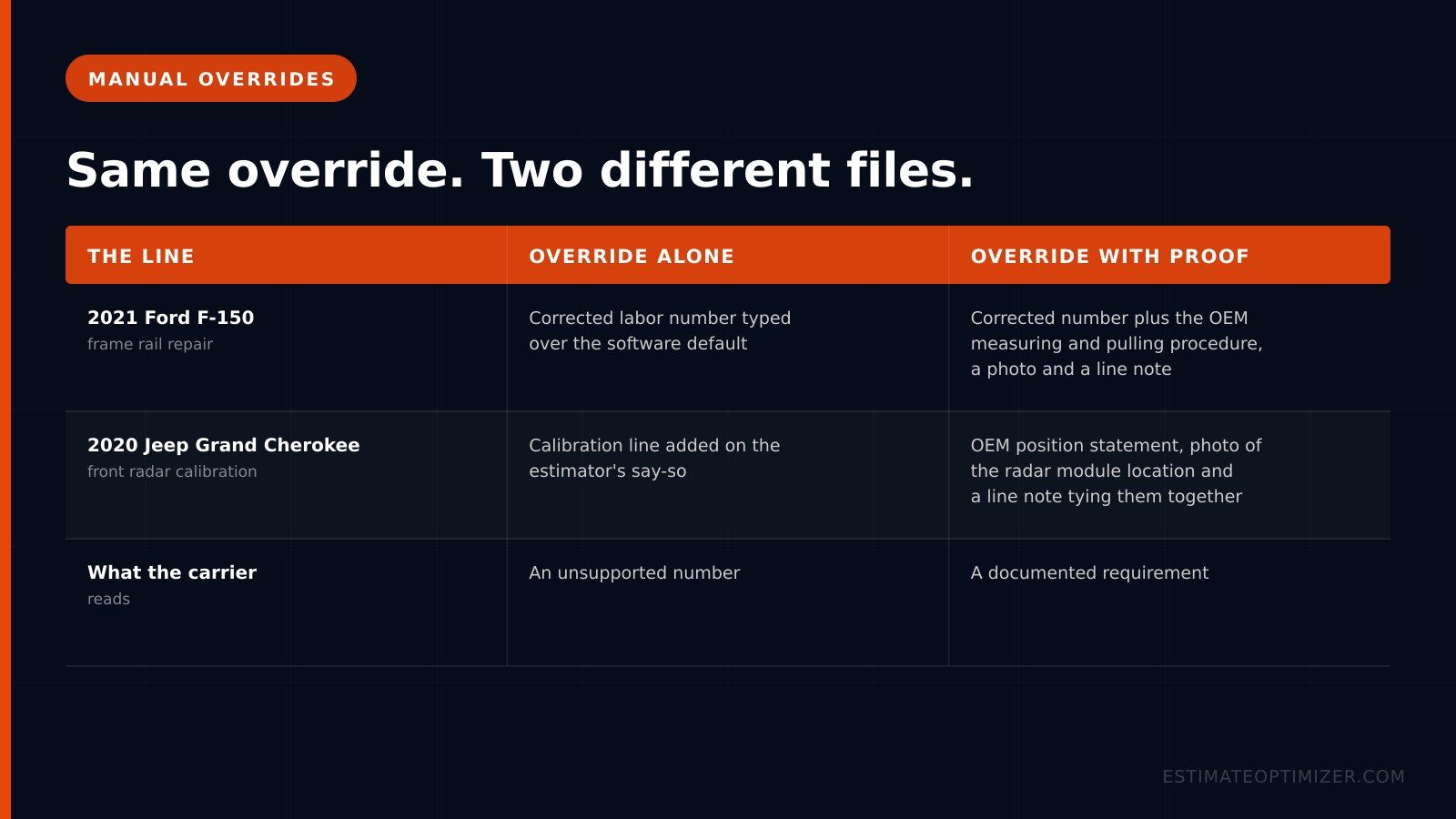
When CCC ONE estimate line items get removed, shops usually blame the software's not-included list. But it happens as often to the override your estimator typed in with his own hands, the number he corrected because he knew CCC ONE's default was wrong.
We covered why the scrub runs the same whether your estimator has two years in the trade or twenty in this week's pillar post, "Your Estimator Has 20 Years of Experience. The Software Still Scrubs the Estimate." The override is where that mechanism gets personal. He wasn't wrong about the truck. He wasn't wrong about the panel. The number he typed didn't carry anything proving it, and proof is the only thing CCC ONE's scrub checks for.
Why CCC ONE Estimate Line Items Get Removed Even After a Manual Override
Take a 2021 Ford F-150 with frame rail damage. CCC ONE's default labor time assumes a straightforward pull, no multi-point measuring. Your estimator has done this repair fifty times. He knows the OEM procedure calls for a full measuring and pulling sequence, so he overrides the default number with the correct one.
He's right. The truck needed the longer process. But the override is only a number he typed over the software's number. Nothing in that keystroke tells the carrier's system why the higher figure is correct, or that it came from a documented OEM procedure instead of a guess. The system doesn't read confidence. It reads what's attached to the line.
Put the same override on two different files and you'll see it. One estimator attaches the OEM citation and a photo before he submits. The other writes the corrected number and moves to the next car. CCC ONE doesn't know which estimator has been doing this longer. It only knows which file carries proof and which one doesn't.
That's the gap. An override is a claim. Without a citation, a photo, or a line note behind it, it reads exactly like every other unsupported number the scrub is built to catch, no matter how many times your estimator has made that exact call before.

What Your Override Survival Rate Is Telling You
Pull your last ten supplements that included a manual override. How many of those overrides survived the first submission intact, no adjuster call, no cutback to CCC ONE's default? Under 70% survival is red territory, no matter how sharp your estimator's eye is. Above 80% is green by a common industry benchmark, and it's where shops land when they treat every override like a small case file instead of a quick correction. If your number is sitting in the red, the override itself isn't broken. What's missing behind it is.
Supplements are routine after teardown, and overrides without documentation add rounds that didn't need to happen. An estimator corrects the software's number on the first pass, the correction goes out unsupported, and the file comes back for a second round to prove what should have been attached the first time.
Across EO's own audit data, 288 estimates turned up 4,441 missed operations, about $989 in potential additional repair dollars identified per estimate (as of Oct 24, 2026). That number doesn't separate cleanly into "estimator didn't know" and "estimator knew but couldn't prove it," but the pattern points hard at the second one. Most of the estimators behind those files know their trade. The overrides they made weren't carrying anything that survives a scrub.