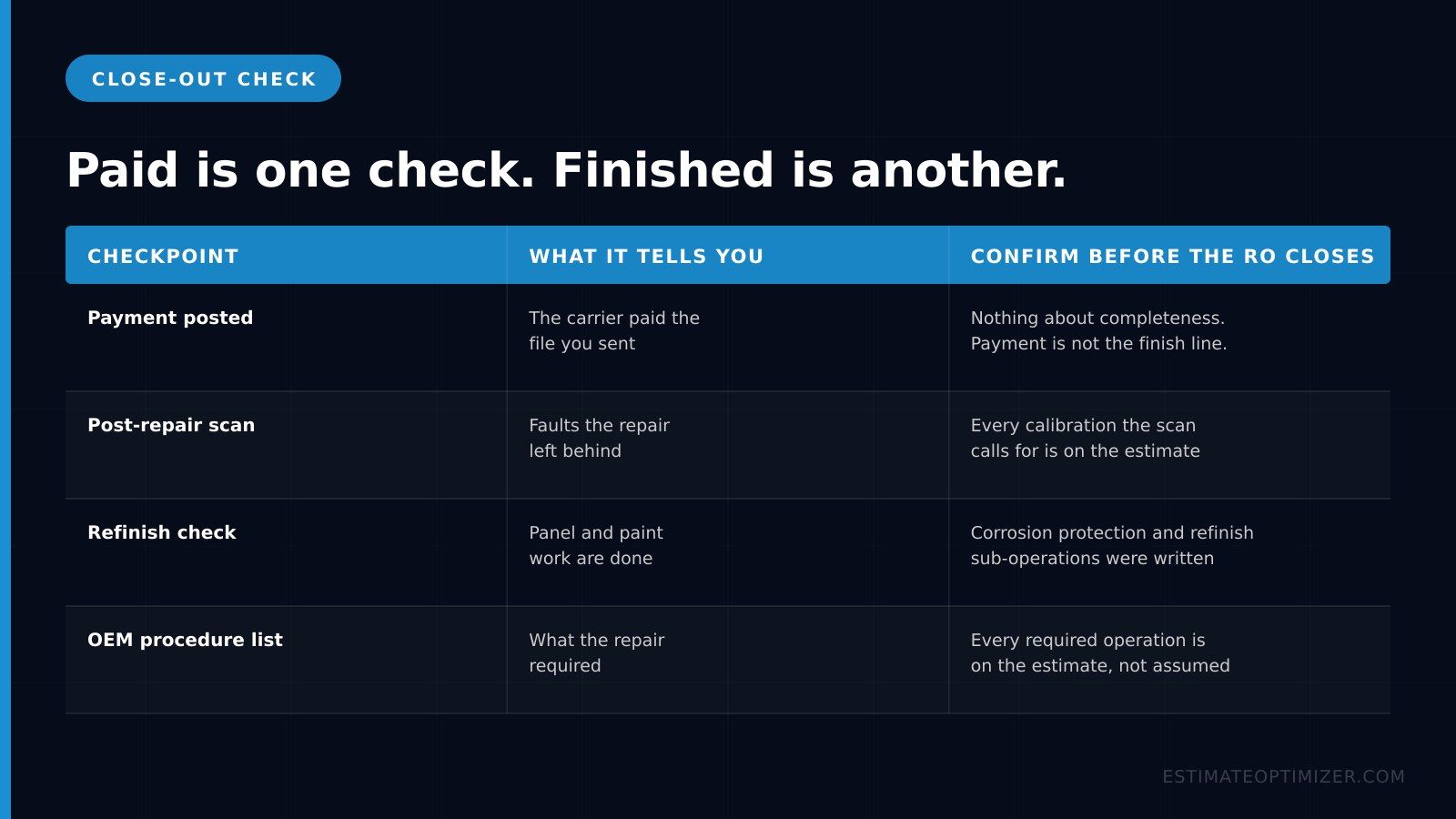
A closed repair order reopened after insurance paid is the supplement nobody budgets for. The check cleared, the car went home, and the file went to the archive.
Why Does a Closed Repair Order Reopen After Insurance Paid?
Three weeks later, the post-repair scan on a 2021 Subaru Outback threw a camera fault. The windshield had been replaced, but the forward camera calibration never made it onto the estimate. Nobody had been looking at that file since the payment posted.
That is how a closed repair order reopens. Nothing dramatic happened. The file stopped getting checked once the money arrived.
Here's the part that stings. The shop felt finished. The estimator felt finished. The carrier's system showed the claim as paid, and to everyone involved that looked like a finish line. A paid claim feels closed, and a closed file stops getting attention. The reopen only looks like a surprise to the people who stopped reading the file.
The second scenario has the same root cause. A 2019 Chevrolet Equinox goes to paint, and the final check finds corrosion protection missing on the replacement rear panel. The panel was on the estimate. The operation that protects it was not.
Both files closed in two systems at once. The shop's management software marked the job done when the deposit posted. The carrier's file closed when the payment went out. Neither system asks whether the operations are complete, so the first place anyone sees the gap is a scan, a paint booth, or a phone call from the customer.
A reopen is usually a file problem, not a relationship problem. The adjuster reviewing a supplement is working from the documents you sent. If those documents show the operation was required and the procedure is attached, the conversation tends to be shorter.
CCC's 2026 Crash Course reports that 28.3% of repairable estimates now include calibrations, reflecting increasing vehicle technology complexity. That's a growing share of the file, and calibration is exactly the line that disappears when the first pass is written from the visible damage alone.
Shops get used to reopens. They get handled as one-offs, and the one-off becomes a habit. A reopen treated as normal is the one that repeats, because nobody asks why it happened.
What Does a Reopen Cost You?
A reopen costs more than the supplement amount. Your estimator loses the hours, your front office spends the calls, and money you already counted as closed goes back into the queue.
The customer pays in time too. The car is back in the bay, the rental clock is running again, and the customer is hearing about a second visit nobody planned. Every extra rental day is a cost someone has to explain, and your front counter is usually the one explaining it.
Timing is the other cost. A reopen three weeks after delivery lands on a different calendar than the original job. The estimator has moved on, the photos sit in another folder, and the person who wrote the first estimate may be writing someone else's now.
Pull your last 30 closed repair orders and count how many came back for a supplement after the check cleared. Under 5 percent is green. Between 5 and 10 percent is yellow. Above 10 percent is red, and it points at your closing process before it points at any carrier. Where does your shop sit on that scale?