Back to Blog
Estimating Platforms

The Blend Time Formula Mitchell Still Gets Wrong

5 min read
Share
Estimator at a dual-monitor workstation reviewing a blend panel line item on a collision estimating software screen

The Mitchell blend time formula collision repair shops are running today still defaults to 50% of full refinish time. The SCRS Blend Study proved that number is wrong. Blend operations average 31.59% more time than a full refinish, not 50% less. And most Mitchell shops haven't flipped the switch that changes it.

Why This Belongs to the Same Problem We Talked About Monday

Monday we covered how carriers changed the language around what they owe you. The platform gap we're breaking down today is part of the same system. The software encodes the low number before the conversation even starts.

When your estimating system produces a blend line item that's built on a formula the industry proved wrong, you're not starting a negotiation. You're submitting documentation that already concedes the argument. The adjuster doesn't have to cut anything. The estimate already did it for them.

That's not a carrier problem. That's a software default problem. And it has a fix, if you know where to look.

Estimator at a dual-monitor workstation reviewing a blend panel line item on a collision estimating software screen
The blend line item on most Mitchell estimates reflects a formula the platform has never changed, regardless of what the research shows.

What the SCRS Blend Study Actually Showed

The study wasn't done in a vacuum. SCRS conducted the research with five major North American refinish manufacturers: AkzoNobel, Axalta, BASF, PPG, and Sherwin-Williams. DEKRA audited the findings. This was industry-funded, multi-company research with independent verification.

The conclusion: blend operations, on average, take 31.59% more time than a full refinish operation. The three estimating systems at the time were all allocating blend at 50% of full refinish time. That's not 31.59% more. That's 50% less. The gap between what the software was allocating and what the research measured isn't a rounding difference. It's the difference between getting paid and donating labor.

CCC and Audatex responded by updating their systems to recognize that blend times vary and require a vehicle-by-vehicle evaluation. Audatex removed its formula entirely and changed its guidance to reflect the variables involved. CCC allowed shops to set profile-level defaults that reflect the study.

Mitchell's response was different. The guidance in the Mitchell Collision Estimating Guide still reads: "Blend adjacent panel(s): Allow .5 per refinish hour (50%) for each panel(s)/refinish area(s) blended." In early 2024, Mitchell added a profile-level setting that lets shops manually configure a different default. The announcement at the Collision Industry Conference confirmed it. And the guidance did not change.

That distinction matters. The fix exists. But you have to know to turn it on. If you're running a Mitchell shop and you haven't touched your profile settings, you're producing estimates with a blend number the research invalidated in 2022.
What This Costs on a Real Repair

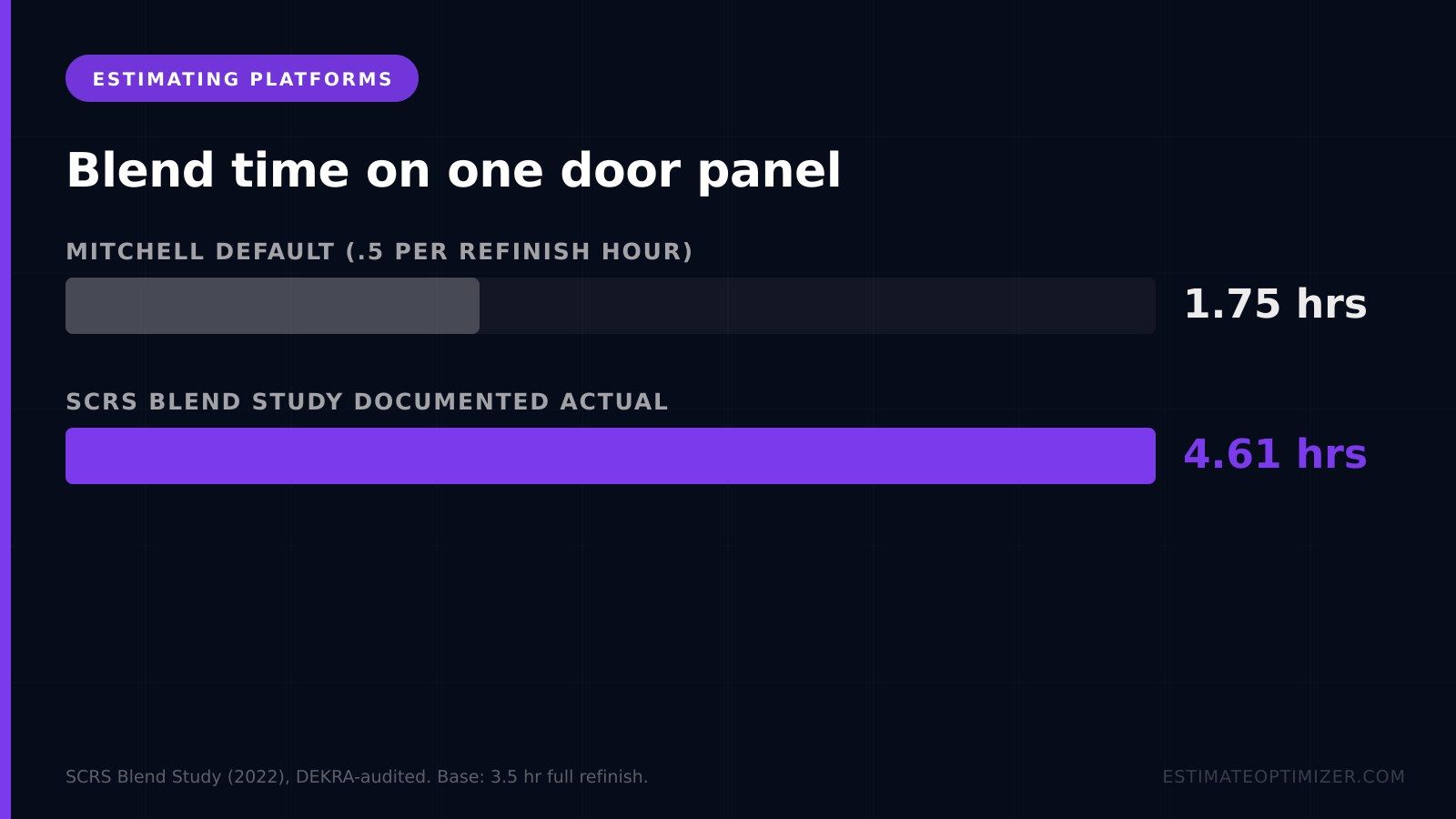
Take a Toyota Camry with three blend panels. A typical full refinish on a door might carry 3.5 hours. At the Mitchell default, you're billing 1.75 hours per panel for blend. The SCRS study says those operations actually run longer than a full refinish. The documented figure isn't 1.75 hours. It's closer to 4.6 hours.

On three panels, that's an 8.57-hour difference between the default formula and the research. At a $60 labor rate, you've given away $514 before you've finished one supplement. Scale that to your monthly ticket count and the number isn't abstract anymore.

The self-diagnostic is simple: go into your Mitchell profile settings and check what your blend percentage is set to. If you've never changed it, it's 50% of full refinish. That is the default the guide still calls for. If you want it to reflect anything closer to what the research shows, you have to set it manually. Mitchell won't prompt you. The estimate won't flag it. It just runs the wrong number quietly on every job.

Bar chart comparing blend time on one door panel: 1.75 hours under Mitchell's default formula versus 4.61 hours documented by the SCRS Blend Study
The gap between the default formula and the SCRS-documented actual is not small enough to ignore across a month of production.

The Bottom Line

The SCRS Blend Study has been public since 2022. The research was thorough, the audit was independent, and the finding was clear. Three years later, Mitchell's default guidance still encodes the old number. The profile flexibility is there, but "flexible" means nothing if you don't know the default is wrong.

Check your blend setting today. If it reads 50%, you're leaving money on every refinish job that has a blend panel. Tools like Estimate Optimizer flag blend discrepancies during estimate reviews and surface jobs where the platform default is producing a number inconsistent with documented research. But the profile fix is something you can handle right now, without a tool, in five minutes. Go do it.

Related Articles

Frequently Asked Questions

Why does Mitchell's blend time formula give me less money than CCC or Audatex?
Mitchell's Collision Estimating Guide still specifies blend as 0.5 per refinish hour (50% of full panel refinish time). CCC and Audatex updated their systems after the SCRS Blend Study showed blend actually takes 31.59% more time than a full refinish. Mitchell added user-configurable profile settings in early 2024 but did not change its guidance, so any shop that hasn't manually adjusted its profile is still running the old default.
What did the SCRS Blend Study find?
The SCRS Blend Study concluded that blend operations average 31.59% more time than a full refinish, not 50% less as all three major estimating systems had been allocating. The study was conducted with AkzoNobel, Axalta, BASF, PPG, and Sherwin-Williams, and audited by DEKRA. Results were published in November 2022 and have been cited in industry debates about estimating accuracy since.
How do I change the blend formula in Mitchell to reflect the SCRS study?
In Mitchell, go to your system profile settings and look for the blend percentage under refinish calculations or adjustments. Change the default from 50% to a percentage that reflects your documented blend time for the type of repairs your shop performs. Any estimate produced after that change will show the adjusted value. Entries that differ from the guide default appear with an asterisk on the estimate.
Do insurance companies have to pay for blend time based on the SCRS study?
Carriers are obligated to pay for time that is actually required to perform the repair. The SCRS Blend Study provides documented, third-party-audited research showing blend operations require more time than the platform default allocates. When you submit blend time that differs from the formula default, attaching the SCRS study as your documentation source shifts the burden to the carrier to explain why their number is more accurate than independently audited research.
Is the blend time problem only on Mitchell or does it affect CCC and Audatex too?
The original 50% formula was the default across all three platforms. After the SCRS Blend Study published in 2022, CCC and Audatex both updated their systems and guidance to recognize that blend times vary and require vehicle-by-vehicle evaluation. Mitchell added profile flexibility in early 2024 but maintained its CEG guidance. Shops running CCC or Audatex still need to verify their profiles are set correctly, but the guidance those platforms provide no longer locks them to the old formula.
Share this article
estimating platformsMitchellcollision repairshop ownerslabor hoursrefinishrevenue recovery
Back to Blog
Follow us