Back to Blog
Estimating Platforms

AI Is Now Processing Your Claims Before a Human Adjuster Reads Them. Here's What It's Looking For.

6 min read
Share
Bar chart comparing AI claims review benchmarks: 88 percent of insurers using or planning AI evaluation, 80 percent first-submission approval for shops with complete files, and a 63 percent supplement rate

The adjuster isn't the first one to read your estimate anymore. AI auto body claims review systems are now active at major carriers, and they score your file for documentation completeness before a human being enters the picture. Files that clear the threshold get routed toward faster approval. Files that don't get flagged for manual review, which means slower payment, more supplement rounds, and more opportunity for line-item pushback.

The queue doesn't care how long you've been doing this. It checks the file.

What Carriers Actually Deployed and When

In July 2024, CCC Intelligent Solutions publicly launched CCC Intelligent Reinspection. The product uses AI analysis to assess incoming shop estimates against insurer-provided rules and automatically routes estimates for approval or further review. CCC has been explicit about how it works: the AI scores the estimate, identifies areas for review, and provides reason codes based on each insurer's configuration. Estimates that score cleanly get routed toward approval. Estimates that flag for mismatches get held for a human reinspector.

This is deployed technology. CCC built it over ten years of AI development and integrates computer vision analysis of your damage photos with the line-item review of your estimate. The same platform that writes the estimate is the one scoring it on submission.
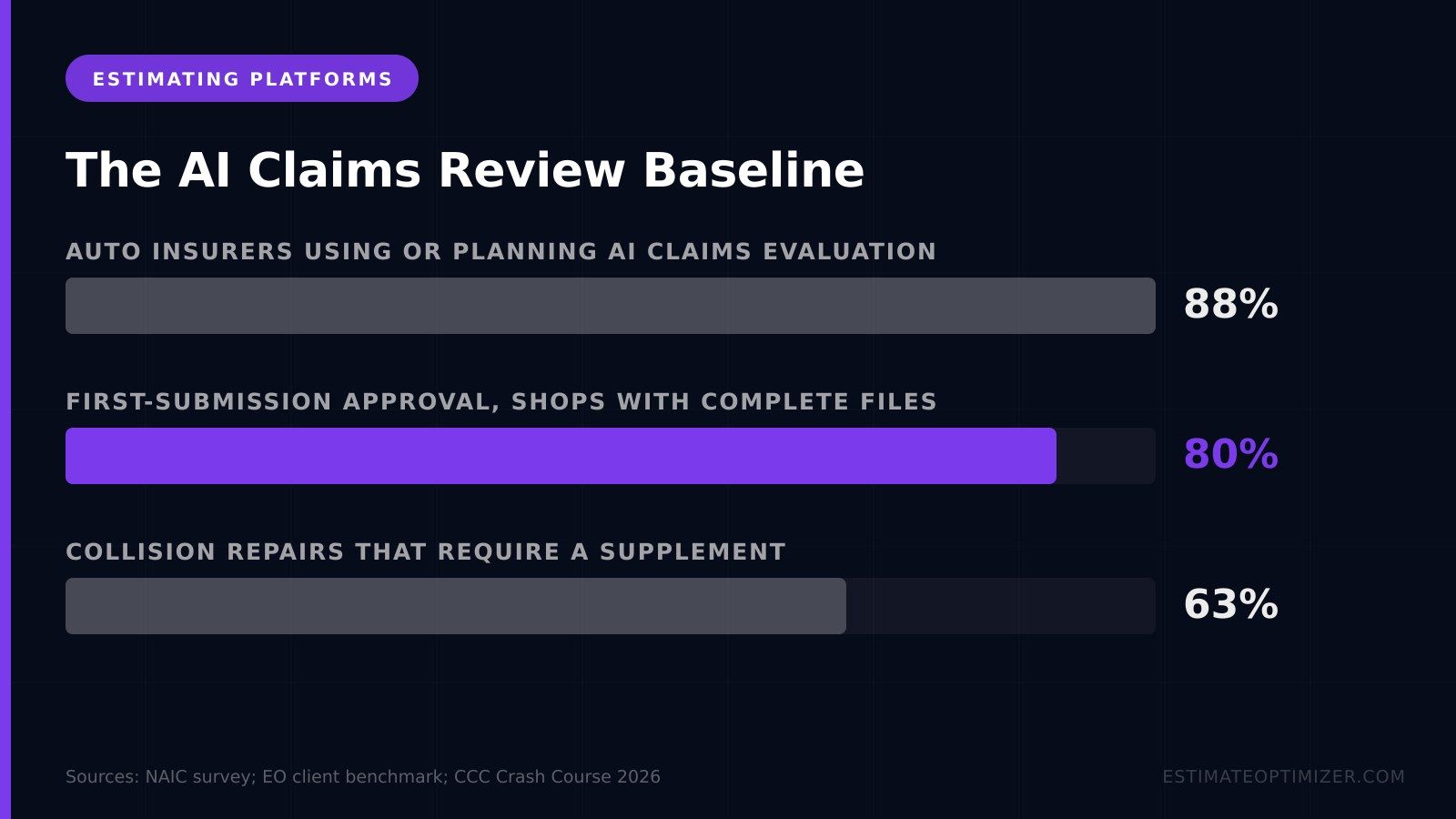
Bar chart showing 88 percent of auto insurers using or planning AI claims evaluation, 80 percent first-submission approval for shops with complete files, and 63 percent of collision repairs requiring a supplement
Most carriers are already using or planning AI claims evaluation, and most repairs still require a supplement. A complete file is what separates the two outcomes.

CCC isn't the only platform moving in this direction. An NAIC survey found that 88% of auto insurers currently use or plan to use AI to evaluate claims. In March 2026, regulators from 12 states launched a formal examination of how insurers deploy these systems, with participating states including California, Florida, and Pennsylvania. The regulators aren't asking carriers whether they use AI. They're asking how. That confirmation from regulators means this technology is operating at scale, and the industry is starting to treat it as a standard part of the claims workflow, not an experiment.

Shops that don't know how the scoring works are submitting estimates into a system they can't see. That's a problem that documentation solves.

Does Your File Clear the AI Auto Body Claims Review Queue or Get Held?

Here is a useful self-diagnostic. Think about the last ten estimates your shop submitted. For each one: did the line notes include specific OEM citations attached to the operations that are commonly challenged? ADAS calibration. Corrosion protection. Single-use fasteners. Refinish operations. Feather, prime, and block.

Fewer than five estimates out of ten with OEM citations embedded in the line notes before submission puts your shop in red territory. Six or seven is yellow. Eight or more is green, and you're building the kind of file an automated scoring system can clear without parking it in a manual review queue.

The AI checks your estimate against the insurer's rule set. On a 2023 Toyota RAV4 with a rear bumper replacement and a parking sensor, the rule set expects a calibration line item. If the calibration isn't there, or if it's there without documentation tying it to a manufacturer requirement, that's a flag. On a 2022 Ford F-150 with any structural operation, the rule set expects corrosion protection documented. If it's missing, the file gets held.

Shops running a consistent 80% first-submission approval rate aren't better negotiators. They're building files that don't generate flags in the first place. The automation rewards documentation completeness the same way a prepared human adjuster does, just faster and without the phone call.

That gap between 80% and the industry average is a documentation gap. CCC's own data shows 63% of collision repairs require a supplement after initial submission. Most of those supplements start with a flagged file.

What the Algorithm Checks Before It Routes Your File

CCC's system works from two inputs at once: the photos of the damage and the line items in the repair estimate. Computer vision analyzes what's visible in the photos. The estimate review checks whether the line items match what the photos show and whether the supporting documentation is present for each operation.

A photo showing rear-end impact on a vehicle equipped with parking sensors creates an expectation in the system. If the estimate doesn't include a calibration line item, or includes it without OEM procedure documentation, there's a mismatch between what the damage photos show and what the estimate claims. The file gets flagged for a human reinspector to review.

A shop estimator reviewing a printed repair estimate with OEM procedure documents and a damage photo spread across a workbench
Pairing OEM procedure citations with damage photos is what closes the gap the automated scoring system is checking for.

The same logic applies to operations that are simply absent. A 2024 Jeep Grand Cherokee rear quarter panel replacement with no corrosion protection line item creates a gap the system will identify. The AI is checking documented expectations against documented line items. The gap is real, and the reason code generated reflects it.

The reason codes CCC's system produces are tied to each insurer's rule configuration. Different carriers have different rule sets, which means the same estimate can clear one carrier's AI queue and get flagged by another. But the documentation standard that satisfies most rule sets is consistent: every commonly challenged operation needs a citation linking it to an OEM requirement the carrier is already obligated to pay on. Build to that standard and the file travels faster through every queue.

Shops find that when they build files this way before submission, the back-and-forth with adjusters shrinks. The file doesn't generate the flags that start those conversations in the first place.

The Bottom Line

AI claims review is here, it's documented at the carrier level, and regulators in 12 states are actively examining how it's being deployed. Your estimate goes through automated scoring before a human reinspector reads it. Files that clear the scoring get routed toward faster resolution. Files that don't get held for manual review, which means more rounds, more delay, and more exposure to line-item pushback.

The documentation standard that satisfies an AI scoring system is the same standard that satisfies a prepared human adjuster: OEM citations attached to every commonly challenged operation, and a file that matches the damage photos to the line items before submission. Tools like Estimate Optimizer audit every estimate against OEM procedure databases and flag documentation gaps before the file leaves your shop.

Every estimate is a legal document. The AI reads it that way. Now you know that too.

Related Articles

Frequently Asked Questions

Is insurance AI claims review actually being used on body shop estimates right now?
Yes. CCC Intelligent Solutions launched CCC Intelligent Reinspection in July 2024. It uses AI to assess shop estimates against insurer-provided rules and automatically routes estimates for approval or manual review. An NAIC survey found 88% of auto insurers currently use or plan to use AI for claims evaluation. This is active technology, not a future development.
What does the AI look for when reviewing a collision repair estimate?
The system cross-references two inputs: photos of the vehicle damage and the repair estimate's line items. It checks whether operations visible in the photos are documented in the estimate, and whether commonly challenged line items have OEM procedure citations attached. Missing calibrations, absent corrosion protection, and undocumented refinish operations are common trigger points for manual review flags.
Why does getting flagged for manual review matter for my shop?
Manual review means a human reinspector evaluates your estimate, which takes longer and creates more opportunity for line-item challenges. Files that clear automated scoring get routed toward faster resolution. Every supplement round that results from a flagged file costs time and increases the chance of a partial denial on operations you're legitimately owed.
How do I build an estimate that passes AI claims review?
Attach OEM citations to every operation that is commonly challenged before submission. ADAS calibration, corrosion protection, single-use fasteners, and not-included refinish operations all need documentation linking them to a manufacturer requirement. The estimate should match the damage visible in the damage photos, with no gap between what the photos show and what the line items claim.
What is CCC Intelligent Reinspection and how does it affect my shop?
CCC Intelligent Reinspection is an AI-powered tool carriers use to assess incoming shop estimates. It scores each estimate against insurer-configured rules, provides reason codes on flagged items, and routes estimates either toward approval or toward a human reinspector. Shops with complete, OEM-documented files get faster resolution. Shops with documentation gaps get held in the manual review queue.
Share this article
CCC ONEinsurance claimssupplementsOEM proceduresestimate scrubbingshop ownerscollision repair
Back to Blog
Follow us