Your paint material invoice says $940. Your insurance estimate pays $450. Paint material pricing on CCC ONE, Mitchell, and Audatex doesn't come from your invoice at all. It comes from a formula tied to refinish hours, what the industry calls finish time, and that formula is why the number never matches what the job cost you.
Why CCC ONE's Paint Material Formula Never Matches Your Invoice
We covered the broader platform-honesty problem in this week's estimating software post: none of the three major systems know your specific vehicle, they know an average. Paint and materials is where that gap shows up hardest, because the formula isn't even trying to estimate your actual cost.
Here's the mechanism. Most insurers calculate P&M reimbursement with a simple multiplier: refinish hours on the estimate, times a flat rate, usually $40 to $60 an hour. That's it. The formula doesn't ask what color you're matching, what brand you're using, whether it's a single stage or a tri-coat, or how many panels need blend. It multiplies two numbers that have no real connection to each other and calls the result your materials allowance.
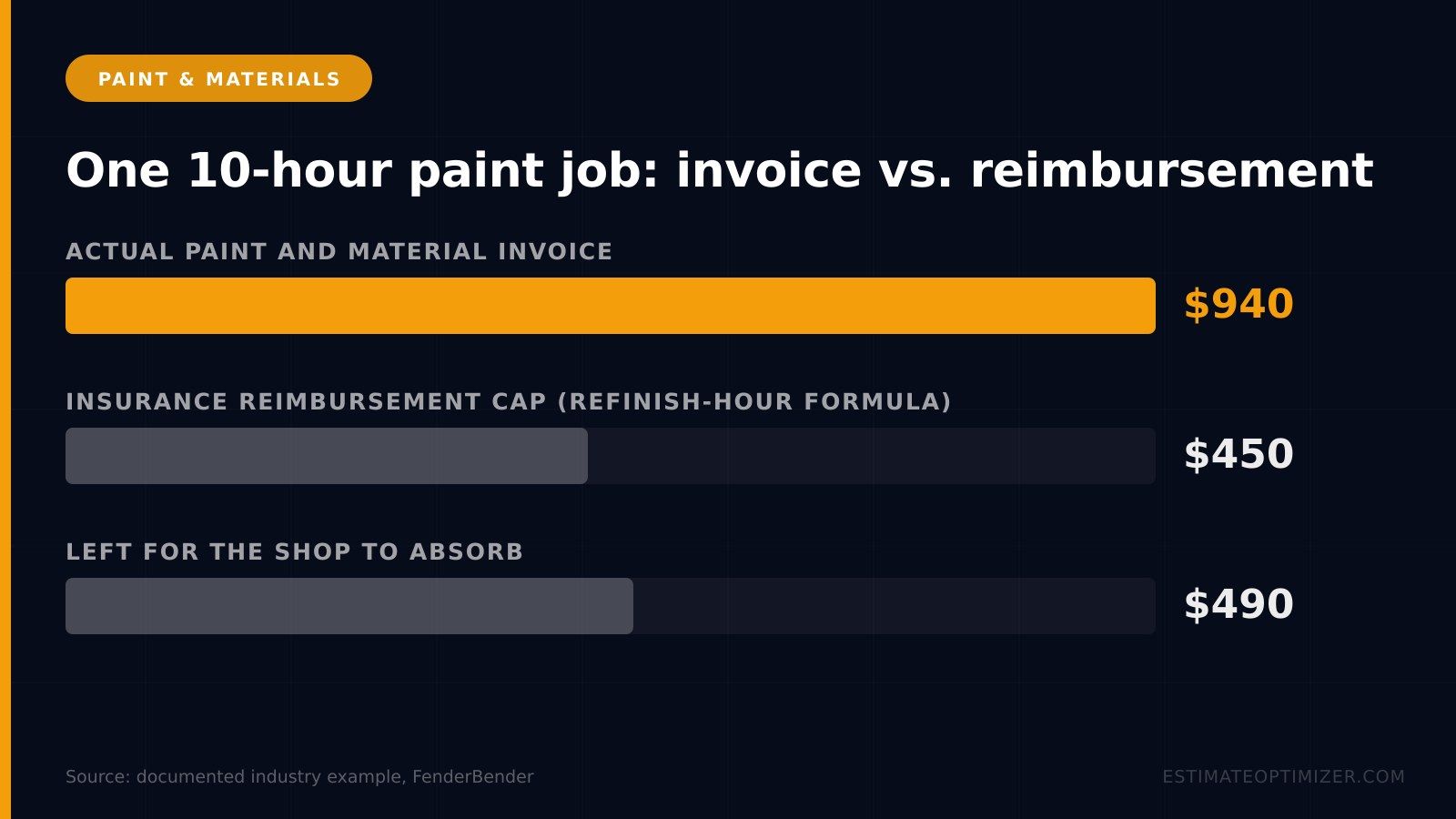
A documented industry example makes the gap concrete: a 10 hour paint job generated a $940 material invoice, real product, real cost. The insurance company capped reimbursement at $450 using the refinish hour multiplier, and refused to individually cover paint, primer, sealer, masking tape, razor blades, or gloves. The shop ate the other $490, not because the materials weren't used, but because the formula never accounted for them in the first place.
Take a 2022 Chevrolet Silverado with a tri-coat metallic repaint across three panels. Tri-coat costs more than single stage, full stop, more base coat, more pearl, more clear, more time between stages. The multiplier formula doesn't know tri-coat from a basic solid color. It applies the same $40 to $60 per refinish hour regardless of what's in the gun.
What the Finish-Time Multiplier Gap Is Costing You Every Month
Here's the check. Pull your last five repair orders with a full refinish. Compare the P&M dollar amount on the insurance estimate against your actual product invoice for that same job. If the estimate lands within 10% of your invoice, you're in green territory, your documentation is already closing the gap. If the estimate comes in 30% or more below your actual invoice, you're in red territory, and that exact gap repeats on every multi-stage or tri-coat job that rolls through your booth.
Run the math on volume. A shop doing even eight full-refinish jobs a month, each one $300 to $400 short under the multiplier, is losing $2,400 to $3,200 a month before anyone documents a thing. That's not one bad estimate. That's the formula working exactly as designed, every single job.
Paint and material costs climbed 7.4% in the first quarter of 2025 alone, and nearly 60% cumulatively since 2020. The $40 to $60 an hour multiplier most insurers use hasn't moved anywhere close to that pace. Every price increase from your paint supplier widens the gap between what the formula pays and what the job costs, and the formula has no mechanism to catch up.