Back to Blog
Estimating Platforms

Your Shop Runs Mitchell, Not CCC ONE. Does Any of This Still Apply?

6 min read
Share
Table of three DEG findings by platform: scanning is not included on CCC ONE, Mitchell or Audatex; color match and spray-out cards are not included on CCC ONE or Mitchell and are in Audatex refinish time; destructive weld testing is not included on all three.

Mitchell estimate missing line items are the same problem CCC ONE shops have been writing about for years. You've never once seen your own platform's name on the screenshot. Every tactic you've read about documenting a supplement or citing a not-included operation probably came with a CCC ONE example attached. So you filed the whole idea under "not my software" and kept writing estimates the way you always have.

We hear a version of this on nearly every call with a Mitchell shop. The owner nods through the documentation talk, then says some version of "that's a CCC ONE thing, right? We run Mitchell." It's a fair guess. It's also wrong, and it's an expensive guess to keep making.

You Hear "CCC ONE Problem" and Stop Listening

A 2023 Ford F-150 bumper repair doesn't know what software wrote its estimate. The scan that truck needs doesn't go missing because of a CCC decision. The Database Enhancement Gateway (DEG), the industry's inquiry process for questions about the three major estimating databases, reported in 2019 that scanning isn't an included operation on any of the three main estimating systems: CCC ONE, Mitchell or Audatex. Mitchell's own guide has said since 2017 that its stated labor times don't include the time to aim, calibrate, diagnose, reset or scan electrical items.

The same pattern shows up line after line. Mitchell and Audatex already classify scanning performed during the repair as a Mechanical operation once it's selected on the estimate, and CCC confirmed plans to add the same classification, per that same 2019 DEG coverage. Color match and spray-out card labor is not included on both CCC and Mitchell, per a 2020 DEG finding. Destructive weld testing is a not-included procedure in all three estimating systems, per DEG coverage from 2021. None of that is a CCC ONE quirk you escaped by running a different platform. The details differ from system to system, but the pattern doesn't: the operation sits outside the stated labor time until someone writes it in, and a shop running Mitchell inherits that gap the same way the shop across town running CCC ONE does.

The Missing Line Items on Your Mitchell Estimate

Pull your last ten supplements. Count how many cite a specific not-included finding or OEM procedure number, versus how many are only a labor-time argument with the adjuster over the phone. Here's a rule of thumb, not a benchmark: if it's three out of ten or fewer, you have the same documentation gap a CCC ONE shop has. The platform was never the variable. The habit was.

In the first half of 2026, repairers submitted 1,030 inquiries to the DEG about the three primary estimating systems, and 46.7% of them resulted in an update or correction of some sort, up from 43% in the first half of 2025, according to DEG figures reported by Autobody News in November 2026. That tells you something concrete: the gaps in the estimating data are real, and when a repairer documents one and sends it in, close to half the time the database changes. The DEG takes inquiries on Mitchell the same way it takes them on CCC ONE and Audatex.

So where does your shop sit? A 2022 Honda Accord that needs a scan during the repair either gets that operation written as its own line, classified and cited the way the DEG says it should be, or it gets quietly absorbed into your labor with nothing to point to later. Mitchell doesn't make that call for you. Your documentation does, car by car and file by file.

If you've been assuming Mitchell shops leave less on the table because Mitchell is a different system, nothing in those DEG findings backs that assumption up.
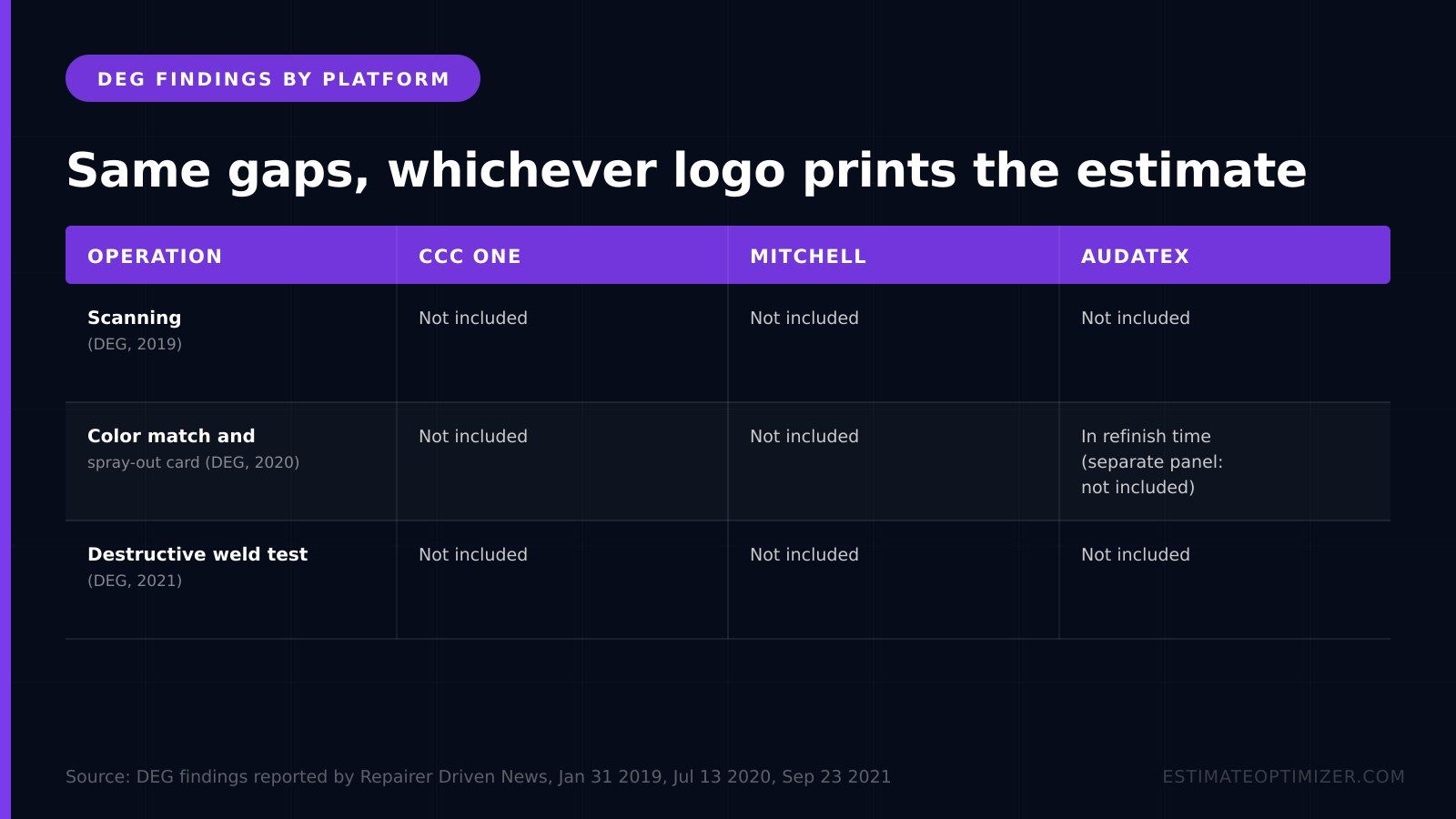
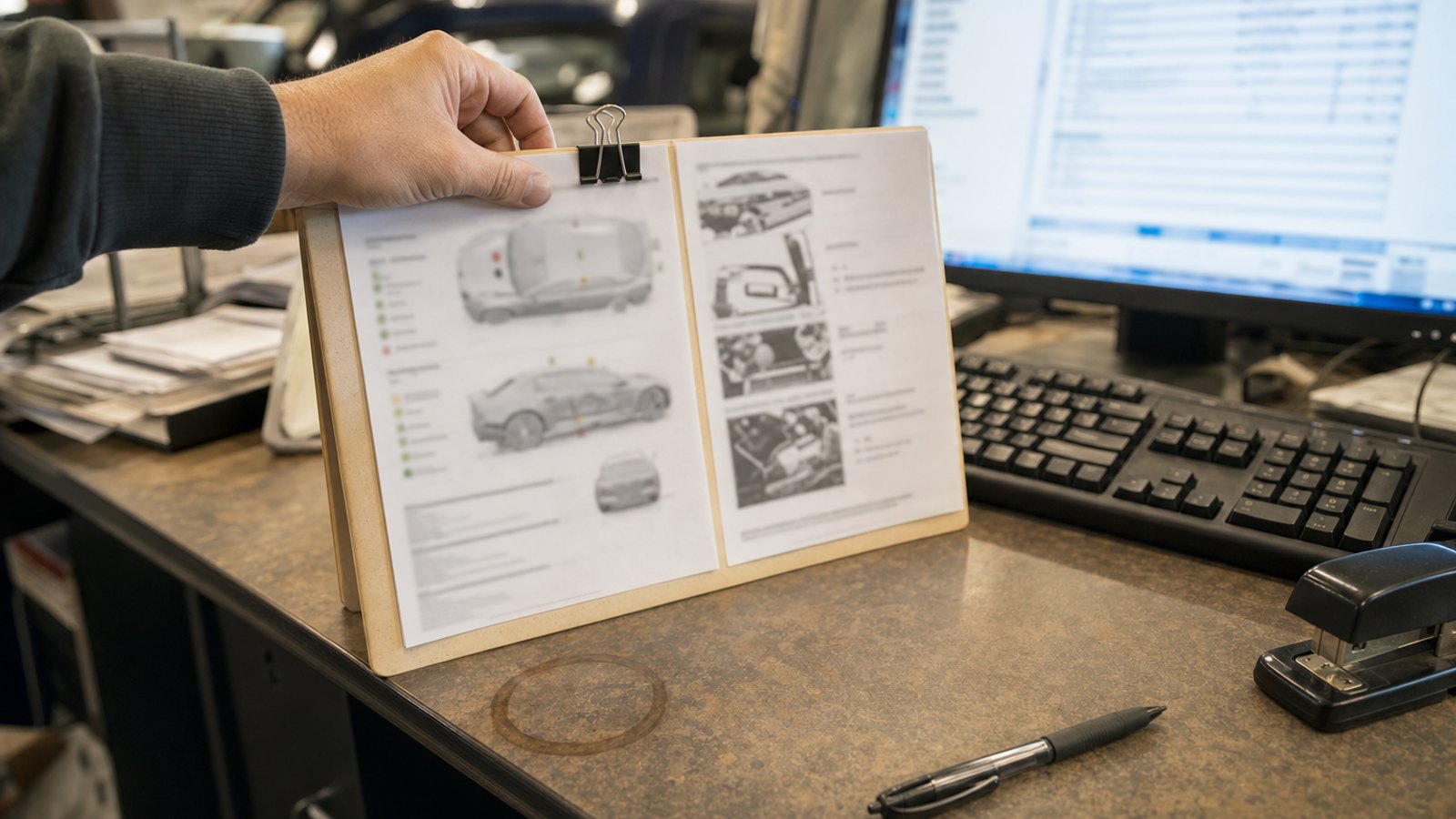
Table of three DEG findings by platform: scanning is not included on CCC ONE, Mitchell or Audatex; color match and spray-out cards are not included on CCC ONE or Mitchell and are in Audatex refinish time; destructive weld testing is not included on all three.
Three DEG findings across three platforms: the not-included gaps don't stop at the CCC ONE logo.

Does an Adjuster Treat a Mitchell File Any Differently?

Ask yourself what an adjuster is evaluating when a supplement lands on their desk. It isn't the software logo in the header. It's whether the line item has a citation behind it: a specific not-included finding, an OEM procedure number, a scan report. Something documented rather than asserted.

Supplements are routine on every platform, and every one of them starts from an estimate written against a labor database with its own not-included list. The gap between the first estimate and the final repair isn't a Mitchell problem or a CCC ONE problem. It's a documentation problem that shows up on both, because the not-included operations sit outside the stated labor time on both.

The Fix Isn't Platform-Specific. The Discipline Is.

Stop treating "not-included" as CCC ONE vocabulary. It's an industry-wide pattern, and Mitchell's own guide spells it out. Your job is identical on either platform: cite the specific not-included finding or OEM procedure number, attach the photo or scan report that proves the operation happened, and put both directly in the line note before the estimate leaves your building.

On the F-150, that means the scan and calibration lines don't get written as "per manufacturer requirement" and left vague. They get written with the OEM procedure or position statement reference attached, plus the scan report showing the work ran. On the Accord, the in-process scan gets a line note citing the DEG's Mechanical-operation finding by name, not a general reference to "scan performed."

Tools like Estimate Optimizer™ audit a Mitchell estimate the same way they audit one from CCC ONE or Audatex: the file gets checked against OEM repair procedures and the missed operations get flagged, whichever platform printed it. The adjuster reading your supplement doesn't care about the logo either, as long as the citation is attached to the line.

A hand clips a printed vehicle scan report and an OEM repair procedure page onto a repair folder at an estimator's desk, beside the keyboard and an estimate on screen.
The citation and the proof attached to the line, not the software license, are what an adjuster has to approve.

The Bottom Line

Mitchell estimate missing line items cost your shop the same way CCC ONE's missing line items cost the shop down the street. The not-included gaps don't stop at one platform, and the adjuster deciding whether to pay you doesn't grade by platform either. Stop waiting for a Mitchell-specific version of a tactic that was never platform-specific to begin with. Attach the citation. Attach the proof. The logo stops mattering the moment you do.

Related Articles

Frequently Asked Questions

Does Mitchell leave out the same operations CCC ONE does?
For many operations, yes. The Database Enhancement Gateway (DEG) has reported that scanning isn't an included operation on CCC ONE, Mitchell or Audatex, and that destructive weld testing is not included in all three. Color match and spray-out card labor is not included on both CCC and Mitchell. The details vary by platform, but the gap isn't unique to CCC ONE.
Why does my Mitchell estimate not include calibration labor?
Mitchell's guide has stated since 2017 that its labor times don't include the time to aim, calibrate, diagnose, reset or scan electrical items, and that this time is in addition to the stated labor. Write it as its own line with the OEM procedure reference and the scan or calibration report, and put both in the line note before the estimate leaves your shop.
Is the supplement documentation process different on Mitchell than on CCC ONE?
No. An adjuster is evaluating whether a line item has a citation behind it, not which software logo is in the header. The same OEM procedure numbers, DEG findings, and scan reports that support a CCC ONE supplement work the same way on a Mitchell file.
What is the Database Enhancement Gateway and does it cover Mitchell?
The Database Enhancement Gateway, or DEG, is the industry inquiry process repairers use to flag missing or incorrect data in the estimating databases, and it takes inquiries on CCC, Mitchell and Audatex. In the first half of 2026, repairers submitted 1,030 inquiries, and 46.7% resulted in an update or correction, according to DEG figures reported by Autobody News.
Will an insurance adjuster treat a Mitchell estimate differently than a CCC ONE estimate?
No. Adjusters evaluate the citation attached to each line item, not the estimating platform that generated the file. A properly documented Mitchell supplement with an OEM procedure number and proof attached gets the same consideration as a CCC ONE supplement built the same way.
Share this article
Mitchellestimate scrubbingOEM proceduresinsurance claimscollision repairshop owners
Back to Blog
Follow us