Why Your Mitchell Estimate Says "Not Included" and Stops There
Mitchell estimate not included operations don't disappear once the adjuster signs off on the total. They stop getting billed, because almost nobody on your team knows there's a line in Mitchell's own guide that lets you override the default.
We covered why these gaps show up on Mitchell the same way they do on CCC ONE in "Your Shop Runs Mitchell, Not CCC ONE. Does Any of This Still Apply?" This is the drill-down: where that "not included" conclusion lives inside Mitchell, and the one sentence Mitchell prints in its own guide telling you how to override it.
Mitchell runs its own Collision Estimating Guide, or CEG. Inside it are Procedure Explanation pages, which many shops call Mitchell's P-pages. Same idea as the P-pages CCC ONE shops know, on a different platform. When an operation isn't covered by the stated labor time, the Procedure Explanation page says so. Your estimator reads that line, sees "not included," and moves on.
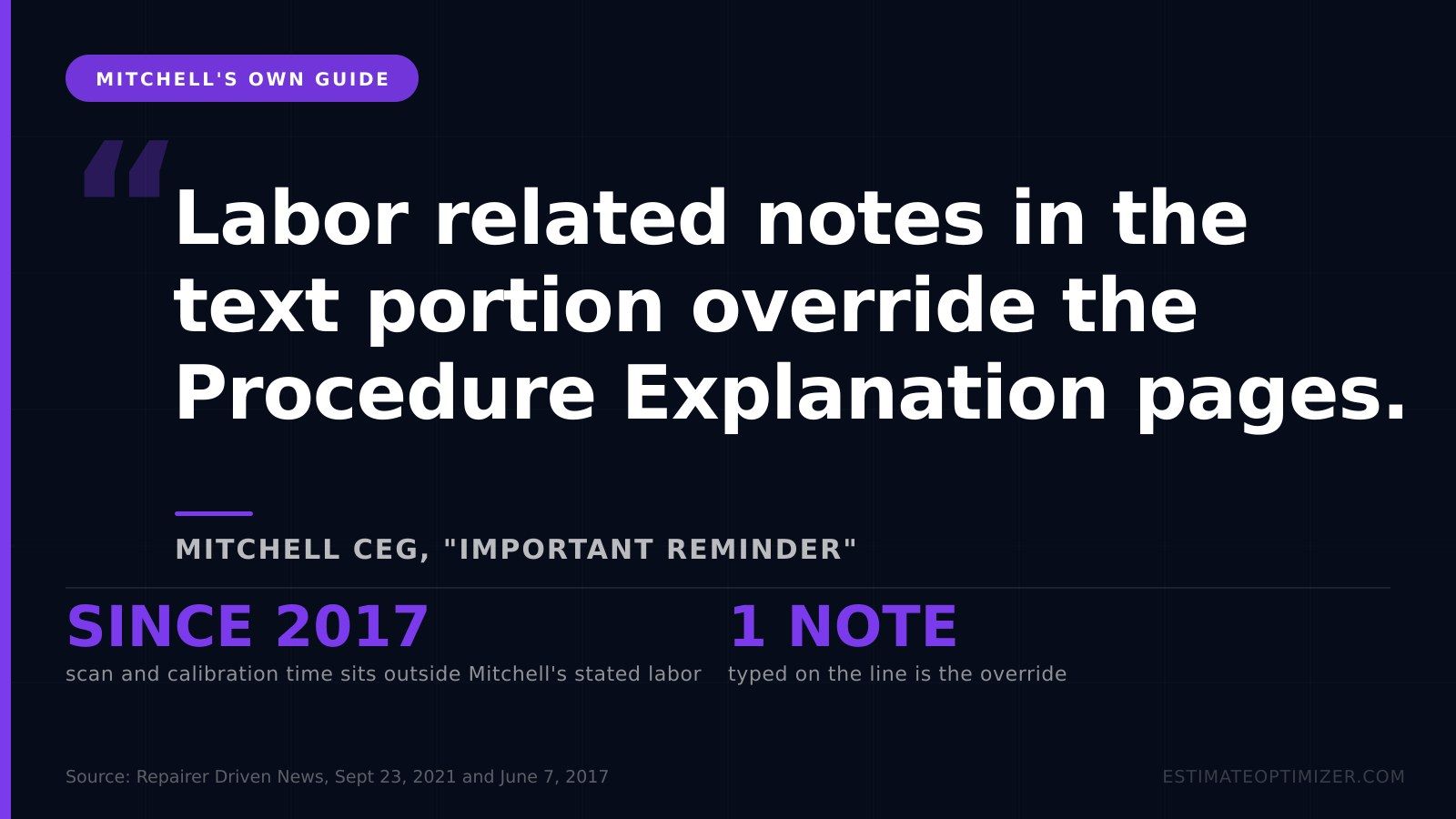
Here's what Mitchell also prints, in writing, in that same guide. According to a 2021 update covered by Repairer Driven News, Mitchell's CEG carries an "IMPORTANT REMINDER" stating that "labor related notes in the text portion override the Procedure Explanation pages." Mitchell isn't hiding the override. It's telling you it exists. Most shops never get that far.
What That Default Costs You Every Time Nobody Overrides It
Take a 2023 Ford F-150 in for a rear bumper replacement that needs its parking sensors calibrated. Mitchell's guide has stated since 2017 that its labor times don't include the time to aim, calibrate, diagnose, reset or scan electrical items, and that the time for those procedures is in addition to the stated labor. Mitchell also added manual lines so shops could enter their own time and price for that work. Nothing bills on those lines until someone types a number in. If nobody does, the calibration isn't denied. Nobody asked for it.
That isn't a Mitchell problem specifically. It's what happens on every platform when a not-included default goes unchallenged: the operation was needed, and the estimate never says so.
Pull your last five Mitchell estimates. Count how many times an operation came back marked not included, and your estimator typed a labor note to override it. If that number is zero, you're not fighting Mitchell's default. You're agreeing with it, every time, without meaning to.
Now take a 2021 Honda CR-V quarter panel repair that needs a destructive weld test to verify the new welds. The same 2021 Repairer Driven News coverage of DEG findings states that destructive weld testing is a not-included procedure in all three estimating systems, Mitchell included. An estimator who assumes Mitchell is worse than CCC on this one is wrong. The platforms agree. The only variable is whether your shop wrote the note that puts it on the estimate.
Where the Override Lives on a Mitchell Estimate
The override isn't a setting buried in a menu. It's a field. Open the line item Mitchell marked not included, and type the labor note directly into the text portion of that line, not a general comment somewhere else on the file. The note needs three things: the OEM procedure that requires the operation, the fact that Mitchell's stated time doesn't include it, and the manual value you're billing for it.
That note is the override Mitchell told you about in its own guide. Skip it, and your estimate reads exactly like Mitchell's default read it. The adjuster has no reason to assume anything beyond that default is owed, because nothing on the file told them otherwise.
Tools like Estimate Optimizer™ check a Mitchell estimate against the governing OEM procedures and flag the missed operations, with the procedure behind each one, so the estimator has what the note needs instead of leaving the field blank because the day ran out at 6pm on a Friday.