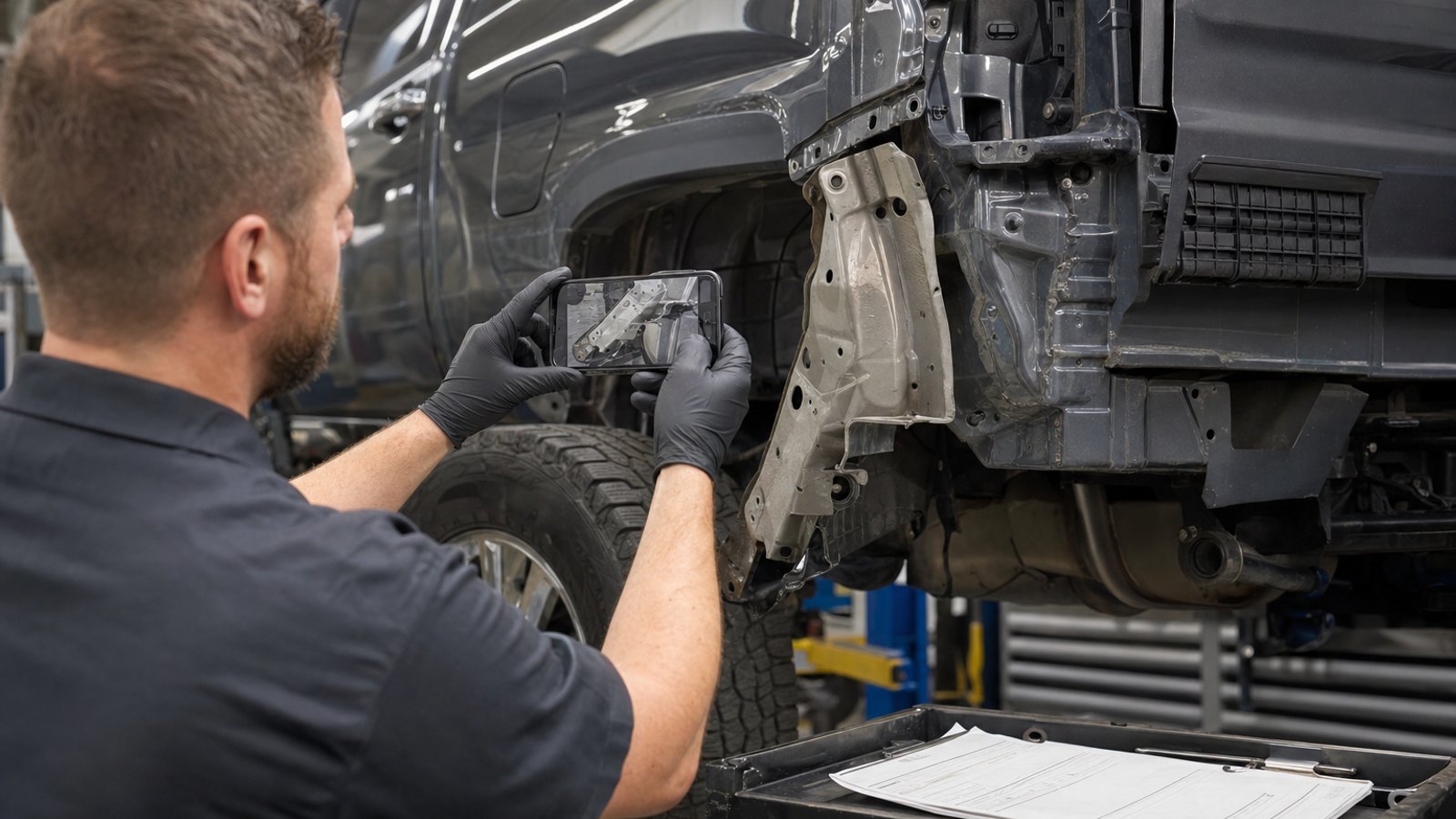
Teardown Finds Work Nobody Has Approved Yet
Supplement approval before repair is the step most shops skip, and it decides whether your supplement holds up. Teardown turns up a cracked absorber, a bent reinforcement behind it, and an operation the estimate never listed. The tech starts that work the same afternoon. Nobody writes down an approval.
Most shops are good at doing the work. Fewer are good at recording who said yes, and when.
Picture a 2021 Chevrolet Silverado 1500 with a rear quarter panel hit. Teardown shows damaged inner structure and a bracket that has to be replaced to meet the OEM repair procedure. The supplement goes out Friday. The adjuster asks one question: who authorized the work?
The operation was required. That's your answer, and it's true. But required and authorized are two different questions, and a file that answers only the first one leaves the second open.
And the timing is where most files break. The estimator found the work honestly. The shop did it honestly. What's missing is the record showing the carrier was asked and answered before the part came off.
How Much of Your Supplement Is Work You Already Did?
Look at where calibration work lands. CCC's 2026 Crash Course reports that 28.3% of repairable estimates now include calibrations. In CCC's Q3 2025 Crash Course report, 56.5% of Q1 2025 calibrations on DRP appraisals appeared on a supplement.
Finding the work usually isn't the hard part. Proving the sequence is. Your documentation is the asset, and a timeline is part of the documentation.
Now check your own shop. Pull your last ten supplements, not the best three, and compare two dates for each: the adjuster's written approval and the first day the operation was performed. How many show approval first? Under half is red territory. Approval before repair on most of them is green.
Red means the approval trails the work by days, with the photos and procedure assembled after the fact. Green means the approval came first, and the file already held everything the adjuster needed to answer.
If your answer is red, the supplement isn't broken. The file is missing its timeline.
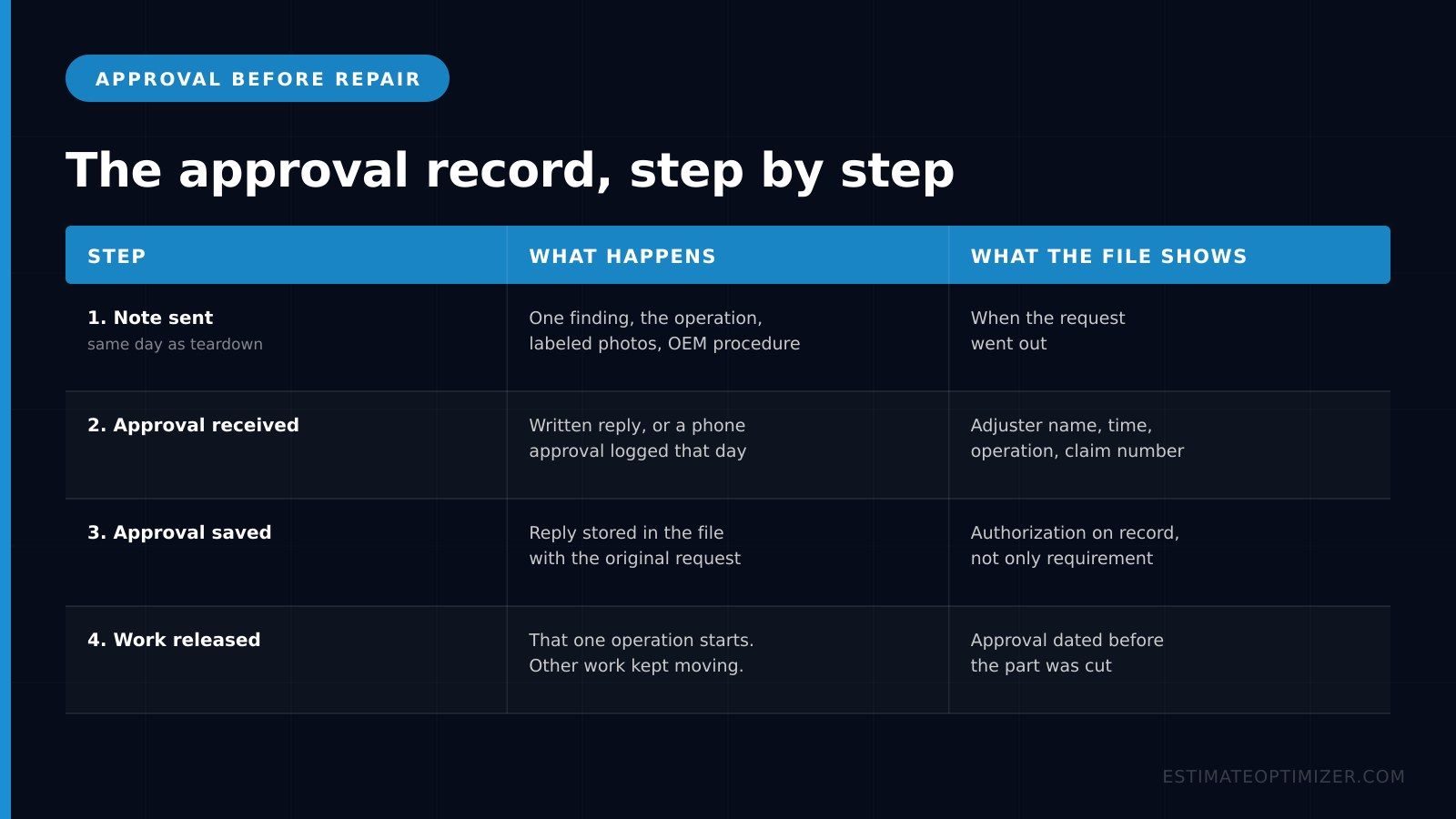
Supplement Approval Before Repair Starts, in Writing, the Same Day
Write a note for every teardown finding the day you find it. Each note names the operation, the labor and parts it requires, labeled photos of the condition, and the OEM procedure that calls for the work. The photos and procedure travel with the request, not in a packet sent later, so the adjuster reads the question and the evidence together.
A usable note has four parts:
- Finding: inner structure damage behind the quarter panel, confirmed at teardown.
- Operation: replace the bracket per the OEM repair procedure.
- Evidence: three labeled photos and the procedure page attached.
- Request: written approval before this operation starts.
Keep each note to one finding. "Additional damage found" gives the adjuster nothing to approve. A note that names one bracket, one OEM citation, and three labeled photos gives the reply something to answer.
Hold that one operation until the reply is saved in the file. Other work on the vehicle can continue. A day's wait is a scheduling cost. An operation with no approval record is a dispute you enter without evidence.
If the adjuster approves by phone, write the call into the file that day. Record the name, the time, the operation, and the claim number. Then send a short email restating the approval so the reply exists in writing.
If work is already done without approval, the rule still applies to the next finding. Write the note the same day and keep the timeline clean from there. The old file can't be rewritten, but the next one can be built this way.